Frequently Asked Questions

Ontologies & Knowledge Graphs

What is an ontology in the context of knowledge graphs?

An ontology is a structured, abstract blueprint that defines entities, relationships, and hierarchies within a specific domain. It acts as a roadmap for machines to understand, interpret, and apply information seamlessly across various applications. For example, in a library system, classes like Book and Author are defined, along with their relationships and attributes.

How do ontologies define the schema for knowledge graphs?

Ontologies provide a structured framework for categorizing entities and specifying relationships, ensuring a coherent organization of knowledge. They impose rules and constraints to maintain integrity and logical correctness in the graph.

What are the main components of an ontology?

The main components of an ontology include classes (concepts), instances (specific examples), attributes (properties), relationships, hierarchies, and axioms or rules. These elements collectively define the structure and logic of a domain.

How do knowledge graphs implement ontologies?

Knowledge graphs use ontologies as their schema, transforming abstract definitions into concrete, interconnected data representations. This enables efficient querying, inference, and semantic reasoning across diverse domains.

What is the difference between an ontology and a knowledge graph?

An ontology is a conceptual schema that defines the structure and relationships between classes of data, while a knowledge graph is the result of applying an ontology to actual data, representing real-world facts in a structured, interconnected format.

How do ontologies facilitate data integration and interoperability?

Ontologies standardize terminology and relationships, enabling seamless communication and integration between different knowledge graphs and data sources. This is crucial for AI systems and complex data ecosystems.

How do ontologies enable semantic reasoning in knowledge graphs?

Ontologies provide logical rules and hierarchies that allow inference engines to deduce implicit information, validate consistency, and perform complex queries on knowledge graphs.

Can you give an example of ontology components in a real-world scenario?

In a library system, classes might include Book and Author, with instances like "The Catcher in the Rye", attributes like ISBN, and relationships like WRITTEN_BY. Hierarchies and rules further organize and constrain the data.

How do knowledge graphs organize and categorize data?

Knowledge graphs use ontologies to define classes and relationships, enabling hierarchical organization and semantic clarity. This supports reasoning, inference, and alignment with domain-specific taxonomies or standards.

What are the key functions of ontology in knowledge graphs?

Ontologies provide conceptual modeling, enable data integration, support semantic interoperability, and facilitate querying, reasoning, and inference. They unlock the full potential of knowledge graphs across industries.

How do ontologies support scalability and adaptability in knowledge graphs?

Ontologies allow for modular growth and refinement of knowledge graphs, supporting the addition of new concepts, relationships, and rules without disrupting existing structures. This ensures scalability and adaptability as data and requirements evolve.

How do Cypher queries leverage ontological definitions in knowledge graphs?

Cypher queries use the schema and relationships defined by ontologies to traverse and extract information from knowledge graphs, enabling advanced, context-aware data retrieval.

What reasoning tasks are performed in ontological systems?

Reasoning tasks include subsumption (determining concept hierarchies), satisfaction (validating logical fit), and inference (deducing implicit information based on rules and relationships).

How do ontologies enable advanced AI and machine learning applications?

Ontologies provide semantic structure and clarity, enabling AI systems to perform accurate reasoning, automate processes, and integrate diverse data sources for higher accuracy and reliable insights.

How do ontologies help maintain consistency and integrity in knowledge graphs?

Ontologies impose rules and constraints that ensure logical correctness and consistency, preventing errors and maintaining the integrity of the graph structure.

How can ontologies be reused across different domains?

Existing ontologies can be adapted and reused in new contexts with minimal modifications, supporting semantic interoperability and efficient data integration across domains.

What is the role of organizing principles in knowledge graphs?

Organizing principles, such as hierarchies, business vocabularies, and geographical structures, provide conceptual frameworks that align the graph with specific use cases and ensure semantic clarity.

How do inference engines use ontologies to deduce implicit information?

Inference engines apply ontology-based rules to fill gaps in data, validate relationships, and ensure consistency, enabling automated deduction and advanced reasoning within knowledge graphs.

Why are ontologies indispensable for enterprise AI systems?

Ontologies provide structure, consistency, and semantic understanding, which are critical for accuracy, interpretability, and scalability in enterprise AI systems.

How do ontologies empower decision-making and business operations?

By structuring and integrating diverse data sources, ontologies enable organizations to enhance decision-making, automate processes, and achieve higher accuracy and reliable insights in business operations.

FalkorDB Product Information & Features

What is FalkorDB and what does it do?

FalkorDB is a high-performance graph database designed for managing complex relationships and enabling advanced AI applications. It supports real-time and interactive environments, making data actionable and accurate for enterprise-grade solutions. Learn more.

What are the key features of FalkorDB?

Key features include ultra-low latency (up to 496x faster than Neo4j), 6x better memory efficiency, support for over 10,000 multi-graphs, flexible horizontal scaling, advanced AI integration (GraphRAG, agent memory), open-source licensing, and built-in multi-tenancy. Source.

What use cases does FalkorDB support?

FalkorDB supports Text2SQL, Security Graphs for CNAPP/CSPM/CIEM, GraphRAG for advanced retrieval, agentic AI and chatbots, fraud detection, and high-performance graph storage for complex relationships. See use cases.

Who is the target audience for FalkorDB?

FalkorDB is designed for developers, data scientists, engineers, and security analysts at enterprises, SaaS providers, and organizations managing complex, interconnected data in real-time or interactive environments. Source.

What integrations does FalkorDB offer?

FalkorDB integrates with frameworks like Graphiti (by ZEP), g.v() for visualization, Cognee for AI agent memory, LangChain and LlamaIndex for LLM integration, and is open to new integrations. See integrations.

Does FalkorDB provide an API?

Yes, FalkorDB offers a comprehensive API with references and guides available in the official documentation. API docs.

Where can I find technical documentation for FalkorDB?

Technical documentation, including setup guides and API references, is available at docs.falkordb.com and the GitHub Releases Page.

How easy is it to implement FalkorDB?

FalkorDB is built for rapid deployment, allowing teams to go from concept to enterprise-grade solutions in weeks. Users can sign up for FalkorDB Cloud, try it for free, run locally via Docker, or schedule a demo. Implementation details.

Pricing & Plans

What pricing plans does FalkorDB offer?

FalkorDB offers four plans: FREE (for MVPs with community support), STARTUP (from /1GB/month, includes TLS and backups), PRO (from 0/8GB/month, includes cluster deployment and high availability), and ENTERPRISE (custom pricing, includes VPC, custom backups, and 24/7 support). See pricing.

What features are included in the FalkorDB Enterprise plan?

The Enterprise plan offers tailored pricing, VPC deployment, custom backups, 24/7 support, and enterprise-grade features for large-scale and mission-critical applications. Source.

Security & Compliance

Is FalkorDB SOC 2 Type II compliant?

Yes, FalkorDB is SOC 2 Type II compliant, meeting rigorous standards for security, availability, processing integrity, confidentiality, and privacy. Source.

What security features does FalkorDB provide?

FalkorDB protects against unauthorized access, ensures operational availability, delivers accurate and timely data processing, safeguards sensitive information, and complies with privacy regulations. Source.

Performance & Technical Requirements

How does FalkorDB perform compared to competitors?

FalkorDB offers up to 496x faster latency and 6x better memory efficiency compared to Neo4j, supports over 10,000 multi-graphs, and is optimized for AI applications. See benchmarks.

What technical requirements are needed to use FalkorDB?

FalkorDB can be deployed in the cloud or on-premises, supports Docker for local installation, and offers comprehensive documentation for setup and advanced configurations. Documentation.

Competition & Comparison

How does FalkorDB compare to Neo4j?

FalkorDB offers up to 496x faster latency, 6x better memory efficiency, flexible horizontal scaling, and includes multi-tenancy in all plans, unlike Neo4j's premium-only feature. See comparison.

How does FalkorDB compare to AWS Neptune?

FalkorDB is open source, supports multi-tenancy, offers highly efficient vector search, and provides better latency performance compared to AWS Neptune. See comparison.

How does FalkorDB compare to TigerGraph and ArangoDB?

FalkorDB delivers faster latency, better memory efficiency, and flexible horizontal scaling compared to TigerGraph and ArangoDB, making it ideal for performance-critical applications. Source.

Use Cases & Benefits

What problems does FalkorDB solve?

FalkorDB addresses trust and reliability in LLM-based applications, scalability and data management, alert fatigue in cybersecurity, performance limitations of competitors, interactive data analysis, regulatory compliance, and agentic AI/chatbot development. Source.

What business impact can customers expect from FalkorDB?

Customers can expect improved scalability, enhanced trust and reliability, reduced alert fatigue, faster time-to-market, enhanced user experience, regulatory compliance, and support for advanced AI applications. Source.

What feedback have customers given about FalkorDB's ease of use?

Customers like AdaptX and 2Arrows have praised FalkorDB for its rapid access to insights, intuitive design, and superior performance, especially for non-traversal queries. AdaptX case study, 2Arrows feedback.

What industries are represented in FalkorDB's case studies?

Industries include healthcare (AdaptX), media and entertainment (XR.Voyage), and artificial intelligence/ethical AI development (Virtuous AI). See case studies.

Can you share specific case studies or success stories of FalkorDB customers?

Yes, AdaptX uses FalkorDB for clinical data analysis, XR.Voyage for immersive experience platform scalability, and Virtuous AI for ethical AI development. Explore case studies.

Who are some of FalkorDB's customers?

Customers include AdaptX, XR.Voyage, and Virtuous AI, each leveraging FalkorDB for industry-specific challenges. See customer stories.

FalkorDB Header Menu

Understanding Ontologies and Knowledge Graphs

Ontologies Blueprints for Knowledge Graph Structures

Highlights

Our brain is naturally wired to process visuals faster than lengthy, unstructured blocks of text. Think about it – the more our memories are visually connected, the easier it is to recall objects and events. It’s the same with AI. Knowledge graphs serve as incredible mind maps, making it easier and faster for LLM-powered systems, like RAG, to retrieve information.

In this article, we’ll explore the fascinating world of Knowledge Graphs. We’ll break down the basics and demystify key terms, helping you get a clear grasp of this transformative technology.

What is Ontology?

Ontologies are like the blueprints of knowledge for a specific domain—a structured, abstract way of representing data that explains itself through entities and the relationships between them. Think of it as a roadmap that helps machines understand, interpret, and apply information seamlessly across various applications.

Let’s break down the components of an ontology with a relatable example: a library system. Here’s how it all comes together:

Classes (concepts)

These are the big categories or main entities in a domain. In a library, classes could include Book, Author, and Publisher.

Instances

These are the specific examples that belong to a class. For instance, "The Catcher in the Rye" would be an example of the Book class.

Attributes (Propeties)

Attributes describe the unique traits or characteristics of a class or its instances. A Book might have properties like Title, Publication Year, or ISBN.

Relationships

These define the connections between different classes or entities. For example, a Book might have a relationship with an Author class through a link called WRITTEN_BY.

Hierarchy

Ontologies often organize classes into a hierarchy where subclasses inherit properties from their parent classes. For example, Fiction and Non-Fiction could be subclasses of the Book class.

Axioms and Rules

These establish constraints and logical rules within the ontology. For instance, you could define a rule stating that every Book must have at least one Author.

What are Knowledge Graphs?

Knowledge Graphs (KGs) are structured representations of real-world facts, where nodes represent entities, and the edges connecting them define relationships. They are stored in graph databases like FalkorDB. Think of them as digital networks that organize and link data seamlessly.

A great analogy is the internet itself—imagine how it connects web pages and content. Every time you google something, you’re navigating this vast network of entities like people, places, and topics, all linked by relationships. In fact, search engines are using underlying graph databases. 

Typically, a knowledge graph can be explained through its three key components:

Nodes

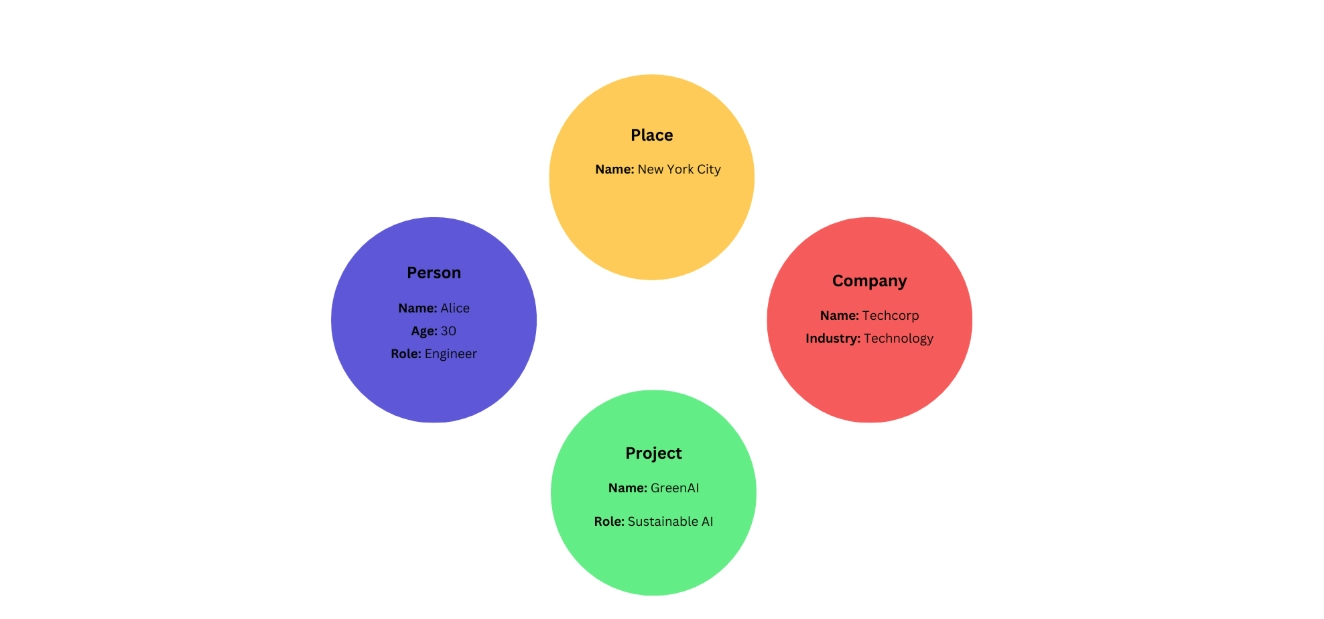
These represent entities in the data, such as people, places, or general concepts. Each node can also include one or more attributes to describe it further.

Nodes in knowledge graphs illustration

Relationships

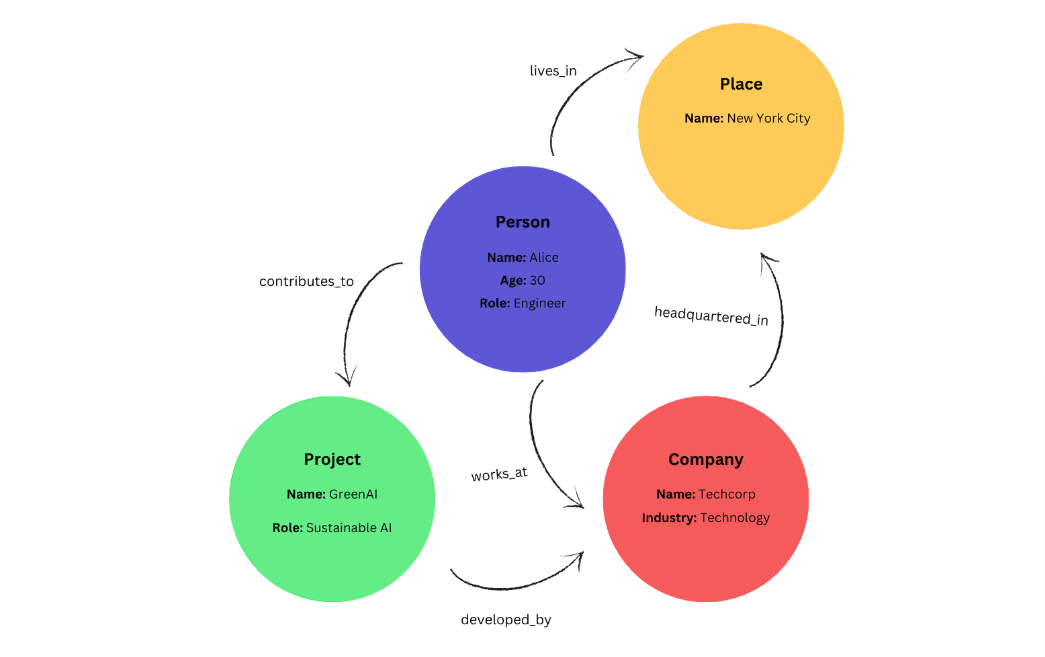
Represented by edges, these define how entities are connected. For example, a node for a person might connect to a node for a city through a relationship like “lives in.”

nodes and relationships in knowledge graphs illustration

Organizing Principles

These act as the conceptual framework or schema that structures the nodes and relationships, ensuring the graph aligns with the specific needs of its use case. These principles can range from simple hierarchies, like product categorizations, to complex frameworks such as detailed business vocabularies. In this example, we can consider the listed components as the organizing principles of the knowledge graph.

Hierarchy-based principle

TechCorp is organized under Industry → Technology → Artificial Intelligence Sub-domain.

Business vocabulary

  • Define “contributes_to” as a relationship where a person actively participates in a project.
  • Define “works_at” as a relationship indicating employment with a company.

Geographical principle

New York City is structured under Country → United States → State → New York → City → New York City.

The Significance of Ontology in Knowledge Graphs

Ontologies are foundational to knowledge graphs because they play key roles in:

  • Defining the schema:
    They provide a structured framework for categorizing entities and specifying relationships, ensuring a coherent organization of knowledge.
  • Ensuring consistency:
    By imposing rules and constraints, ontologies maintain the integrity and logical correctness of the graph.
  • Facilitating interoperability:
    They standardize terminology and relationships, enabling seamless communication and integration between different knowledge graphs.


While these concepts may seem similar, the terms “Ontologies” and “Knowledge Graphs” are not interchangeable. Here’s the distinction:

  • Ontology:
    A blueprint or schema that defines the structure and relationships between different classes of data. It is a conceptual model and does not include specific data points.
  • Knowledge Graph:
    The result of applying an ontology to actual data. It represents real-world data in a structured, interconnected format, allowing for complex queries and insights.
Complex QueriesConceptual ModelInterconnected FormatBlueprintSchemaStructured FormatOntology vs. Knowledge GraphsKnowledge GraphOntology

Using Knowledge Graphs to Answer Questions

Knowledge graphs excel at analyzing and retrieving data with deeply embedded relationships. In graph databases, Cypher queries are used to query and traverse the graph structure to extract the required information. Let’s break down how a sample query is processed in a graph database to understand retrieval from knowledge graphs.

Sample query:

“Find all projects Alice contributes to and the companies developing them, along with their headquarters location.”

Step-by-Step Thinking Procedure

  1. Understand the Query Needs:
    • Identify the key components:
      • Start with Alice (a Person node).
      • Follow the contributes_to relationship to find Project nodes.
      • For each project, identify the Company nodes via the developed_by relationship.
      • Retrieve the headquartered_in relationship to determine the company’s location.
  2. Frame the Logical Query in Graph Terms:
    • Traverse the graph starting from the Person node (Alice).
    • Explore the contributes_to relationship to reach connected Project nodes.
    • Traverse the developed_by relationship to locate associated Company nodes.
    • Follow the headquartered_in relationship to retrieve the location details.
  3. Write the Graph Query:
    • The Cypher query might look like this:
				
					MATCH (person:Person {name: "Alice"})-[:contributes_to]->(project:Project)
      -[:developed_by]->(company:Company)-[:headquartered_in]->(location:Place)
RETURN project.name AS Project, company.name AS Company, location.name AS Headquarters


Expected Output Based on the Example:

  • Project: GreenAI
  • Company: TechCorp
  • Headquarters: New York City

Organizing and Categorizing with Ontology

As you can see from the example, ontologies play a critical role in providing structure and meaning to knowledge graphs, acting as the backbone for organizing and categorizing data. They transform disconnected information into a coherent, semantically rich framework that enables understanding, reasoning, and discovery. This is achieved through the following features:

  • Defining Classes and Relationships:
    Ontologies establish a formal framework for organizing data by defining key entities (classes) and the relationships between them. For example, an ontology might specify that “Person” is a class and “works_at” is a relationship linking a “Person” to a “Company.” These definitions ensure consistency and semantic clarity, allowing the graph to reflect real-world meanings accurately.
  • Hierarchical Organization:
    Ontologies enable the organization of entities into a hierarchy of general categories and specific subcategories. For instance, the class “Vehicle” might include subclasses such as “Car,” “Bike,” and “Truck.” This hierarchy supports reasoning and inference, enabling users to generalize or specialize queries (e.g., retrieving all vehicles or just cars). Additionally, it helps align data with domain-specific taxonomies or standards, improving interoperability and scalability.

Key Functions of Ontology in Knowledge Graphs

At the core of knowledge graph construction lie ontologies. From providing conceptual clarity to enabling advanced reasoning, the application of ontologies unlocks the full potential of knowledge graphs across industries. Let’s explore the role and functions of ontologies in knowledge graphs.

Conceptual Modeling: Building a Common Language

Ontologies serve as the foundation for creating a shared language that ensures consistency in understanding key concepts. By defining terms, relationships, and hierarchies, they establish a unified framework that stakeholders can rely on to interpret and communicate information accurately. This shared vocabulary minimizes ambiguity and fosters collaboration across teams and domains.

Data Integration: Unifying Disparate Data Sources

For data integration, ontologies act as a bridge between disparate data sources. They define mappings between different data schemas, enabling seamless merging of data into a unified knowledge graph. By providing a consistent framework, ontologies support data cleaning efforts, helping to standardize and reconcile inconsistencies across integrated datasets. This process enhances the reliability and usability of the resulting knowledge graph.

Semantic Interoperability: Overcoming Data Diversity

Ontologies play a critical role in addressing challenges related to semantic interoperability, especially when dealing with diverse data formats, vocabularies, and systems. They create a semantic layer that facilitates data exchange and understanding across different platforms. For example, an ontology might align terms used in various databases (e.g., "employee" vs. "staff") to ensure accurate interpretation and integration. This common semantic framework not only improves communication but also enables advanced reasoning and inference, allowing systems to draw meaningful insights from interconnected data. Additionally, existing ontologies can be reused in new contexts with minimal modifications.

Enabling Querying, Reasoning, and Inference

Ontologies provide a powerful semantic framework that enables users to perform advanced queries by leveraging the relationships, classes, and rules defined within a knowledge graph. For example, when using Cypher, a popular query language for knowledge graphs, ontological definitions are intrinsically utilized to execute complex queries. These queries can traverse entity hierarchies or semantic relationships, moving beyond simple keyword-based retrieval to deliver precise, context-aware results.

What reasoning task should be performed?SubsumptionSatisfactionDetermine if a concept is a subset or specific type within a broader category.Check if a concept logically fits within a given framework or model.

Ontological axioms enhance reasoning, allowing us to derive new insights or validate existing relationships. Reasoning tasks typically performed in ontological systems include:

  • Subsumption: Determining whether a concept is a subset or a specific type within a broader category.
  • Satisfaction: Checking whether a concept logically fits within a given framework or model.

These tasks can help you organize data into categories and structures, making it easier to analyze and leverage for AI and machine learning applications.

Inference engines take this a step further by using ontology-based rules to deduce implicit information. For example, if an ontology states that “All employees of a company are also contributors to the company’s projects,” a reasoning engine can infer the specific projects associated with individuals who have a works_at relationship with the company. This automated deduction fills gaps in the data, ensures consistency, and validates the graph’s integrity.

Adapting and Scaling with Ontologies

Ontologies lay a solid foundation for building adaptable and scalable knowledge graphs. Their flexible and dynamic nature allows users to tweak and expand the graph’s structure as needed while maintaining its integrity. Designed to evolve with changing contexts and newly acquired knowledge, ontologies ensure that a knowledge graph stays accurate and aligned with its domain. This adaptability allows for ongoing refinement without the hassle of starting from scratch.

As a knowledge graph grows, ontologies shine in their ability to support scalability. New concepts, relationships, and rules can be seamlessly added, ensuring that integrating new data doesn’t disrupt the existing structure. This modular growth keeps the graph organized and future-ready.

Beyond scaling individual knowledge graphs, ontologies enable connections across disparate graphs, empowering organizations to contribute to the broader linked data movement. By standardizing relationships and fostering semantic interoperability, they ensure that knowledge graphs can expand beyond their original boundaries and integrate into a global knowledge network. This interconnected approach paves the way for a more unified and accessible world of knowledge.

Conclusion: The Importance of Ontology

Ontologies are the dynamic enablers that bring knowledge graphs to life. Far from being static frameworks, they provide the structure, consistency, and semantic understanding needed to make knowledge graphs truly valuable. For your AI systems—especially in enterprise settings where accuracy, interpretability, and scalability are critical—ontologies are indispensable.

By investing in ontologies, you unlock the full potential of knowledge graphs. They empower you to enhance decision-making, automate repetitive processes, and seamlessly integrate diverse data sources. This means higher accuracy, more reliable insights, and a stronger foundation for your business operations. If you’re looking to take your organization’s AI capabilities to the next level, ontologies are the key to making it happen.

What's the difference between ontologies and knowledge graphs?

Ontologies are conceptual schemas defining entity types and relationships, while knowledge graphs are concrete implementations of these schemas with actual data instances.

How do ontologies enable semantic reasoning in knowledge graphs?

Ontologies provide logical rules and hierarchies that allow inference engines to deduce implicit information, validate consistency, and perform complex queries on knowledge graphs.

Can you give an example of ontology components in a real-world scenario?

In a library system, classes might include Book and Author, with instances like "The Catcher in the Rye", attributes like ISBN, and relationships like WRITTEN_BY.

Build fast and accurate GenAI apps with GraphRAG SDK at scale

FalkorDB offers an accurate, multi-tenant RAG solution based on our low-latency, scalable graph database technology. It’s ideal for highly technical teams that handle complex, interconnected data in real-time, resulting in fewer hallucinations and more accurate responses from LLMs.