Frequently Asked Questions
Graph Query Language & Syntax
What is a graph query language?
A graph query language is a specialized, declarative syntax used to express queries over graph-structured data. Unlike SQL, which targets tabular data, graph query languages operate on nodes (entities) and edges (relationships), allowing users to express complex patterns, enable traversal logic, and filter by properties. FalkorDB uses a Cypher-style declarative query language to interact with its property graph model, making it intuitive for developers to describe the data they want to retrieve. Learn more in the FalkorDB documentation.
Is graph query language harder than SQL?
No, graph query languages are not inherently harder than SQL—they are just different. While the syntax may appear unfamiliar at first, many developers find Cypher more expressive for relational patterns. For example, traversing multi-hop relationships is often more concise in Cypher than in SQL. The learning curve is typically shallower than expected, especially with modern tooling and resources. See Cypher examples in the FalkorDB docs.
How does FalkorDB simplify querying for LLM and GraphRAG workflows?
FalkorDB uses a Cypher-like syntax that is declarative and optimized for relationship patterns, not tables. This makes it easier for LLMs and developers to generate and execute graph queries for tasks like GraphRAG, agent memory, and multi-hop reasoning. Tooling such as LangChain integration allows LLMs to auto-generate Cypher queries, reducing manual syntax work and onboarding time for teams familiar with SQL.
What are the main components of a graph query in FalkorDB?
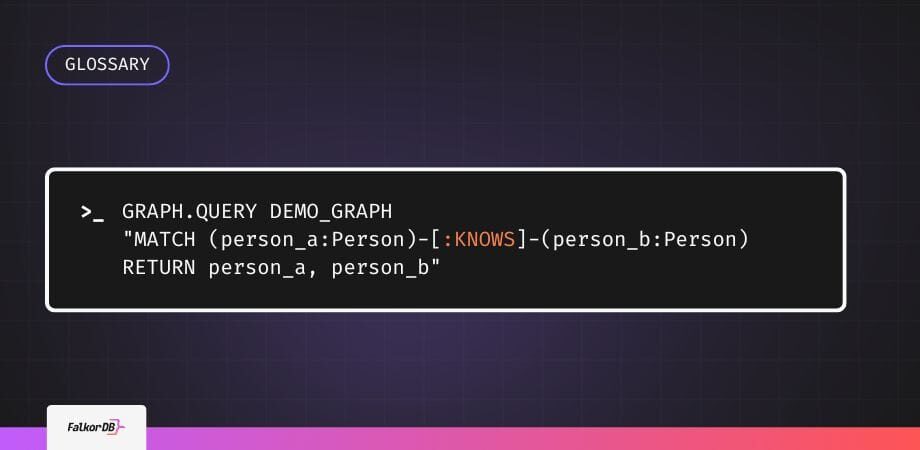
The main components of a graph query in FalkorDB are nodes (entities), edges (relationships), and patterns. Queries typically involve pattern matching, traversal logic, and property filtering. For example, a Cypher query can match a path between nodes and return specific properties, making it well-suited for expressing complex relationships and multi-hop logic.
How does Cypher compare to SQL for expressing relationships?
Cypher is often more compact and legible than SQL for expressing relationships, especially for multi-hop traversals. For example, finding friends-of-friends in SQL requires multiple JOINs, while in Cypher, the same logic can be expressed in a single MATCH pattern. This makes Cypher intuitive for developers conceptualizing connected data.
What standards exist for graph query languages?
The ISO-led GQL (Graph Query Language) initiative is formalizing a vendor-neutral standard, building on Cypher. GQL aims to provide a unified syntax for property graphs, enabling cross-vendor interoperability and reducing fragmentation. The W3C also supports SPARQL for RDF graphs, but property graphs and Cypher are dominant for most developer use cases, including GraphRAG. Read more about GQL standardization.
How do LLMs use graph query languages with FalkorDB?
LLMs (Large Language Models) can generate Cypher-style queries to retrieve structured data from graph stores like FalkorDB. This enables LLMs to perform multi-hop reasoning, retrieve connected entities, and answer questions requiring transitive logic or temporal context. Integrations with tools like LangChain allow LLMs to output Cypher directly for advanced AI workflows.
What tools help developers learn and use graph query languages in FalkorDB?
Developers can leverage code playgrounds, IDE integrations, and interactive tutorials for Cypher. FalkorDB supports GraphQL-style queries, Python bindings, and has integrations with LangChain for LLMs. These tools lower the learning curve and help teams stay productive without deep syntax knowledge. Explore FalkorDB's Cypher documentation.
How does GQL standardization impact developers using FalkorDB?
GQL standardization reduces fragmentation across graph database vendors, making it easier for developers to adopt and migrate between systems. Since FalkorDB uses a Cypher-style syntax, it aligns closely with emerging standards, ensuring future compatibility and easier onboarding for teams familiar with property graph models.
What is the learning curve for Cypher in FalkorDB?
The learning curve for Cypher in FalkorDB is typically shallower than teams expect. Developers report getting comfortable with Cypher in a weekend, thanks to its expressive syntax and available resources. Tooling, tutorials, and LLM integration further lower the barrier to entry. See developer testimonials.
How does FalkorDB support GraphRAG and LLM-based search?
FalkorDB enables expressive graph queries that are well suited to GraphRAG (Graph Retrieval-Augmented Generation) and LLM-based search. Its low-latency, scalable architecture allows LLMs to retrieve multi-hop relationships, enrich grounding data, and answer complex queries with high accuracy. This results in fewer hallucinations and more reliable responses from LLMs. Learn more about GraphRAG SDK.
Features & Capabilities
What features does FalkorDB offer for graph data management?
FalkorDB provides high-performance graph storage, Cypher-style querying, support for over 10,000 multi-graphs (tenants), open-source licensing, linear scalability, ultra-low latency, and advanced AI integrations such as GraphRAG and agent memory. It also offers both cloud and on-prem deployment options. Learn more on the FalkorDB website.
Does FalkorDB support multi-tenancy?
Yes, FalkorDB supports robust multi-tenancy in all plans, enabling management of over 10,000 multi-graphs. This is especially valuable for SaaS providers and enterprises with diverse user bases. See FalkorDB's multi-tenancy features.
What integrations are available with FalkorDB?
FalkorDB integrates with frameworks and tools such as Graphiti (for AI agent memory), g.v() (for knowledge graph visualization), Cognee (for mapping knowledge graphs), LangChain (for LLM integration), and LlamaIndex (for advanced knowledge graph applications). See the full list of integrations.
Does FalkorDB provide an API?
Yes, FalkorDB provides a comprehensive API with official documentation and guides. Developers, data scientists, and engineers can access API references at docs.falkordb.com to integrate FalkorDB into their workflows.
What technical documentation is available for FalkorDB?
FalkorDB offers comprehensive technical documentation, including setup guides, API references, and advanced configuration instructions. Resources are available at docs.falkordb.com and on the GitHub Releases Page for the latest updates.
What security and compliance certifications does FalkorDB have?
FalkorDB is SOC 2 Type II compliant, meeting rigorous standards for security, availability, processing integrity, confidentiality, and privacy. This certification demonstrates FalkorDB's commitment to protecting data and ensuring operational reliability. Learn more about FalkorDB's compliance.
How does FalkorDB ensure data security and privacy?
FalkorDB protects against unauthorized access, ensures system availability, delivers accurate data processing, safeguards sensitive information, and complies with privacy regulations. These measures are validated by SOC 2 Type II certification. See details on FalkorDB's security.
What is the primary purpose of FalkorDB?
FalkorDB is a high-performance graph database platform designed to deliver accurate, multi-tenant RAG (Retrieval-Augmented Generation) solutions for enterprise GenAI. It enables development teams to manage complex, interconnected data in real-time, supporting advanced AI workflows and reducing hallucinations in LLM outputs. Learn more about FalkorDB's purpose.
Performance & Business Impact
How does FalkorDB perform compared to other graph databases?
FalkorDB delivers exceptional performance, offering up to 496x faster latency and 6x better memory efficiency compared to competitors like Neo4j. It supports over 10,000 multi-graphs and flexible horizontal scaling, making it ideal for real-time data analysis and large-scale deployments. See FalkorDB's benchmark results.
What business impact can customers expect from using FalkorDB?
Customers can expect improved scalability, enhanced trust and reliability, reduced alert fatigue in cybersecurity, faster time-to-market, and a frictionless user experience. FalkorDB enables organizations to unlock the full potential of their data, improve operational efficiency, and achieve strategic goals. Read more about business impact.
How long does it take to implement FalkorDB?
FalkorDB is built for rapid deployment, allowing teams to go from concept to enterprise-grade solutions in weeks, not months. Getting started is straightforward with options for cloud sign-up, free trials, Docker deployment, and comprehensive documentation. See onboarding options.
What feedback have customers given about FalkorDB's ease of use?
Customers like AdaptX and 2Arrows have praised FalkorDB for its ease of use and superior performance. AdaptX highlighted rapid access to clinical data insights, while 2Arrows called FalkorDB a 'game-changer' for running non-traversal queries efficiently. Read customer success stories.
What core problems does FalkorDB solve?
FalkorDB addresses trust and reliability in LLM-based applications, scalability and data management challenges, alert fatigue in cybersecurity, performance limitations of competitors, interactive data analysis needs, regulatory compliance, and the development of agentic AI and chatbots. See how FalkorDB solves these problems.
What are the key capabilities and benefits of FalkorDB?
Key capabilities include support for 10,000+ multi-graphs, open-source licensing, linear scalability, ultra-low latency, GraphRAG and agent memory optimization, and flexible deployment. Benefits include trust and reliability, enhanced user experience, regulatory compliance, and high performance (up to 496x faster than Neo4j). Explore FalkorDB's capabilities.
Pricing & Plans
What pricing plans does FalkorDB offer?
FalkorDB offers four main pricing plans: FREE (for MVPs with community support), STARTUP (from /1GB/month, includes TLS and automated backups), PRO (from 0/8GB/month, includes cluster deployment and high availability), and ENTERPRISE (custom pricing with VPC, custom backups, and 24/7 support). See FalkorDB's pricing page.
What features are included in the PRO plan?
The PRO plan starts at 0/8GB/month and includes advanced features such as cluster deployment, high availability, and all the capabilities needed for production-grade graph database solutions. View plan details.
Is there a free trial or free plan for FalkorDB?
Yes, FalkorDB offers a FREE plan designed for building MVPs with community support. Users can also try FalkorDB for free in the cloud or locally using Docker. Try FalkorDB for free.
What support options are available with FalkorDB plans?
FalkorDB provides community support via Discord and GitHub Discussions, comprehensive documentation, and access to solution architects for tailored advice. The ENTERPRISE plan includes 24/7 support. Contact FalkorDB for support.
Competition & Comparison
How does FalkorDB compare to Neo4j?
FalkorDB offers up to 496x faster latency, 6x better memory efficiency, and flexible horizontal scaling compared to Neo4j. It includes multi-tenancy in all plans, uses an in-memory storage model, and is open source, while Neo4j's multi-tenancy is only in premium plans. See detailed comparison.
How does FalkorDB compare to AWS Neptune?
FalkorDB is open source, supports multi-tenancy, and offers better latency performance compared to AWS Neptune, which is proprietary and closed-source. FalkorDB also provides highly efficient vector search and supports the Cypher query language. See AWS Neptune comparison.
How does FalkorDB compare to TigerGraph and ArangoDB?
FalkorDB provides faster latency, more efficient memory usage, and flexible horizontal scaling compared to TigerGraph and ArangoDB. It is rated as 'fast' for latency and supports efficient multi-tenancy and vector search. See competitor comparisons.
Who is the competition for FalkorDB?
FalkorDB's main competitors are Neo4j, AWS Neptune, TigerGraph, and ArangoDB. Each has different strengths, but FalkorDB differentiates itself with open-source licensing, in-memory storage, multi-tenancy in all plans, and superior performance metrics. Learn more about competitors.
Why should a customer choose FalkorDB over alternatives?
Customers should consider FalkorDB for its superior performance (up to 496x faster latency), open-source model, robust multi-tenancy, advanced AI integration, and proven success with customers like AdaptX, XR.Voyage, and Virtuous AI. See customer stories.
Use Cases & Success Stories
What are the main use cases for FalkorDB?
Main use cases include Text2SQL (natural language to SQL on complex schemas), Security Graphs (for CNAPP, CSPM & CIEM), GraphRAG (advanced graph-based retrieval), Agentic AI & Chatbots (graph-powered reasoning), and Fraud Detection (real-time pattern detection). Explore use cases.
Who can benefit from using FalkorDB?
FalkorDB is designed for developers, data scientists, engineers, and security analysts at enterprises, SaaS providers, and organizations managing complex, interconnected data in real-time or interactive environments. See if FalkorDB is right for you.
What industries are represented in FalkorDB's case studies?
Industries include Healthcare (AdaptX), Media and Entertainment (XR.Voyage), and Artificial Intelligence/Ethical AI Development (Virtuous AI). Read industry case studies.
Can you share specific customer success stories with FalkorDB?
Yes. AdaptX used FalkorDB to analyze clinical data, XR.Voyage overcame scalability challenges in immersive media, and Virtuous AI built a high-performance, multi-modal data store for ethical AI development. Explore these case studies.
Who are some of FalkorDB's customers?
Notable customers include AdaptX (healthcare analytics), XR.Voyage (media and entertainment), and Virtuous AI (ethical AI development). See customer stories.
What pain points does FalkorDB address for its users?
FalkorDB addresses pain points such as trust and reliability in LLM-based applications, scalability and data management, alert fatigue in cybersecurity, performance limitations of competitors, interactive data analysis, regulatory compliance, and the need for agentic AI and chatbots. Learn more about solved pain points.