Frequently Asked Questions

Graph Algorithms & Analytics

What graph algorithms does FalkorDB support for analyzing complex networks?

FalkorDB supports a suite of advanced graph algorithms, including Betweenness Centrality, Weakly Connected Components (WCC), and Community Detection via Label Propagation (CDLP). These algorithms help users identify key connectors, detect isolated systems, and uncover behavioral clusters in large-scale graphs. For a full list, see the FalkorDB algorithms documentation.

How does Betweenness Centrality help detect security risks in a network?

Betweenness Centrality measures how often a node appears on the shortest paths between other nodes, revealing critical bridge systems that attackers could exploit for lateral movement. In FalkorDB, this algorithm helps identify high-risk nodes, such as workstations or servers that connect otherwise isolated groups, enabling proactive risk mitigation. Learn more in the Betweenness Centrality documentation.

What is the purpose of Community Detection (CDLP) in FalkorDB?

Community Detection via Label Propagation (CDLP) groups nodes based on structural proximity, uncovering clusters of users or machines with similar access patterns. This is valuable for identifying coordinated activity, such as insider threats or credential sharing, and typically runs in near-linear time for large graphs. See CDLP documentation for details.

How does the Weakly Connected Components (WCC) algorithm improve network security analysis?

WCC identifies groups of nodes that are connected by some path, regardless of edge direction. This helps surface isolated legacy systems, shadow IT assets, or disconnected business zones that may lack proper monitoring, supporting more comprehensive security audits. For more, visit the WCC documentation.

What are the performance characteristics of FalkorDB's graph algorithms?

FalkorDB's graph algorithms are optimized for scalability and speed. For example, Betweenness Centrality operates at O(n×m) for unweighted graphs, CDLP and WCC run in near-linear time O(n+m), making them suitable for large-scale, real-time analytics. See the algorithm documentation for benchmarks and complexity details.

How can I visualize graph algorithm results in FalkorDB?

FalkorDB provides a built-in graph browser that allows users to visualize and explore algorithm results interactively using Cypher queries. This enables hands-on data analysis and rapid insight generation. Try the FalkorDB graph browser for live exploration.

What are some practical use cases for graph algorithms in FalkorDB?

Graph algorithms in FalkorDB are used for cybersecurity (detecting attack paths, insider threats), network segmentation, fraud detection, and uncovering hidden communities in social or enterprise data. For example, Betweenness Centrality can reveal lateral movement vectors, while CDLP can surface suspicious user clusters. See the blog post for real-world scenarios.

How do pathfinding algorithms work in FalkorDB?

Pathfinding algorithms in FalkorDB, such as Dijkstra’s algorithm and Single Source Shortest Path (SSSP), determine the most efficient route between nodes based on distance, cost, or time. These are essential for navigation, routing, and resource optimization in both physical and digital networks. See algorithm docs for supported pathfinding methods.

What is the difference between local and global graph algorithms in FalkorDB?

Local algorithms, like Degree Centrality, focus on a node’s immediate connections, while global algorithms, such as Betweenness Centrality or WCC, analyze the entire graph structure to identify influential nodes, communities, or disconnected components. FalkorDB supports both types for comprehensive analytics.

How does FalkorDB help with insider threat detection?

FalkorDB’s graph algorithms, especially Community Detection and Betweenness Centrality, help identify clusters of suspicious activity and critical access bridges. This enables security teams to spot coordinated attacks, credential sharing, or lateral movement within enterprise networks. See the security solutions page for more details.

Features & Capabilities

What features make FalkorDB stand out as a graph database?

FalkorDB offers ultra-low latency (up to 496x faster than Neo4j), 6x better memory efficiency, support for 10,000+ multi-graphs (tenants), open-source licensing, advanced AI integration (GraphRAG, agent memory), and flexible horizontal scaling. It also provides built-in multi-tenancy in all plans and is optimized for both cloud and on-prem deployments. See FalkorDB features for more.

Does FalkorDB support integration with AI and LLM frameworks?

Yes, FalkorDB integrates with frameworks like LangChain and LlamaIndex for LLM-powered applications, as well as Graphiti and Cognee for agent memory and knowledge graph visualization. These integrations enable natural language interfaces, advanced knowledge graph applications, and enhanced AI precision. See the integrations page for details.

What deployment options are available for FalkorDB?

FalkorDB supports both cloud and on-premises deployments, allowing organizations to choose the best fit for their infrastructure and compliance needs. Users can launch a free cloud instance, run locally via Docker, or deploy in enterprise environments. See deployment options for more information.

Is FalkorDB open source?

Yes, FalkorDB is open source, encouraging community collaboration and transparency. This differentiates it from proprietary solutions and allows users to contribute to and audit the codebase. See the FalkorDB GitHub repository for more.

Does FalkorDB provide an API and technical documentation?

Yes, FalkorDB offers comprehensive API references and technical documentation, covering setup, advanced configurations, and integration guides. These resources are invaluable for developers, data scientists, and engineers. Access the docs at docs.falkordb.com.

What security and compliance certifications does FalkorDB have?

FalkorDB is SOC 2 Type II compliant, meeting rigorous standards for security, availability, processing integrity, confidentiality, and privacy. This ensures enterprise-grade protection for sensitive data. See security and compliance details for more.

How does FalkorDB support multi-tenancy?

FalkorDB supports over 10,000 multi-graphs, enabling robust multi-tenancy in all plans. This allows SaaS providers and enterprises to manage isolated tenant data efficiently and at scale. Multi-tenancy is included by default, unlike many competitors. See FalkorDB features for more.

What is the GraphRAG-SDK and how does it help with compliance?

The GraphRAG-SDK is a toolkit provided by FalkorDB to help organizations map regulations to workflows, identify compliance gaps, and receive actionable recommendations. It is especially useful for financial and regulated industries needing to stay ahead of evolving standards. See GraphRAG-SDK for more information.

How does FalkorDB ensure high performance and scalability?

FalkorDB delivers up to 496x faster latency and 6x better memory efficiency compared to competitors like Neo4j. It supports linear scalability, flexible horizontal scaling, and high throughput, making it ideal for enterprise and SaaS workloads. See benchmarks for detailed performance data.

Pricing & Plans

What pricing plans does FalkorDB offer?

FalkorDB offers four main pricing plans: FREE (for MVPs with community support), STARTUP (from /1GB/month, includes TLS and automated backups), PRO (from 0/8GB/month, includes cluster deployment and high availability), and ENTERPRISE (custom pricing with VPC, custom backups, and 24/7 support). See pricing details for more.

What features are included in the FREE plan?

The FREE plan is designed for building a powerful MVP and includes community support. It allows users to try FalkorDB's core features at no cost. For more, visit the plans page.

What does the STARTUP plan cost and include?

The STARTUP plan starts at per 1GB per month and includes features like TLS encryption and automated backups, making it suitable for small teams and early-stage projects. See pricing for details.

What does the PRO plan cost and include?

The PRO plan starts at 0 per 8GB per month and includes advanced features such as cluster deployment and high availability, ideal for production workloads. See pricing for more information.

What is included in the ENTERPRISE plan?

The ENTERPRISE plan offers tailored pricing and includes enterprise-grade features such as VPC deployment, custom backups, and 24/7 support. It is designed for large organizations with advanced requirements. Contact FalkorDB sales for a custom quote.

Competition & Comparison

How does FalkorDB compare to Neo4j?

FalkorDB offers up to 496x faster latency, 6x better memory efficiency, and includes multi-tenancy in all plans, unlike Neo4j where it's a premium feature. FalkorDB also supports flexible horizontal scaling and is open source. See the detailed comparison for more.

How does FalkorDB compare to AWS Neptune?

FalkorDB is open source, supports multi-tenancy, and delivers better latency performance compared to AWS Neptune. It also offers highly efficient vector search and supports the Cypher query language. See the AWS Neptune comparison for details.

How does FalkorDB compare to TigerGraph?

FalkorDB provides faster latency, more efficient memory usage, and flexible horizontal scaling compared to TigerGraph. It is rated as fast for latency and supports advanced AI use cases. See FalkorDB features for more.

How does FalkorDB compare to ArangoDB?

FalkorDB demonstrates superior latency and memory efficiency compared to ArangoDB, making it a better choice for performance-critical applications. It also supports flexible horizontal scaling and advanced AI integrations. See FalkorDB features for more.

Why should a customer choose FalkorDB over alternatives?

Customers choose FalkorDB for its exceptional performance (up to 496x faster latency), built-in multi-tenancy, open-source model, advanced AI integration, and proven success in industries like healthcare, media, and AI development. See case studies for real-world examples.

Use Cases & Benefits

Who can benefit from using FalkorDB?

FalkorDB is designed for developers, data scientists, engineers, and security analysts in enterprises, SaaS providers, and organizations managing complex, interconnected data. It is ideal for applications requiring high scalability, low latency, and advanced AI integrations. See target audience details.

What industries use FalkorDB?

Industries represented in FalkorDB case studies include healthcare (AdaptX), media and entertainment (XR.Voyage), and artificial intelligence/ethical AI development (Virtuous AI). See case studies for more.

What business impact can customers expect from FalkorDB?

Customers can expect improved scalability, enhanced trust and reliability, reduced alert fatigue in cybersecurity, faster time-to-market, and support for advanced AI applications. FalkorDB enables organizations to unlock actionable insights and achieve strategic goals efficiently. See business impact details.

What core problems does FalkorDB solve?

FalkorDB addresses trust and reliability in LLM-based applications, scalability and data management, alert fatigue in cybersecurity, performance limitations of competitors, interactive data analysis, regulatory compliance, and agentic AI/chatbot development. See problem-solution overview for more.

Can you share specific case studies or customer success stories?

Yes, AdaptX used FalkorDB to analyze clinical data, XR.Voyage overcame scalability challenges in immersive media, and Virtuous AI built a high-performance, multi-modal data store for ethical AI development. See case studies for details.

What feedback have customers given about FalkorDB's ease of use?

Customers like AdaptX and 2Arrows have praised FalkorDB for its rapid access to insights, ease of running complex queries, and user-friendly dashboards. Anthony Ray, CTO of 2Arrows, called FalkorDB a "game-changer" for performance and usability. See customer stories for more.

How quickly can FalkorDB be implemented?

FalkorDB is built for rapid deployment, enabling teams to go from concept to enterprise-grade solutions in weeks, not months. Users can sign up for the cloud, run locally via Docker, or schedule a demo for onboarding. See implementation details.

What support and training resources are available for FalkorDB?

FalkorDB provides comprehensive documentation, community support via Discord and GitHub, solution architects for tailored advice, and practical tutorials on the blog. See documentation and blog for resources.

Finding Connections With Graph Algorithms in Complex Networks

Advanced-graph-algorithms-for-cybersecurity-fakordb

Key Takeaways

On June 18, 2025, Cybernews reported the largest data breach in history: 16 billion login credentials leaked from 30 different databases. The exposed data spanned everything from social media and developer platforms to corporate tools and VPNs, with most of it siphoned off by infostealer malware.

billions passwords leaked FalkorDB
Credit: Cybernews

When you analyze breaches like this, relationships matter more than individual data points. Graph databases, paired with the right algorithms, surface hidden patterns and potential attack paths. But storing data as nodes and edges isn’t enough. To uncover real influence or lurking risks, you need algorithms built for community detection and connectedness.

FalkorDB recently introduced several new graph algorithms: Betweenness Centrality, Weakly Connected Components (WCC), and CDLP (Community Detection via Label Propagation). The built-in graph browser helps you quickly visualize and explore results with Cypher queries, so you can get hands-on with your data right away.

“When data breaches spread like contagion, it’s not just who you are that matters, but who you’re connected to.” Roi Lipman, CTO, FalkorDB

Graph Algorithms & Analytics

cyber graph blast radius analysis falkordb FalkorDB
Graph algorithms examine how nodes relate to one another: not just directly, but structurally and strategically across the entire graph. Unlike basic traversal or pattern-matching queries, graph algorithms help you discover communities, identify key influencers, measure resilience or vulnerability, and optimize navigation or data flow.

Path Finding Algorithms

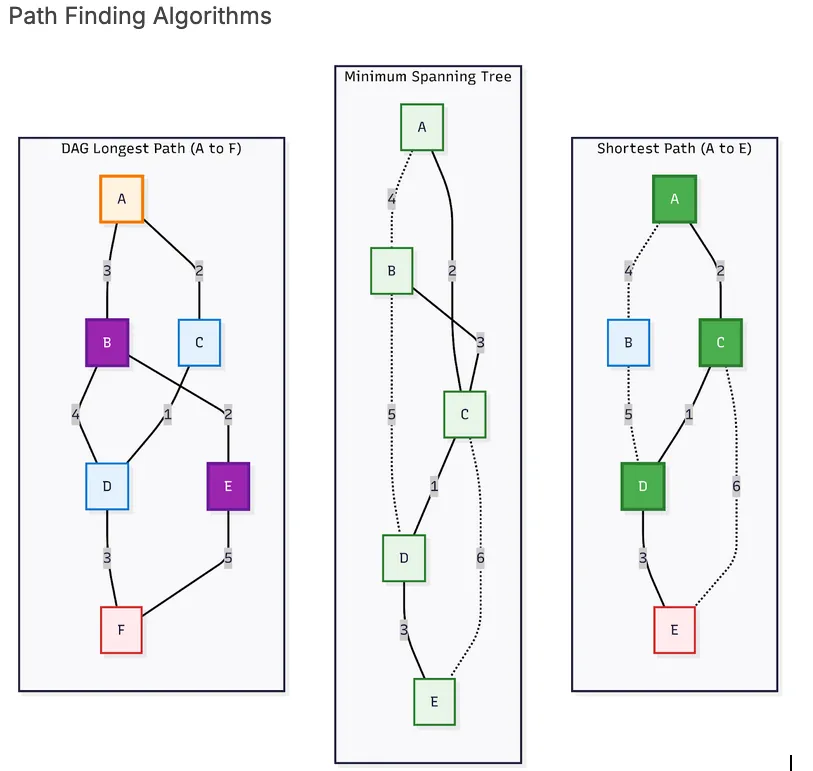
Pathfinding algorithms determine the most efficient route between nodes in a graph, based on metrics like distance, cost, or time. These algorithms are fundamental to navigation, routing, and resource optimization across both physical and digital networks.

Notable examples include Dijkstra’s algorithm, which computes the shortest path from a source node to all other nodes; A*, a heuristic-based method that speeds up pathfinding with informed guesses; and Single Source Shortest Path (SSSP), which finds optimal routes from a specific starting point. In Directed Acyclic Graphs (DAGs), where cycles are absent, the Longest Path algorithm determines the maximum-weighted path, particularly useful in project scheduling, dependency resolution, and build systems.

path finding algorithms graph databases falkordb FalkorDB

Centrality Algorithms

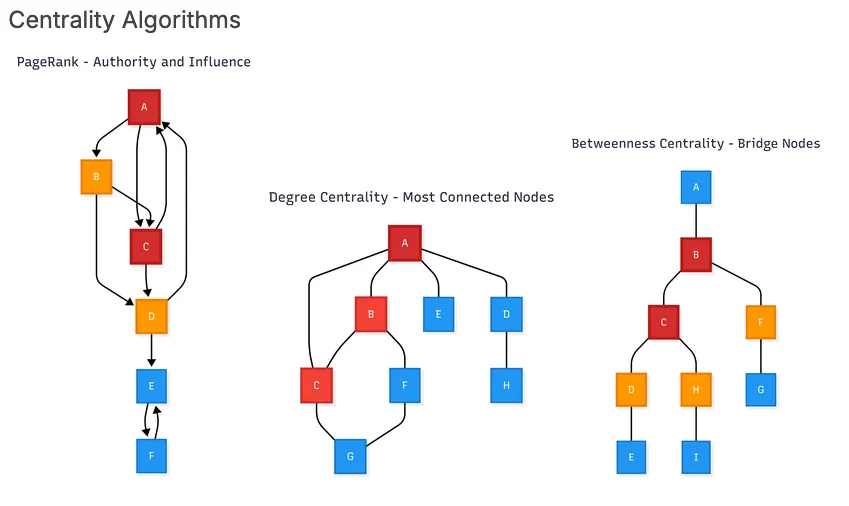
Centrality algorithms evaluate the importance of nodes based on their position and role within a graph’s structure. These measures identify key nodes in a network: influential users in social networks, weak points in critical infrastructure, or web pages ranked by relevance and connectivity.

Some of the most widely used centrality algorithms include Betweenness Centrality, which highlights nodes that act as bridges between different parts of the graph; PageRank, originally developed by Google to rank search results; and Degree Centrality, which measures importance based on the number of direct connections a node has.

centrality algorithms graph databases falkordb FalkorDB

Community Detection Algorithms

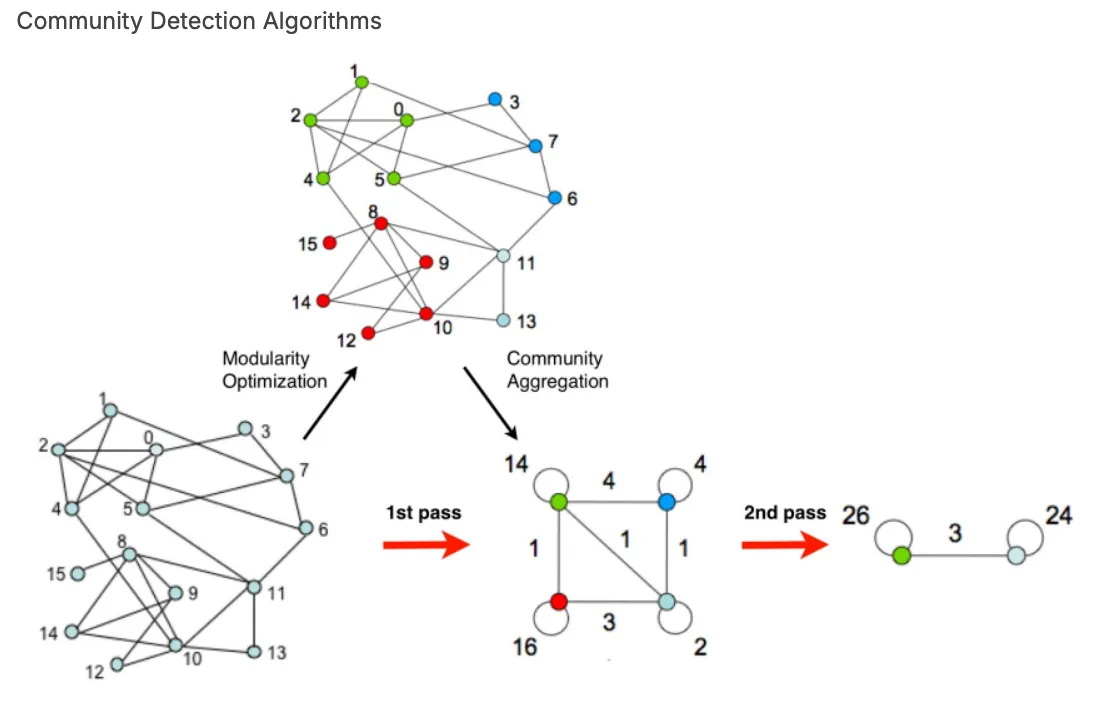
Community detection and connectivity algorithms identify clusters or groups of nodes that are more closely connected to each other than to the rest of the graph. These algorithms uncover hidden structures and patterns in networks, such as customer segments, coordinated fraud rings, or organizational subgroups. They can also determine whether a graph is fully connected or if it contains isolated “islands” of disconnected components.

Popular algorithms in this category include Louvain Modularity, which detects communities by optimizing the density of connections within groups compared to between them, making it an efficient choice for large-scale graphs. Its improved variant, Leiden Modularity, offers greater stability and more clearly defined communities. Label Propagation (LPA) provides a fast, scalable approach by having nodes adopt the majority label from their neighbors, making it ideal for massive networks where performance is critical.

For analyzing connectivity, Strongly Connected Components (SCC) identify tightly-knit groups in directed graphs where every node is reachable from every other node. Meanwhile, Weakly Connected Components (WCC) uncover broader connectivity by grouping nodes based on mutual reachability, regardless of edge direction.

community detection algorithms graph databases falkordb FalkorDB

Graph Algorithms in Action

Let’s explore practical use cases for graph algorithms in production systems, using examples from the latest additions in the FalkorDB algorithm suite (v4.10).

Betweenness Centrality

Betweenness Centrality measures a node’s significance by calculating how often it appears on the shortest paths between other node pairs. Nodes with high scores can be identified as critical connectors or intermediaries within the network. This algorithm finds nodes that play a central role in facilitating communication or information flow, making it especially valuable for analyzing influence and structural importance in complex graphs.

Performance: Betweenness Centrality is computationally more intensive than local algorithms. Its time complexity is typically O(n×m) for unweighted graphs, where n is the number of nodes and m is the number of edges. Because it requires shortest path calculations between all node pairs, it scales less efficiently on very large graphs.

Let’s model a corporate network where users access machines. We’ll represent User, Server, and Workstation nodes connected via ACCESSES and CONNECTS_TO relationships.

Now, we’ll apply Betweenness Centrality on this graph to detect nodes critical to access flow, such as systems that bridge users to sensitive resources. The algo.betweenness procedure lets you specify node labels and relationship types, so you can focus analytics on specific graph segments without needing manual subgraph extraction.

Results show:

  • Workstation-2 is the most central: it sits on many shortest paths between users and shared resources. This makes it a high-risk lateral movement surface.

  • Shared-Storage also connects multiple workstations, indicating a sensitive aggregation point.

  • Users like Bob who access multiple workstations may bridge departments, especially if combined with Label Propagation or Degree Centrality.

Community Detection using Label Propagation (CDLP)

Label Propagation (CDLP) is a community detection algorithm that groups nodes based on their structural proximity in a graph. Starting with each node assigned a unique label, the algorithm iteratively updates each node’s label to match the most frequent label among its neighbors. Over time, densely connected regions naturally converge to a shared label, revealing distinct communities within the network.

Performance: CDLP runs in near-linear time, with each iteration operating at O(n+m) complexity, where n is the number of nodes and m is the number of edges. It typically converges within a few iterations, making it well-suited for large-scale graphs where speed and simplicity are critical.

Imagine a network where users log into systems, and over time, attackers may compromise certain users or machines. By analyzing access patterns, you can uncover clusters of accounts and systems that may be involved in coordinated activity, potentially identifying malicious lateral movement or insider collusion.

Results show:

  • Communities 0 & 1 represent normal user activity with expected machine access.

  • Community 3 is a dense cluster of users (Eve, Mallory, Trent) accessing the same high-value machines: a strong signal for investigation, possibly indicating shared credentials, malware propagation, or insider threat behavior.

Weakly Connected Components (WCC)

The Weakly Connected Components algorithm identifies groups of nodes in a graph that are connected by some path, ignoring the direction of edges. In each component, every node is reachable from every other node if the graph is treated as undirected. This algorithm is especially useful for detecting disjoint subgraphs or structural partitions in large, directed networks.

WCC begins by assigning each node a unique component ID. It then iteratively traverses all edges, merging connected nodes into the same component, ignoring edge direction throughout. The process continues until no more merges are possible.

Performance: Time Complexity: O(V+E), where V is the number of nodes and E is the number of edges. This near-linear performance makes WCC highly scalable and suitable for very large graphs.

The algo.wcc procedure supports real-time component analysis across filtered subgraphs by label or relationship type, helping you quickly isolate disconnected or shadow assets with a single query.

Results show:

  • Component 0 is a developer environment used by Alice and Bob.

  • Component 2 is a sensitive financial system accessed by Eve, possibly a separate trust zone.

  • Component 5 is an isolated legacy server: this could signal an orphaned asset or a misconfigured endpoint lacking proper integration or monitoring.

Quick graph algorithms recap

Algorithm Purpose Reveals Performance Best Used For
Betweenness Centrality Measure influence of a node based on shortest paths Key connectors, chokepoints, potential high-risk hubs O(n×m)O(n \times m)O(n×m)for unweighted graphs Identifying shared access nodes, influential users, or lateral movement vectors
Weakly Connected Components (WCC) Detect disconnected or loosely connected graph segments Isolated systems, legacy assets, disconnected business zones O(n+m)O(n + m)O(n+m) Auditing network segmentation, locating shadow IT or misconfigured environments
Community Detection (CDLP) Group nodes into clusters based on structural proximity Behavioral clusters, coordinated access patterns, implicit user groups O(n+m)O(n + m)O(n+m)per iteration; fast to converge Detecting suspicious clusters, shared credentials, insider threat investigation

Conclusion

Graph algorithms are rapidly becoming required tools for cybersecurity teams, enabling them to look beyond isolated data points and map the true structure of risk, influence, and vulnerability in digital systems. Modern graph databases like FalkorDB empower you to not only store and visualize relationships, but also apply advanced algorithms such as Betweenness Centrality, Weakly Connected Components, and Community Detection, to spot hidden attack paths, risky access patterns, and potential insider threats in real time.

If you haven’t explored graph analytics in your security stack yet, now is the time. With intuitive tools and an ever-expanding library of built-in algorithms, platforms like FalkorDB make it easier than ever to translate complex real-world systems into actionable insight.

FAQ

What are graph algorithms used for in cybersecurity?

Graph algorithms analyze network structure to identify attack paths, insider threats, shared credentials, and vulnerable access points by mapping relationships between users and systems.

It calculates how often nodes appear on shortest paths between others, revealing critical bridge systems that attackers could exploit for lateral movement across networks.

CDLP runs in near-linear time to group users and machines by access patterns, quickly surfacing suspicious clusters that may indicate coordinated attacks or credential sharing.