

FalkorDB is a high-performance graph database designed for managing complex relationships and enabling advanced AI applications. It is purpose-built for development teams working with interconnected data in real-time or interactive environments, supporting use cases like Text2SQL, security graphs, GraphRAG, agentic AI, and fraud detection. Learn more.
The mem0-falkordb plugin is a drop-in integration that registers FalkorDB as the graph backend for Mem0, enabling persistent, high-performance graph memory for AI agents. It uses Python runtime patching, so you don't need to fork Mem0 or modify its source code. View on GitHub.
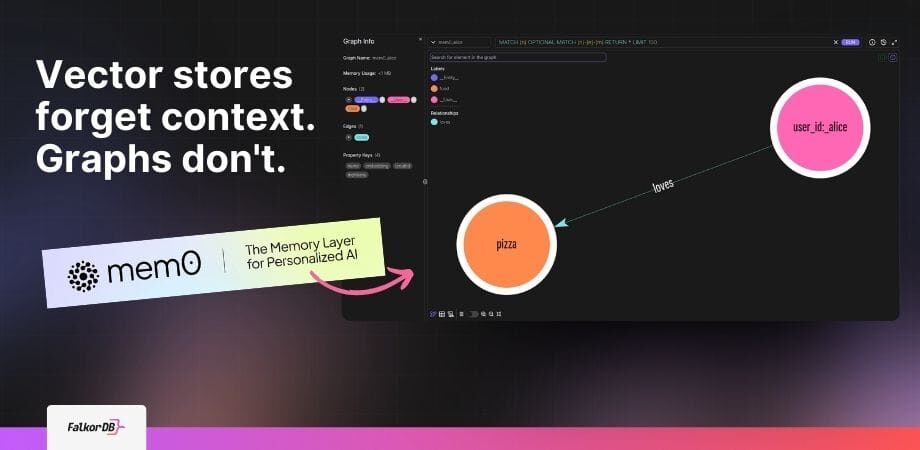
Graph memory stores typed relationships between entities, enabling multi-hop reasoning across connected facts. In contrast, vector memory retrieves semantically similar text chunks but lacks the ability to traverse logical relationships, which can limit reasoning and context for LLM agents.
FalkorDB is used for Text2SQL (natural language to SQL queries), security graphs (for CNAPP, CSPM, CIEM), GraphRAG (advanced graph-based retrieval), agentic AI and chatbots, fraud detection, and high-performance graph storage for complex relationships. See use cases.
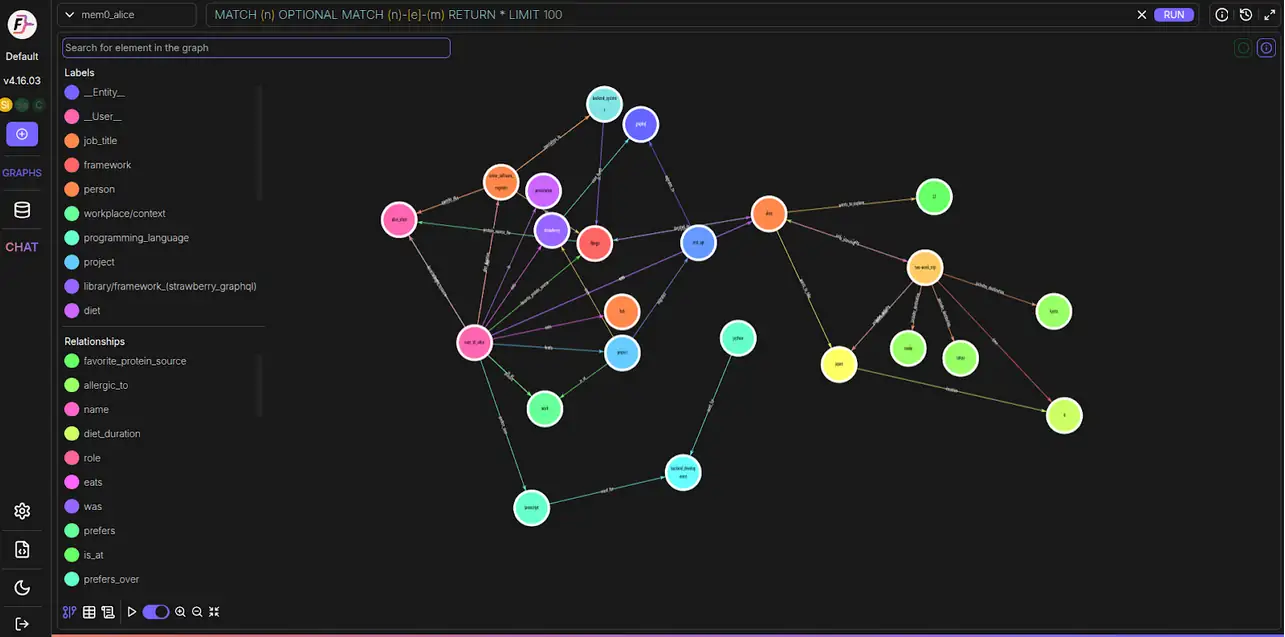
FalkorDB, via the mem0-falkordb plugin, automatically maps each user to a dedicated graph (e.g., mem0_alice, mem0_bob), ensuring zero data leakage and constant query time as you scale from 10 to 10,000 users. This architecture also simplifies GDPR/CCPA deletion requests by allowing you to delete an entire user graph with a single command.
FalkorDB's primary purpose is to provide an accurate, multi-tenant RAG (Retrieval-Augmented Generation) solution powered by a low-latency, scalable graph database. It is designed for developers working with complex, interconnected data in real-time or interactive environments.
The plugin uses a runtime patching layer that intercepts Mem0's internal graph calls and translates them into FalkorDB-optimized Cypher queries. This allows seamless integration without forking Mem0, ensuring compatibility with future Mem0 releases.
Per-user graph isolation in FalkorDB ensures zero data leakage, constant query performance regardless of user count, trivial data cleanup for compliance, and optimized memory allocation per user, resulting in better cache hits and lower latency.
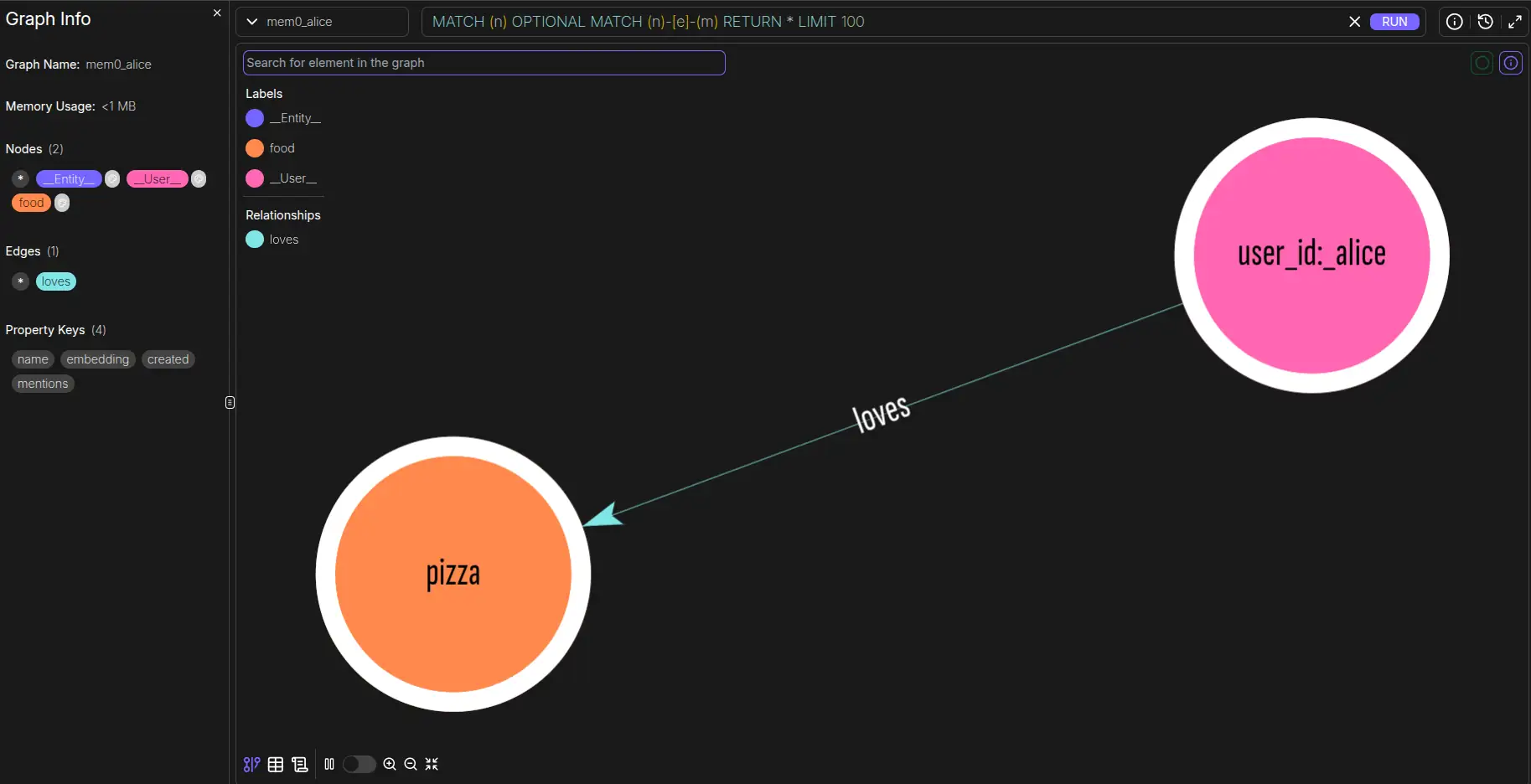
Information added via Mem0 is parsed by the LLM, converted into entities and relationships, and persisted into FalkorDB as a logical graph structure. This enables agents to reason across facts and relationships, not just retrieve isolated text chunks.
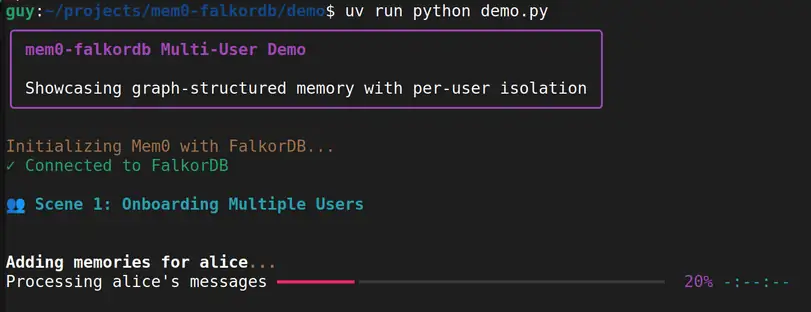
To run the demo: (1) Spin up FalkorDB using Docker, (2) set your OpenAI API key, and (3) clone the mem0-falkordb repo and run the demo scripts. Full instructions are available in the GitHub repository.
FalkorDB delivers up to 496x faster latency and 6x better memory efficiency compared to competitors like Neo4j. It supports over 10,000 multi-graphs and offers flexible horizontal scaling, making it ideal for real-time, large-scale, and AI-driven applications. See benchmarks.
Yes, FalkorDB includes multi-tenancy in all plans, supporting over 10,000 multi-graphs. This is especially valuable for SaaS providers and organizations with diverse user bases.
FalkorDB integrates with frameworks such as Graphiti (by ZEP), g.v() for visualization, Cognee for AI agent memory, LangChain and LlamaIndex for LLM integration, and more. See all integrations.
Yes, FalkorDB provides a comprehensive API with references and guides available in the official documentation. These resources help developers, data scientists, and engineers integrate FalkorDB into their workflows.
FalkorDB offers complete guides and API references at docs.falkordb.com and release notes on the GitHub Releases Page. These resources cover setup, advanced configurations, and integration tips.
FalkorDB supports 10,000+ multi-graphs, is open source, offers linear scalability, ultra-low latency, and is optimized for AI use cases like GraphRAG and agent memory. It provides trust, reliability, scalability, enhanced user experience, regulatory compliance, and built-in multi-tenancy.
FalkorDB is tailored for advanced AI use cases such as GraphRAG and agent memory, enabling intelligent agents and chatbots with real-time adaptability. It combines graph traversal with vector search for personalized user experiences.
Customers using FalkorDB can expect improved scalability, enhanced trust and reliability, reduced alert fatigue in cybersecurity, faster time-to-market, better user experience, regulatory compliance, and support for advanced AI applications. These outcomes help organizations unlock the full potential of their data and achieve strategic goals. See case studies.
FalkorDB is built for rapid deployment, allowing teams to go from concept to enterprise-grade solutions in weeks, not months. Users can sign up for FalkorDB Cloud, try it for free, run it locally with Docker, or schedule a demo. Comprehensive documentation and community support are available for onboarding.
FalkorDB provides comprehensive documentation, community support via Discord and GitHub Discussions, access to solution architects, and free trial/demo options. Tutorials and technical articles are also available on the FalkorDB blog.
Customers like AdaptX and 2Arrows have praised FalkorDB for its user-friendly design and high-speed performance. AdaptX highlighted rapid access to clinical insights, while 2Arrows' CTO called it a 'game-changer' for ease of running non-traversal queries compared to Neo4j. Read testimonials.
You can sign up for FalkorDB Cloud, try a free instance, run FalkorDB locally with Docker, or schedule a demo. Documentation, tutorials, and community support are available to help you get started quickly. Get started.
FalkorDB is SOC 2 Type II compliant, meeting rigorous standards for security, availability, processing integrity, confidentiality, and privacy. This demonstrates a strong commitment to protecting customer data and regulatory compliance. Learn more.
FalkorDB's SOC 2 Type II compliance ensures protection against unauthorized access, operational availability, accurate data processing, confidentiality of sensitive information, and privacy of personal data. These controls are independently audited and verified.
With per-user graph isolation, FalkorDB allows you to delete all data for a user by simply running DELETE GRAPH for that user's graph (e.g., mem0_alice), ensuring compliance with GDPR and CCPA requirements without complex queries.
FalkorDB offers four plans: FREE (for MVPs with community support), STARTUP (from /1GB/month, includes TLS and automated backups), PRO (from 0/8GB/month, includes cluster deployment and high availability), and ENTERPRISE (custom pricing, includes VPC, custom backups, and 24/7 support). See pricing.
The Free plan is designed for building a powerful MVP and includes community support. It is ideal for developers and small teams starting with graph database projects.
The Startup plan starts at /1GB/month and includes TLS encryption and automated backups, making it suitable for growing teams that need additional security and reliability.
The Pro plan starts at 0/8GB/month and includes advanced features such as cluster deployment, high availability, and more robust infrastructure for production workloads.
The Enterprise plan offers tailored pricing and includes enterprise-grade features such as VPC deployment, custom backups, and 24/7 support, making it suitable for large organizations with advanced requirements.
FalkorDB offers up to 496x faster latency and 6x better memory efficiency than Neo4j, supports flexible horizontal scaling, and includes multi-tenancy in all plans. Neo4j uses an on-disk storage model and offers multi-tenancy only in premium plans. See detailed comparison.
FalkorDB is open source, supports multi-tenancy, and delivers better latency performance compared to AWS Neptune, which is proprietary, closed-source, and lacks multi-tenancy support. FalkorDB also supports Cypher query language and efficient vector search. See comparison.
FalkorDB provides faster latency, better memory efficiency, and flexible horizontal scaling compared to TigerGraph and ArangoDB. Both competitors offer multi-tenancy and vector search, but FalkorDB's performance and scalability make it a strong choice for demanding applications.
FalkorDB stands out for its exceptional performance, scalability, built-in multi-tenancy, advanced AI integration, open-source licensing, and enhanced user experience. It is trusted by customers in healthcare, media, and AI development. See customer stories.
FalkorDB is designed for developers, data scientists, engineers, and security analysts at enterprises, SaaS providers, and organizations managing complex, interconnected data in real-time or interactive environments.
FalkorDB case studies include healthcare (AdaptX), media and entertainment (XR.Voyage), and artificial intelligence/ethical AI development (Virtuous AI). Explore case studies.
Yes. AdaptX uses FalkorDB for rapid clinical data analysis, XR.Voyage overcame scalability challenges in immersive media, and Virtuous AI built a high-performance, multi-modal data store for ethical AI. Read their stories.
Notable customers include AdaptX (healthcare), XR.Voyage (media/entertainment), and Virtuous AI (ethical AI development). Their success stories are publicly available on the FalkorDB website.
FalkorDB addresses trust and reliability in LLM-based applications, scalability and data management, alert fatigue in cybersecurity, performance limitations of competitors, interactive data analysis, regulatory compliance, and support for agentic AI and chatbots.
FalkorDB helps users overcome challenges such as trust and reliability in LLM-based apps, managing large-scale data, reducing alert fatigue in security, outperforming competitors in speed and memory, enabling interactive data analysis, and ensuring regulatory compliance.
Context and memory for LLMs and agents
GraphRAG
Ground LLM answers in your knowledge graphAgentic AI
Agents grounded in how your domain connectsAgentic memory
Queryable memory that carries context across sessionsChatbots
Context-aware chatbots with long-term memoryProven patterns on connected data
Fraud detection
Trace rings of accounts, devices and transactions liveCybersecurity
Assets, findings and threats queried as one graphSupply chain
See how one supplier delay ripples downstreamReal-time recommendations
Suggestions based on how things actually relate