
GraphRAG That Gets It Right.
A specialized toolkit for building GraphRAG systems: knowledge graphs, ontology management and LLMs in one pipeline. Available as a developer SDK or a ready-to-use GraphRAG Server.
OPEN-SOURCE
STRUCTURED AND UNSTRUCTURED DATA
OPTIMIZED FOR AI
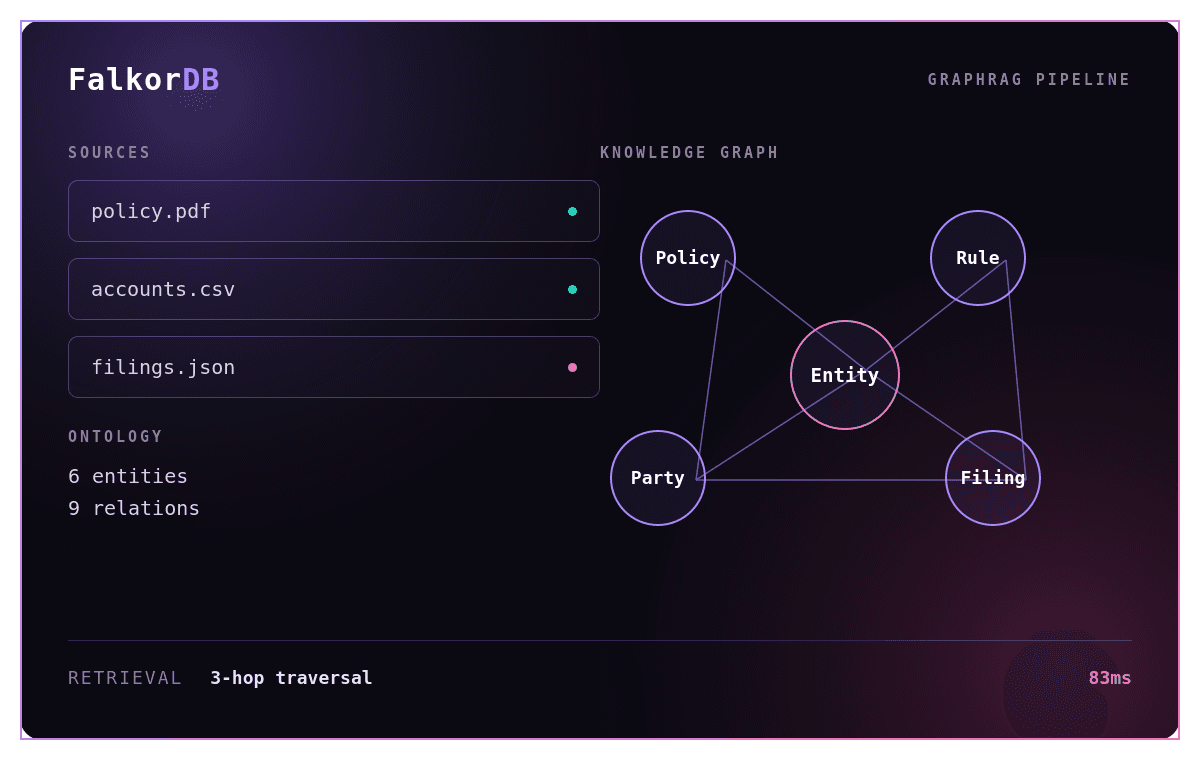
What is GraphRAG?
GraphRAG is a retrieval-augmented generation approach that uses a knowledge graph to retrieve entities, relationships and multi-hop context for an LLM. Unlike vector-only RAG, GraphRAG reasons over the connections between facts, which improves traceability and answer quality on complex questions.
FalkorDB's GraphRAG-SDK supplies the four pieces that pipeline needs: ontology discovery from your raw data, knowledge-graph construction, multi-hop graph retrieval on a low-latency graph database, and multi-agent orchestration. Use it as a library, or run the same engine as a hosted GraphRAG Server.
How It Works
// detect ontology
kg.detect_ontology("./docs")
// review + iterate
kg.ontology.entities → 14
STEP 01
Remove the barrier of ontology creation
Transform raw data into structured knowledge models automatically.
✓ Use generative AI to detect and construct ontologies from your datasets
✓ Review, modify and iterate on detected ontologies to optimize graph structures
✓ Define custom parameters to scope and control ontology detection processes
CSV
HTML
TXT
JSON
URL
STEP 02
Handle structured and unstructured data
Ingest diverse data formats through a streamlined ETL process.
✓ Process multiple file formats including PDF, CSV, HTML, TXT, JSON and URLs
✓ Deploy FalkorDB instances via cloud infrastructure or containerized environments
✓ Utilize genAI capabilities to construct knowledge graphs efficiently
ORCHESTRATOR
Planner agent
KG agent · Risk
KG agent · Legal
STEP 03
Use multi-agent Orchestration
Coordinate specialized agents for complex knowledge operations.
✓ Configure domain-specific Knowledge Graph agents for targeted analysis
✓ Implement orchestration layer for automated agent coordination and planning
✓ Execute sophisticated queries through multi-agent collaboration
DELIVERY OPTIONS
Choose how you build with GraphRAG.
FOR DEVELOPERS
GraphRAG-SDK
For developers who want full code-level control, custom pipelines, and deep integration.
FOR TEAMS
GraphRAG Server
For teams who want to upload documents and start querying a knowledge graph immediately, no code required.
Not sure which path fits?
WHY FALKORDB
Why FalkorDB for GraphRAG
✓
Automatic ontology discovery
Detected from raw and structured data, then reviewable and editable before the graph is built.
SDK docs →
✓
Native knowledge-graph construction
Entities and relationships written straight into FalkorDB, with no separate graph-modelling step.
Read the guide →
✓
Multi-hop retrieval
Traversals run as sparse matrix operations in memory, keeping relationship-heavy queries at low latency.
Benchmark →
✓
Structured and unstructured input
PDF, CSV, HTML, TXT, JSON and URLs through one ETL pipeline.
Supported formats →
✓
Multi-agent orchestration
Expose each graph as a domain agent and let an orchestrator plan across them.
Orchestration docs →
✓
Open Source
The SDK is open source and developed in the open on GitHub.
View repository →
How Teams Use GraphRAG
01 COMPLIANCE
Regulatory Compliance Analyzer
Stay ahead of financial regulations with GraphRAG-SDK.
Extract Key Requirements
NLP-driven analysis organizes regulatory mandates into a knowledge graph for precise insights.
Map Regulations to Processes
Link policies to workflows, ensuring compliance across departments.
Identify Compliance Gaps
Query relationships to spot misalignments and track updates.
Suggest Improvements
Get data-driven recommendations to refine policies, training, and risk management.
02 FINANCIAL CRIME
AML Network Analyzer
Detect and analyze financial crime with GraphRAG-SDK.
Trace Fund Flows
Visualize transaction networks across institutions to track money movement with clarity.
Identify Shell Companies
Uncover hidden relationships and detect illicit entities within financial ecosystems.
Flag Suspicious Patterns
Use graph-based analysis to detect anomalies, refine detection over time, and scale AML efforts effectively.
03 PERSONALIZATION
Financial Product Recommendation Engine
Deliver precise financial recommendations using GraphRAG-SDK.
Analyze Customer Data
Structure financial records and life events into knowledge graphs for relevant, personalized insights.
Map Product Relationships
Clearly visualize connections between products, customer segments, and risk profiles.
Tailored Recommendations
Leverage graph reasoning to offer transparent, explainable suggestions, boosting trust and satisfaction.
EXPLORE MORE ON GRAPHRAG
Guides, benchmarks and documentation.
GUIDE
What is GraphRAG? Types, Limitations and When to Use
Read →
BENCHMARK
GraphRAG vs Vector RAG: Accuracy Benchmark Insights
Read →
TUTORIAL
Implement GraphRAG with FalkorDB, LangChain, and More
Read →
DOCS
GraphRAG SDK Docs
Open docs →
DOCS
GraphRAG Toolkit Docs
Open docs →
COMPARISON
GraphRAG vs. vector RAG vs. agentic RAG
GraphRAG is not always the answer. Where a question resolves inside a single passage, vector RAG is cheaper and sufficient.
DIMENSION
Vector RAG
GraphRAG
Agentic RAG
Retrieval unit
Nearest text chunks
Entities, relationships and multi-hop paths
Tool calls chosen at runtime
Multi-hop questions
Weak. Context is flattened
Strong. Traversal follows the links
Depends on the tools available
Explainability
Chunk provenance only
A path through the graph
Trace of agent steps
Setup cost
Lowest. Embed and index
Ontology plus graph construction
Agent and tool design
Best fit
Single-passage lookup, FAQ, search
Relationship-heavy, regulated, aggregate questions
Multi-step tasks and actions
Knowledge-graph RAG and GraphRAG describe the same retrieval model; GraphRAG adds the automated construction and orchestration around it.
GRAPHRAG FAQ
Frequently asked questions.
What is GraphRAG and how is it different from traditional RAG?
GraphRAG retrieves from a knowledge graph of entities and relationships instead of isolated text chunks. Standard RAG returns the passages that look most similar to the question. GraphRAG returns a connected subgraph, so questions that depend on several linked facts get answered correctly, and you can see why.
How does GraphRAG work, step by step?
Detect an ontology from your data. Ingest documents and records through ETL and map them onto entities and relationships. Store the graph in FalkorDB. At query time, turn the question into graph traversals and pass the result to the LLM as context.
What are the benefits of GraphRAG over vector-only RAG?
Multi-hop and aggregate questions get answered correctly. Every answer traces back to specific entities and relationships, so you can audit it. Similar-but-unrelated chunks stop leaking into context, and structured records sit alongside unstructured documents in one retrieval step.
What are the current limitations or challenges of GraphRAG?
Building the graph is an extra step, and the ontology sets a ceiling on answer quality. Keeping it current needs a pipeline. Automated ontology detection and incremental ingestion cut most of that work, but it is still more design than loading chunks into a vector index.
What's the difference between using the GraphRAG-SDK and the GraphRAG Server?
The SDK is a library you build into your application: you control the ontology, chunking, prompts and agents. The Server is a running service: upload documents, query the graph, no code. Same engine underneath.
How does GraphRAG-SDK optimize query performance to achieve low-latency operations?
FalkorDB runs traversals as sparse matrix operations in memory rather than pointer chasing. The ontology scopes each query and entity keys are indexed, which keeps multi-hop retrieval in the millisecond range.
How does GraphRAG-SDK facilitate the implementation of multi-agent systems?
Each knowledge graph can be exposed as its own agent. An orchestrator decides which agents to call, in what order, and how to merge what they return, so one question can span several graphs and tools without custom glue code.
Does GraphRAG require a graph database?
In practice, yes. The retrieval step is a traversal, and traversals need a graph engine to stay fast. FalkorDB is that engine here: it stores the constructed graph and executes multi-hop queries in memory, so relationship-heavy retrieval returns in milliseconds rather than seconds.
What data formats does the GraphRAG-SDK support?
PDF, CSV, HTML, TXT, JSON and URLs, all through the same ETL path. Structured records and unstructured documents land in one graph, so a single query can join a row in a table to a clause in a document.
Can I use the GraphRAG-SDK with my own LLM?
Yes. The SDK treats the model as a pluggable component for ontology detection, extraction and answer generation, so you can point it at a hosted API or a model you run yourself and keep the rest of the pipeline unchanged.
Is the FalkorDB GraphRAG-SDK open source?
Yes. The SDK is open source and developed in the open on GitHub, so you can read the ontology detection and retrieval code, extend it, or vendor it into your own stack.
Build fast and accurate GenAI apps with GraphRAG SDK at scale
FalkorDB offers an accurate, multi-tenant RAG solution based on our low-latency, scalable graph database technology, built for technical teams handling complex, interconnected data in real time.