


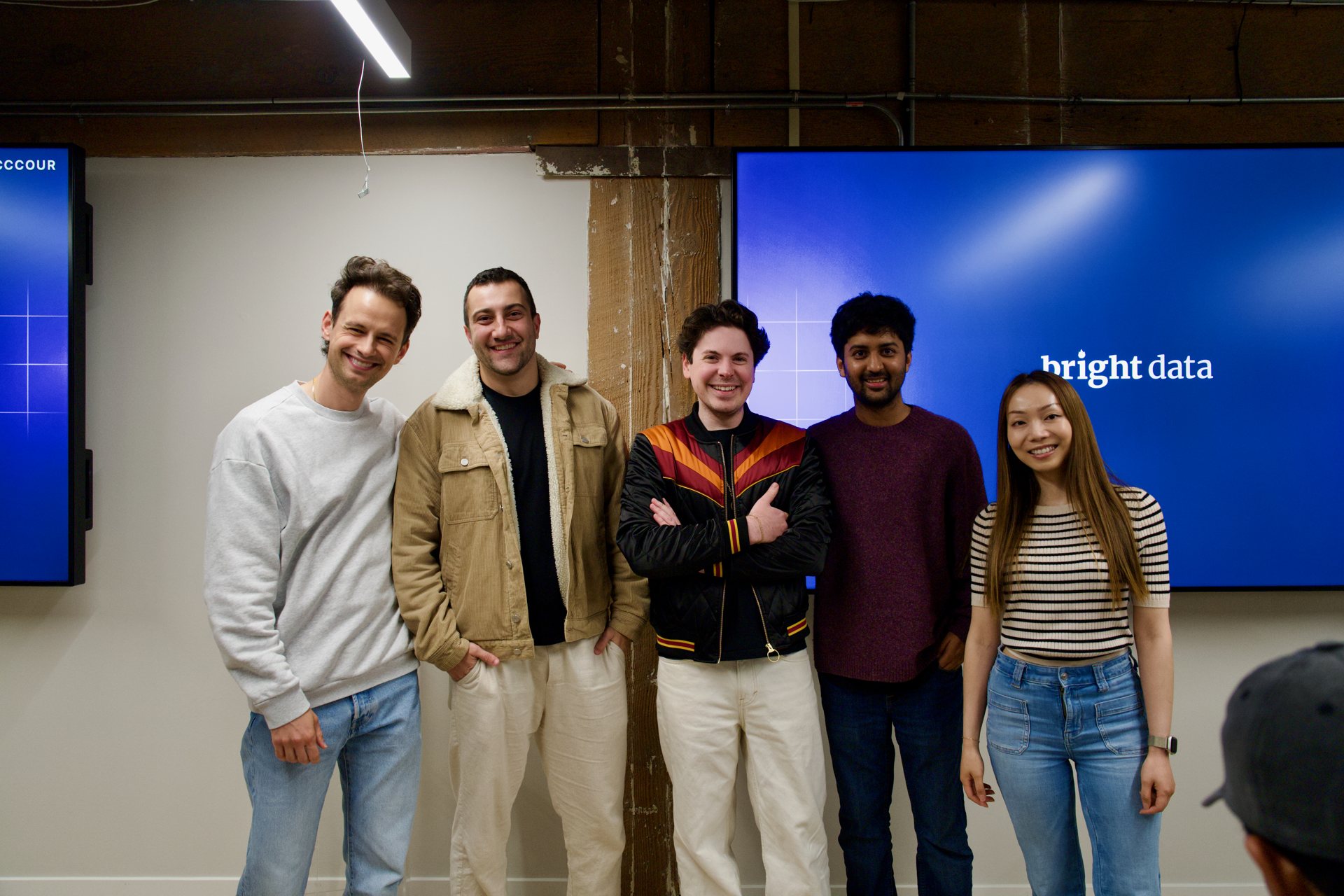
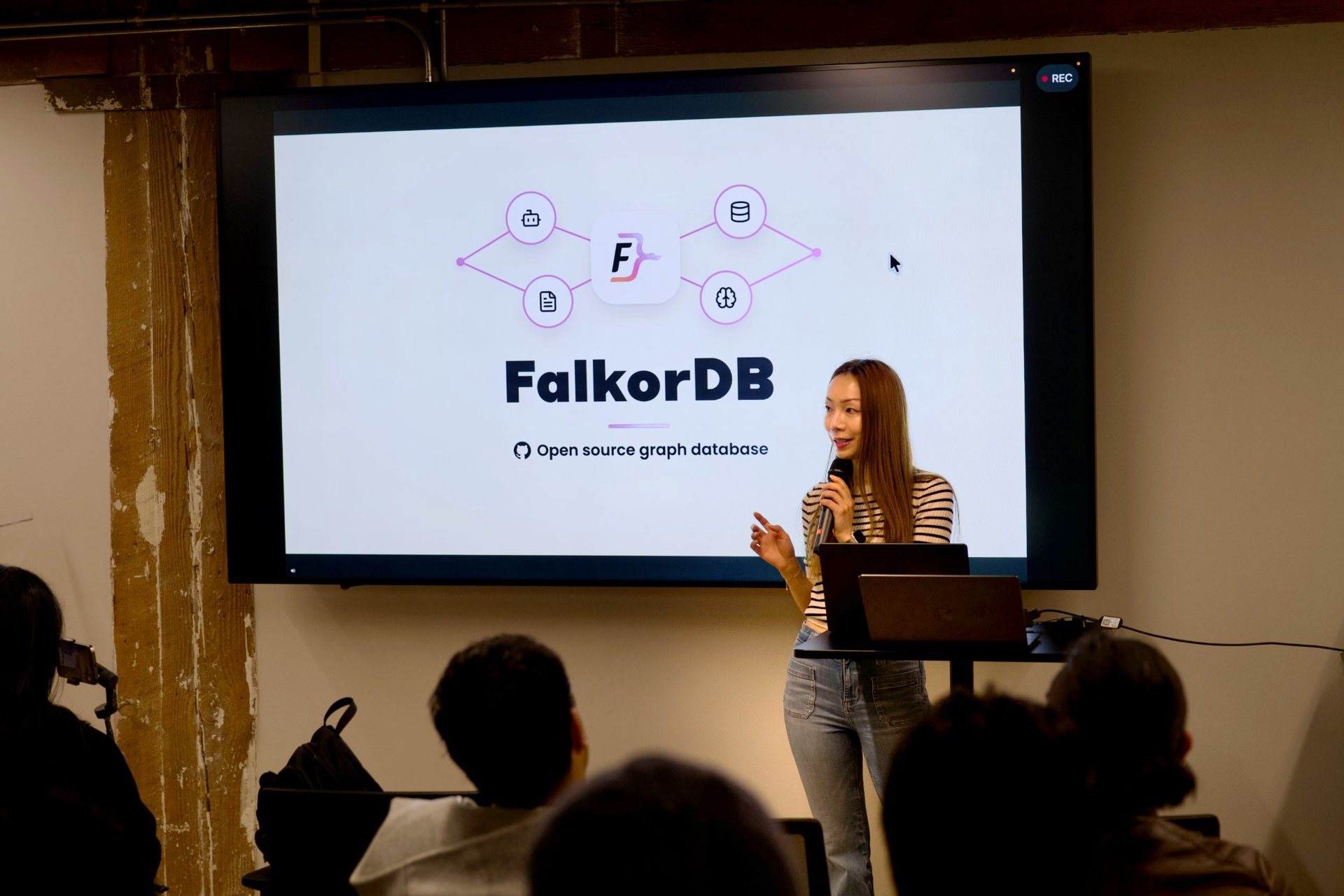
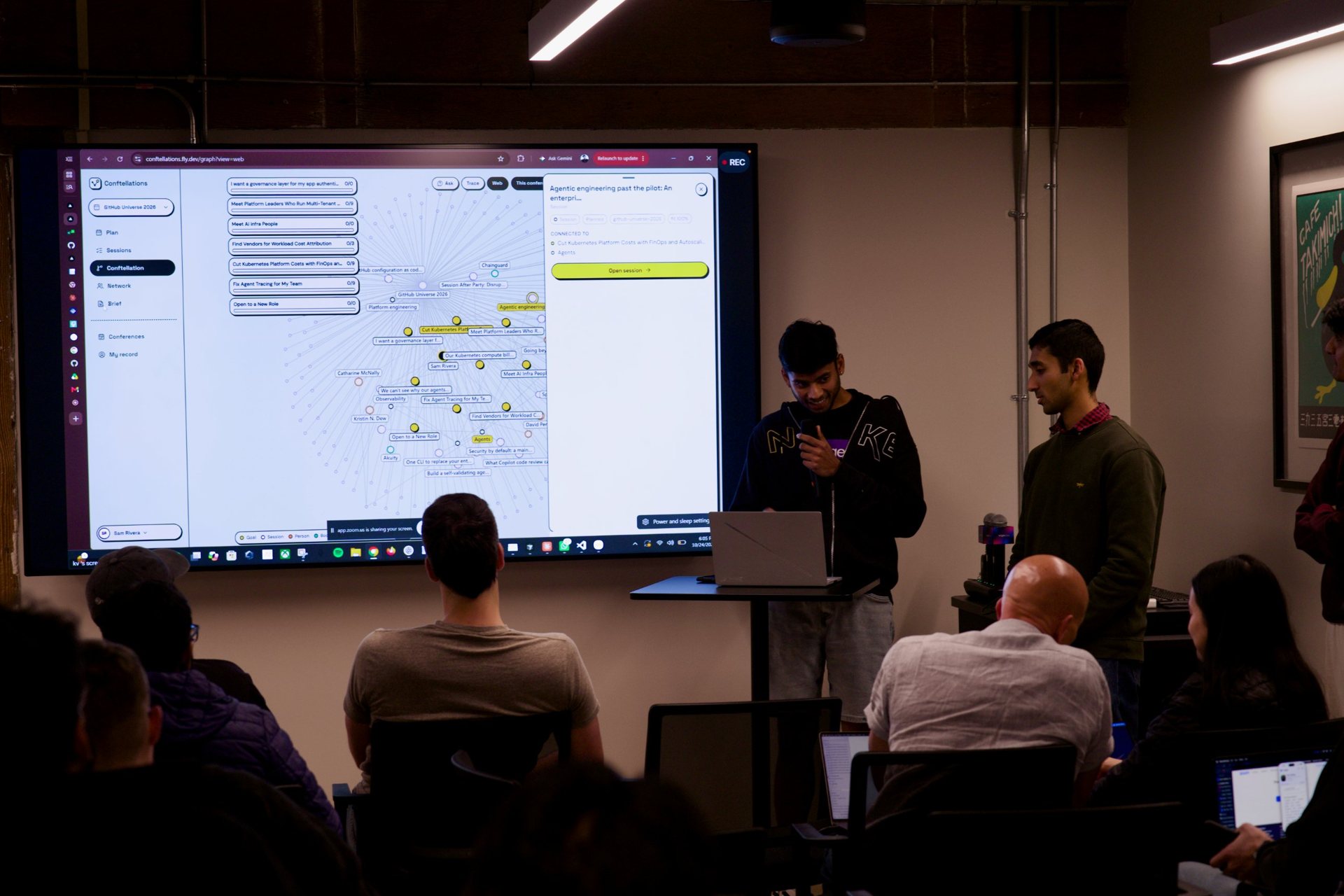
Patch the Conference was a one-day, in-person conference knowledge graph hackathon in San Francisco on Saturday, October 24, 2026, right before GitHub Universe. 647 developers registered to patch a real problem with tech conferences, like finding the right people, picking which talks are worth the time, or keeping the day running when something breaks. After about six hours of building, 59 builders on 50 teams demoed projects built on FalkorDB, 28 of them deployed live, and Rally, a live connection graph that learns who knows what, won Best use of FalkorDB. Our Developer Relations Lead, Liz Zhang, opened by walking everyone step by step through creating their first FalkorDB database.
algo.pageRank, algo.maxFlow, GRAPH.COPY and read-only queries to do the real work.Want to build one yourself? Start free on FalkorDB Cloud and load your first conference knowledge graph in minutes, the same way these teams did.
What is a conference knowledge graph?
A conference knowledge graph is a graph database of a conference's people, talks, topics, rooms, companies and times, and how they connect, that an app or AI agent queries to answer questions like who to meet and where to be.
Conference data is mostly relationships. A speaker presents a talk on a topic you care about, and someone you met works at the speaker's company. Answering "who should I meet, and why" means walking those links at once. On FalkorDB that is one Cypher query, and the path doubles as the explanation.
| Question | Conference app or spreadsheet | Conference knowledge graph on FalkorDB |
|---|---|---|
| Who should I meet? | Filters a list by job title | Follows shared topics, talks and companies to a person |
| Which talk is worth my hour? | Lists every talk by time | Walks from your goal to the talks that teach it |
| A session just filled up. Now what? | You find out at the door | Finds the alternatives you can still reach in time |
| Why this recommendation? | A score with no reason | The exact nodes and edges behind the answer |
| Have I met them already? | Lost in a notes app | A MET edge the next query reads |
What did builders patch?
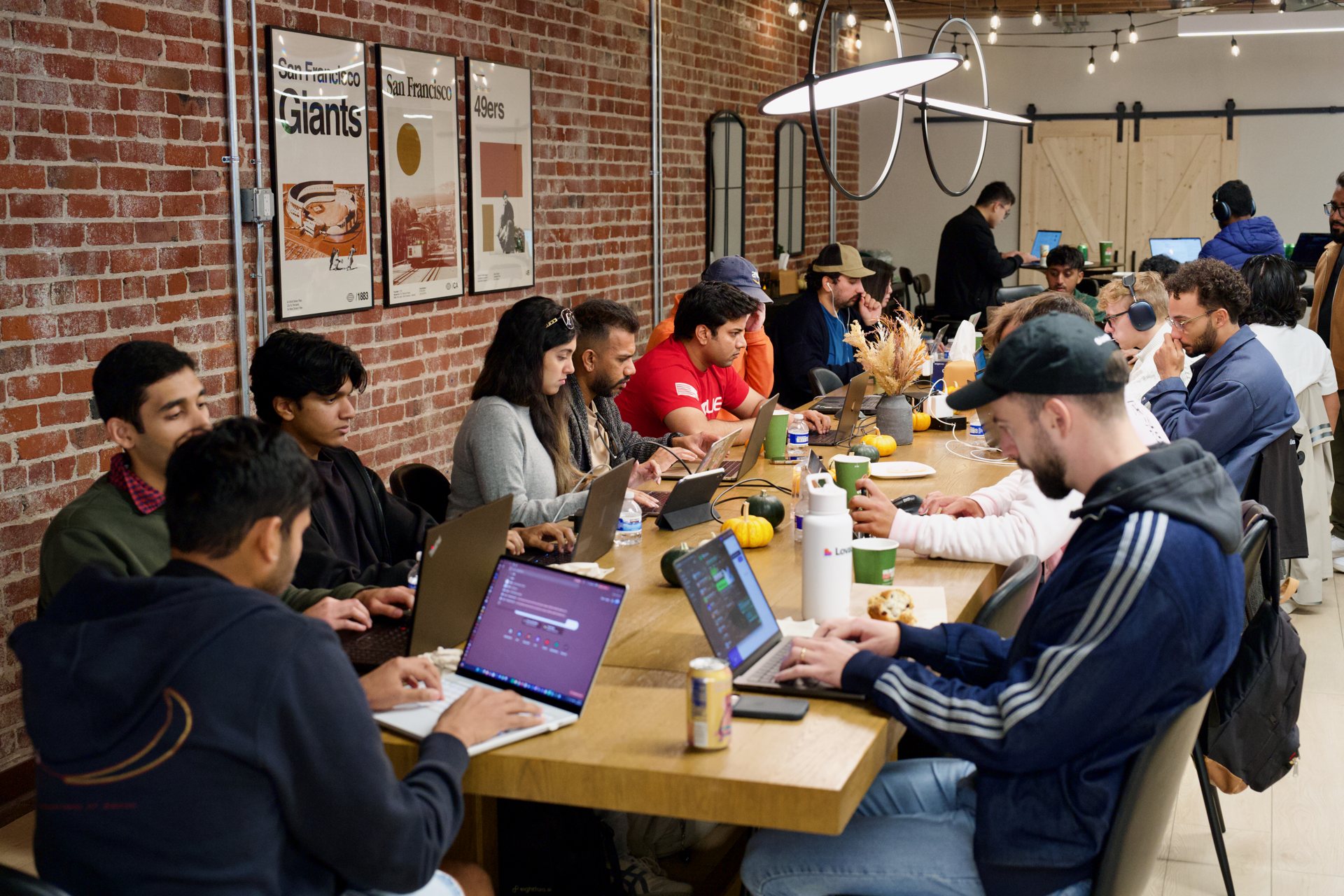
We read all 50 FalkorDB submissions and sorted each by the main problem it patched.
| Problem patched | Projects |
|---|---|
| Who should I meet, and what do I say? | 24 |
| Which conference, talk or room is worth my time? | 11 |
| How do I keep what I learned and who I met? | 7 |
| What happens when something breaks on the day? | 6 |
| Something else (like shopping the swag you just saw) | 2 |
Which conference knowledge graph projects stood out?
Teams competed for the Best use of FalkorDB prize, judged on four things: the graph at the core, explainable answers, a real conference problem, and a working demo. Rally took the prize. Here it is, with four more projects that hit all four.
1. Rally: a live connection graph for conferences (Best use of FalkorDB winner)
Rally · Matei Olaru, Michael Greenberg and Paul Seufert · See the code · Watch the video
At a trade show, an exhibitor launching a new sauce wants the people who shape what gets bought, and attendees want conversations worth their time. Both depend on who happens to walk past, and a directory shows job titles, not who people are learning from.
Rally turns the event into a live FalkorDB graph that learns from every meeting. It models Pizza Expo 2027 with 1,000 attendees and makes each of 10 topics, like dough, ovens and sauce, its own relationship type, so each topic is a separate layer FalkorDB can compute on. Attendees get scheduled 15-minute meetings, and QR scans capture chance encounters. After each one, both people answer a short survey, and every "I learned from them" becomes an edge on that topic's layer.
Then FalkorDB's built-in algorithms do the real work. algo.pageRank on each topic layer ranks who people really learn from, so expertise comes from peers, not job titles. algo.maxFlow plans every round of meetings with a fairness floor so nobody gets a dud. Label propagation finds natural circles, so matching can bridge them, and betweenness and harmonic centrality show exhibitors which of their micro-influencers are brokers with wide reach. Every match comes with a "why we matched you" built from graph evidence.
MATCH (s:Source), (t:Sink)
CALL algo.maxFlow({sourceNodes: [s], targetNodes: [t],
                   capacityProperty: 'cap', relationshipTypes: ['CAP']})
YIELD edges, edgeFlows, maxFlow
RETURN [i IN range(0, size(edges) - 1) |
        [startNode(edges[i]).id, endNode(edges[i]).id, edgeFlows[i]]] AS flows, maxFlow
Try it. Give each relationship layer its own type, and every FalkorDB algorithm can run on just that layer. Start free on FalkorDB Cloud.
2. BumpMyAgent: find the warm intro to anyone in the room
BumpMyAgent · Oscar Hong · Use the app · Watch the video
Swapping phone numbers at a conference tells you nothing about who someone knows. Oscar Hong, co-founder of Pacific Systems, went after a sharper question. If the person you want to meet is a stranger, who in your network can introduce you?
BumpMyAgent lets two people bump phones to connect their personal AI agents, so the agents can handle the follow-up. It plugs into any agent through an MCP connector. At Patch the Conference, Oscar added warm intros on FalkorDB. Every person is a node and every bump is an edge, so the people you have met become a live connection graph.
Ask for someone, and a multi-hop shortest path query walks that graph to the fastest chain, like You → Maya → Sam → Alex. BumpMyAgent shows the full route, tells you who to ask first and drafts the intro. Because the answer is a path, you can see exactly why each intro was suggested. Here is the pattern on FalkorDB:
MATCH (me:Person {name: 'You'}), (target:Person {name: 'Alex'})
WITH shortestPath((me)-[:BUMPED*1..4]->(target)) AS route
RETURN [p IN nodes(route) | p.name] AS intro_chain,
       nodes(route)[1].name AS ask_first
Try it. Store every connection as an edge, and one shortest path query turns your contacts into intro routes. Start free on FalkorDB Cloud.
3. Capy Pals: find the speaker who already solved your problem
Capy Pals · Nelson Lai · See the code
GitHub Universe 2026 has 162 sessions and 183 speakers. Somewhere in there is the person who already solved your problem.
Nelson turned 365 session abstracts and speaker posts into one FalkorDB graph of 2,393 entities and 1,911 facts with the FalkorDB GraphRAG SDK. Ask who already solved code review for AI-generated pull requests, and Capy runs a vector search inside FalkorDB for similar problems, then walks to the speakers who solved them and the session where you can catch them. Meetings become MET edges, so a new chat still knows who you met.
UNWIND $cids AS cid
MATCH (p:Speaker)-[r1:RELATES]->(x:__Entity__)
      -[r2:RELATES {rel_type: 'ADDRESSES'}]->(c:__Entity__ {id: cid})
RETURN cid, p.id, p.name, r1.rel_type, x.name, r2.fact, r1.source_chunk_ids
Try it. Keep vector search and multi-hop paths in one FalkorDB graph. Start free on FalkorDB Cloud.
4. Throughline: know what to learn before each talk
Throughline · Vasudha Jain and Akshay Prajapati · See the code · Use the app · Watch the video
A schedule never says what each talk assumes you know, so people walk into advanced talks unprepared while the intro session that would have helped goes unnoticed.
Throughline loaded GitHub Universe 2026 into one FalkorDB graph of 125 talks, 55 concepts and 491 relationships. Talks require and teach concepts that depend on each other. Pick a talk and one variable-length query returns what to learn first, minus what you know, plus an earlier talk that teaches it. For the workshop "Own your Copilot", a newcomer gets a 4-step path and someone with some experience gets 1. The agent's free-form Cypher runs read-only on an attendee-free copy made with GRAPH.COPY, so it can never read another attendee's data.
MATCH (:Talk {code: $talk})-[:REQUIRES]->(root:Concept)
MATCH p = (root)-[:DEPENDS_ON*1..3]->(:Concept)
UNWIND relationships(p) AS d
WITH DISTINCT d
RETURN startNode(d).id, endNode(d).id, endNode(d).name, d.support, d.via
Try it. Turn a DEPENDS_ON query into a study plan. Start free on FalkorDB Cloud.
5. Unstuck Live: fix one setup problem for everyone at once
Unstuck Live · Ananta Verma · See the code · Use the app
At hands-on AI workshops, attendees get stuck on setup and fall behind. The instructor sees raised hands but can't tell whether ten errors share one cause.
Unstuck keeps attendees, sessions, rooms, setup checks, results and help reports in one FalkorDB graph. When "I'm stuck" reports arrive, a query finds the environment fact every reporter shares and counts how many attendees who passed the same check share it too. In the demo, all 6 failing attendees use a retired endpoint and 0 of 19 who passed do, so the organizer approves one fix for everyone.
MATCH (a:Attendee)-[:USES]->(e:EnvFact) WHERE a.id IN $aids
WITH e, count(DISTINCT a) AS n WHERE n = $total
OPTIONAL MATCH (p:Attendee)-[:RESULT {status:'pass'}]->(:Check {id: $cid})
WHERE (p)-[:USES]->(e)
RETURN e.key AS key, e.value AS value, n, count(DISTINCT p) AS passing
Try it. Turn a pile of tickets into one root cause with a single FalkorDB query. Start free on FalkorDB Cloud.
Four more conference knowledge graph projects worth a look
Follow the room you're not in. Backstage, by Hatem Elsisi, maps public posts about a conference to the sessions they're about, in one FalkorDB graph per conference, and answers questions through read-only Cypher. Use the app.
Break the ice on the venue screens. RoomFacts, by Jai Surya Gupta, shows rare, anonymous facts about the room, like guests who contributed to the same repo, each a live FalkorDB count shown only when at least three people share it. Watch the video.
Cover the talks your code depends on. Crew, by Anu Bitsaa, links a team's repos to the agenda in one shared FalkorDB graph and finds sessions about packages your code uses that nobody on the team is covering. Watch the video.
Show how you know. luckdragon, by Nishil Faldu, keeps one FalkorDB graph per person plus a shared room graph, and shows the exact read-only query behind every claim. Its demo ranks this hackathon's own judges. Watch the video.
Building agents that need to remember? Read our agent memory patterns from Graph Hacks.
What did builders say about FalkorDB?
We read every team's answer to what they liked about FalkorDB. Of the 50 teams, 46% brought up multi-hop paths, 38% named Cypher and 38% called FalkorDB easy or natural to work with. A few in their own words:
“FalkorDB Cloud was ready in minutes and worked with the Python client over TLS.” Ananta Verma, Unstuck Live
“Cypher with no learning curve, ro_query for agent safety, and the browser view made the multi-hop paths easy to sanity-check.” Nick Lok, Should We Go?
“I liked how naturally the graph models people and connections, with visible paths that explain each introduction suggestion.” Oscar Hong, BumpMyAgent
Frequently asked questions
What was the Patch the Conference Hackathon?
Patch the Conference was a one-day, in-person conference knowledge graph hackathon in San Francisco on October 24, 2026, right before GitHub Universe. 647 developers registered, and 50 teams built projects on FalkorDB in one day.
What is a conference knowledge graph?
A conference knowledge graph stores a conference's people, talks, topics and rooms as nodes, and how they connect as relationships. Apps and AI agents query it on a graph database like FalkorDB to answer questions like who to meet, and show the path behind each answer.
Why use a graph database for event networking?
Good introductions come from chains of facts, like a shared topic, a talk and a company in common. A graph database like FalkorDB walks those chains in one Cypher query and returns the path as the reason, while similarity search only says two profiles look alike. Read more on why graph answers beat vector search on accuracy.
How do you stop an AI agent from changing a conference knowledge graph?
Run the agent's queries read-only and keep private data out of the graph it can see. On FalkorDB, GRAPH.RO_QUERY rejects writes on the server, and GRAPH.COPY makes a copy you can strip of attendee data before the agent queries it.
How do you find a warm introduction to someone at a conference?
Store people as nodes and each connection as an edge in a graph database like FalkorDB, then run a shortest path query from you to the person you want to meet. The path, like You → Maya → Sam → Alex, shows who to ask first and why. BumpMyAgent built this at Patch the Conference.
Patch your next conference with a graph
Every project here runs on the same FalkorDB you can start with one Docker command, docker run -p 6379:6379 -p 3000:3000 -it --rm falkordb/falkordb:latest, or a free cloud instance. Load your sessions, speakers and topics, write one multi-hop query, and return the path as the answer.
Not ready to build yet? Join the FalkorDB Discord to get help from our engineers, share what you build, and hear about our next hackathon first.
