


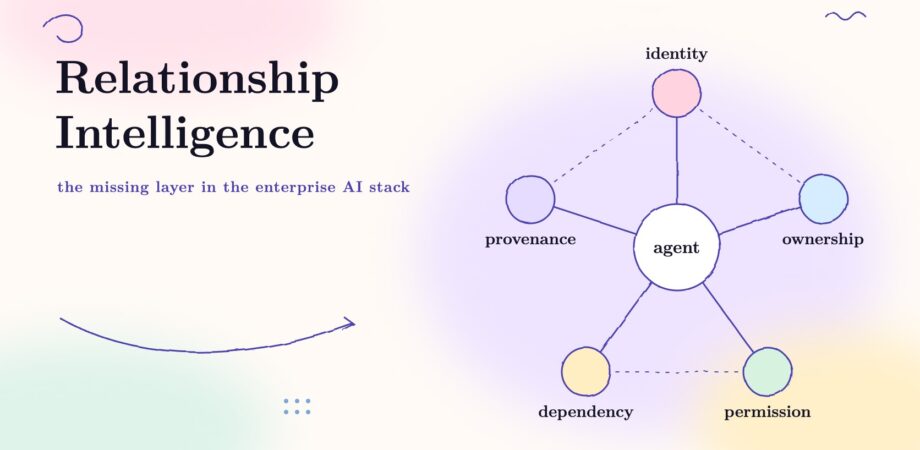
Most enterprise AI failures are not model failures. They are relationship failures.
The agent cannot tell which customer record is canonical. It does not know who owns a policy, whether a user has access to a document, what downstream systems a change will affect, or where a recommendation actually came from. Bigger models do not solve that. Longer context windows do not solve that. Relationship intelligence does.
The pattern is consistent: teams invest in foundation models, vector databases, and orchestration frameworks, then discover that their agents still hallucinate, violate access boundaries, or produce answers nobody can trace. The model is not broken. It was never given the relationships it needed to reason correctly.
This post makes the case for that layer and how to build it without trying to graph everything.
Why More Context Is Not the Answer
Longer context windows and bigger RAG pipelines solve retrieval problems. They do not solve relationship problems. A 200,000-token window cannot tell an agent which of three “Acme Corp” records is canonical, whether a user’s project assignment still entitles them to a document, or which workflows a policy change will break. We covered this argument in detail in the context layer reference. The short version: context windows hold text, not structured business relationships. The infrastructure that fills that gap is what this post is about.
Why Vector Search Cannot Supply Enterprise Context
Vector search is useful. It retrieves semantically relevant text at scale, handles unstructured content well, and integrates cleanly into most AI pipelines. For many retrieval tasks, it is the right tool.
But vector search is a similarity engine. It finds text that resembles the query. It does not model the relationships that govern how a business actually works.
Consider what an enterprise AI agent needs to do its job correctly:
- Resolve identity: Are “Acme Corp,” “Acme Corporation,” and “ACME” the same entity? Which record is canonical?
- Check permissions: Can this user, in this role, on this project, access this document right now?
- Establish ownership: Who is responsible for this data asset, this policy, this service?
- Trace dependencies: If this API changes, which services, teams, and downstream processes are affected?
- Verify provenance: Where did this fact come from, and through what chain of transformations did it arrive here?
Vector search cannot answer any of these questions reliably. It can retrieve documents that mention permissions, ownership, or provenance. It cannot enforce them, traverse them, or guarantee their accuracy at query time.
Semantic similarity and structured relationship traversal are different operations. The enterprise AI stack needs both, and most teams have only built one.
The FalkorDB GraphRAG benchmark shows a 16-point overall gap in favor of graph-based retrieval, with the largest advantages on contextual summarization and creative generation tasks.
The Five Relationships Every Enterprise Agent Must Understand
Relationship intelligence is not about graphing everything in the enterprise. It is about modeling the specific relationships that determine whether an agent can act correctly, safely, and accountably. There are five of them.
Identity
Every enterprise has duplicate records. Customers appear in multiple systems under slightly different names. Employees have records in HR, IAM, and CRM that may or may not agree. Vendors exist in procurement, finance, and legal databases as separate entities.
An agent that cannot resolve identity to a canonical node makes decisions based on incomplete or conflicting information. Identity resolution is a graph problem: model the same-as relationships between records and query the canonical node.
Ownership
Every data asset, policy, service, and business process has an owner. Ownership determines who can authorize changes, who receives notifications, and who is accountable when something goes wrong.
An agent that does not understand ownership cannot route decisions correctly, cannot identify the right human to involve, and cannot produce an audit trail that assigns accountability.
Permission
Access control in enterprise AI is more complex than role-based access control handles. A user’s permission to access a record often depends not just on their job title but on their current project assignment, their relationship to the record’s owner, the data sensitivity classification, and the specific action being taken.
An agent that cannot evaluate permission at query time is a data-leakage risk. Permission is a graph traversal: does a valid path exist between this user and this resource through the current set of active relationships?
Dependency
Enterprise systems are deeply interconnected. A change to one service affects downstream consumers. A policy update ripples through workflows. A personnel change affects access, ownership, and approval chains.
An agent that does not understand dependencies will propose changes that break things it cannot see. Dependency is a directed graph: nodes are systems, services, teams, and processes; edges are the connections between them.
Provenance
Every fact an agent uses has a history. It came from a source, passed through transformations, was asserted by someone, and was valid as of a particular time.
An agent that cannot trace provenance cannot be audited. It cannot explain why it made a recommendation, identify when a fact became stale, or be corrected when its knowledge is wrong.
These five relationships are not optional for enterprise AI. They are the difference between an agent that can be trusted in a consequential workflow and one that cannot.
From Knowledge Graphs to Relationship Intelligence
A traditional knowledge graph models what exists: entities, attributes, and the stable relationships between them. It is updated periodically and queried for lookups and discovery. Useful, but not sufficient for live agent systems.
Relationship intelligence is an operational layer. It combines three things that most teams have been treating as separate problems:
| Layer | What it models | Update frequency |
|---|---|---|
| Knowledge graph | Entities, attributes, stable relationships | Hours to days |
| Context graph | Agent decisions, events, handoffs, outcomes | Real-time |
| Provenance graph | Sources, transformations, assertion history | Continuous |
The knowledge graph tells an agent what the business looks like. The context graph tells the agent what is happening right now. The provenance graph tells the agent where every fact came from and whether it can be trusted.
According to Gartner predictions as reported by Atlan, more than 50% of AI agent systems will leverage context graphs by 2028, context engineering features will be built into 80% of AI-building tools by the same year, and context engineering improvements will raise agentic AI accuracy by at least 30%. The market is moving toward more sophisticated context infrastructure, not just more sophisticated models.
The practical implication: the graph is no longer a separate analytics system. It is the operational backbone of agent behavior. Agents read from it to retrieve governed context. They write back to it to create auditable records of every consequential action.
This is what enterprise AI agents actually need: not a bigger context window, but a live, queryable, governed relationship layer that persists across sessions, enforces access boundaries, and produces an inspectable record of why an agent did what it did.
Where to Start
The instinct to graph everything is wrong. It produces expensive, slow-to-maintain structures that teams abandon before they deliver value.
Start with your most expensive AI failure mode and identify the relationship type behind it.
If agents produce answers that cannot be traced to sources, start with provenance. If agents surface data that users should not see, start with permissions. If agents propose policy changes that break downstream approval workflows, start with dependencies. If support agents give contradictory answers because they cannot resolve duplicate customer records, start with identity.
In each case, the graph you need is small, focused, and high-value. You do not need to model every entity in the enterprise. You need to model the relationships behind the specific failure you are trying to fix.
A practical starting framework:
- Name one AI failure mode that is costing you time, accuracy, or trust.
- Identify the relationship type behind it: identity, ownership, permission, dependency, or provenance.
- Model a minimal set of entities and edges that cover that relationship.
- Attach provenance and access rules from the first commit.
- Measure whether graph-grounded retrieval improves the outcome before expanding.
The graphs that hold up in production are the focused ones: built around the relationships that matter, not everything that could be modeled.
FalkorDB runs graph traversal and vector search in one engine, and the GraphRAG SDK builds on both. You can store provenance as nodes and edges in the same graph, so retrieved facts trace back to their source without a separate audit system.