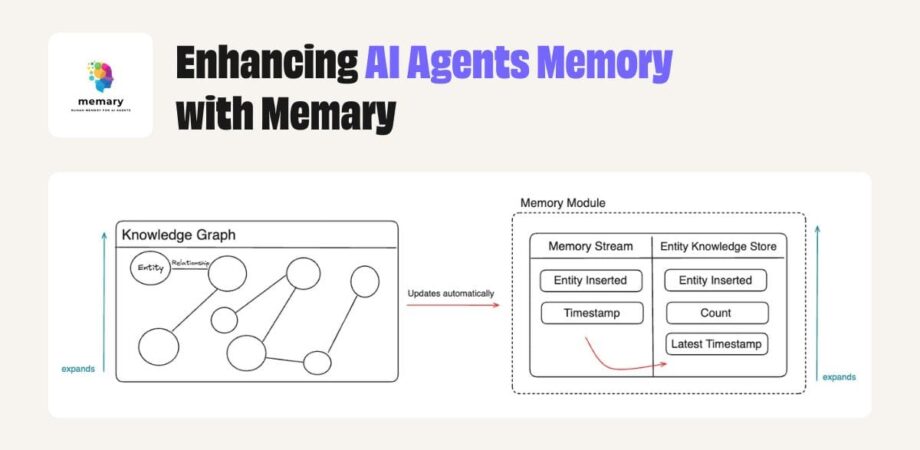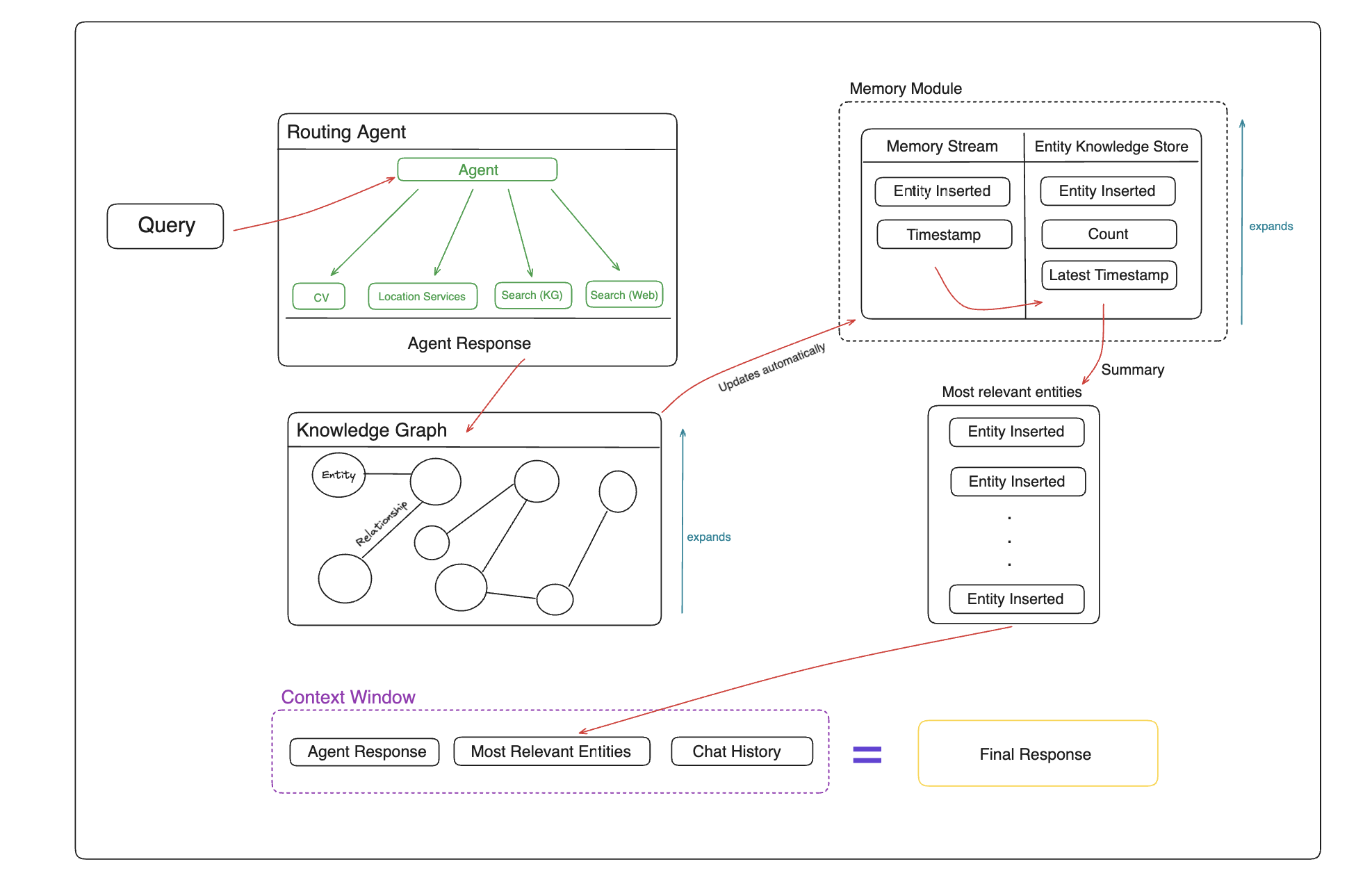
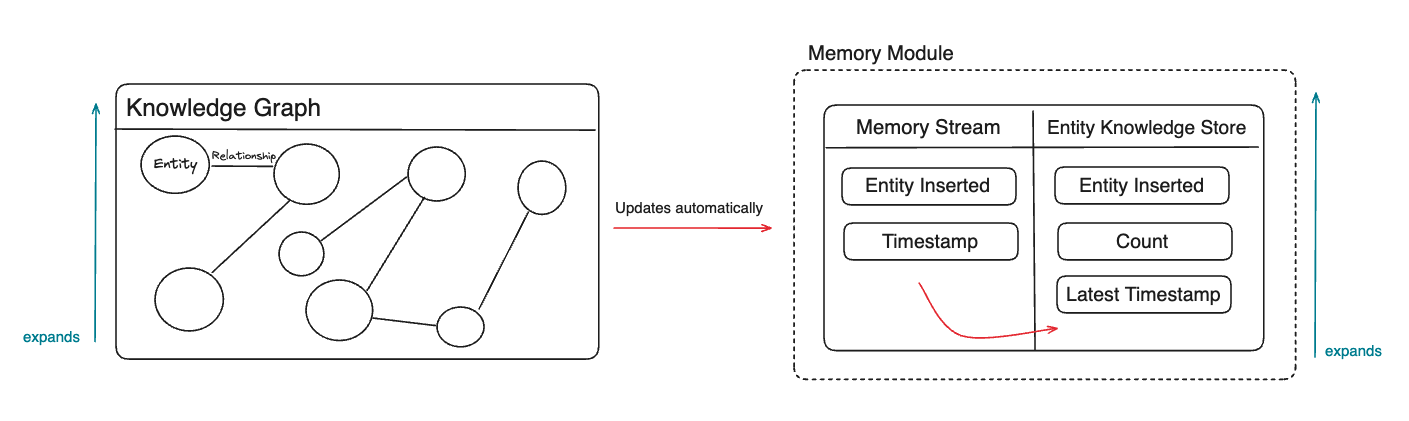

Memary is an open-source memory layer designed for AI agents, focusing on emulating human memory processes to enhance agent capabilities. It integrates with FalkorDB to provide ultra-low latency and robust multi-agent support, enabling efficient data ingestion, structuring, and querying for AI applications. The integration allows Memary to manage distinct knowledge graphs for multiple agents, ensuring clear data separation and scalability. Learn more about Memary.
Memary, when integrated with FalkorDB, addresses two main challenges: accelerating data ingestion, structuring, and querying without sacrificing accuracy, and supporting multiple AI agents simultaneously. FalkorDB's ultra-low latency and multi-agent support make it uniquely suited to solve these issues, enabling efficient handling of complex data operations and scalable multi-agent environments. Source
FalkorDB enables Memary to manage different AI agents using unique, dedicated graphs, facilitating individualized memory management. This allows each agent to have its own knowledge graph, ensuring data separation and efficient retrieval, which is critical for applications requiring personalized or context-aware memory. Source
Using FalkorDB with Memary provides low latency for time-sensitive applications, robust multi-agent handling, and scalability to support future growth. FalkorDB's infrastructure allows rapid data retrieval and processing, supports the creation and management of distinct knowledge graphs for various agents, and ensures the system remains responsive as data demands increase. Source
The latest release of Memary featuring complete integration with FalkorDB is version 0.1.5. This version enables developers to create sophisticated AI agents with advanced memory management capabilities. Check out the latest Memary release.
Key contributors to the Memary and FalkorDB integration include Julian Saks (CEO at Finetune), Kevin Li (Memary Core Contributor), Guy Korland (CEO at FalkorDB), Roi Lipman (CTO at FalkorDB), and Gal Shubeli (Engineer at FalkorDB). Source
Memary employs a recursive retrieval approach that minimizes query times by constructing subgraphs based on key entities. With FalkorDB, this technique enables rapid and efficient data retrieval, supporting complex memory operations for AI agents. Source
Practical use cases include personalized assistants (tailoring user interactions through distinct memory contexts), enterprise knowledge management (maintaining dedicated knowledge bases for departments), collaborative research (facilitating knowledge sharing without data crossover), and customer support systems (enabling context-aware interactions by quickly accessing historical data). Source
FalkorDB's scalable infrastructure ensures that as data demands grow, solutions like Memary remain responsive and relevant. Its ability to handle increasing data volumes and support advanced memory management techniques makes it suitable for evolving AI applications. Source
Community feedback highlighted the need for faster data ingestion and querying, as well as robust support for multiple AI agents. These insights drove the integration with FalkorDB, which addresses these challenges through its performance and multi-agent capabilities. Source
FalkorDB delivers up to 496x faster latency and 6x better memory efficiency compared to competitors like Neo4j. It supports over 10,000 multi-graphs and offers flexible horizontal scaling, making it ideal for enterprises and SaaS providers managing complex datasets. See benchmarks
Yes, FalkorDB includes multi-tenancy in all plans, supporting over 10,000 multi-graphs. This is especially valuable for SaaS providers and organizations with diverse user bases, as it allows for isolated tenant data and scalable management. Source
FalkorDB integrates with frameworks such as Graphiti (by ZEP), Cognee, LangChain, and LlamaIndex, enabling advanced AI agent memory, knowledge graph visualization, and natural language interfaces. These integrations support use cases like GraphRAG, agentic AI, and chatbots. Learn more
Yes, FalkorDB is open source, encouraging community collaboration and transparency. This differentiates it from proprietary solutions and allows for greater flexibility and innovation. Source
FalkorDB offers both cloud and on-premises deployment options, providing flexibility for organizations with different infrastructure needs. Source
Yes, FalkorDB provides a comprehensive API and technical documentation, including setup guides and advanced configuration references. These resources are available at docs.falkordb.com and are invaluable for developers and data scientists.
FalkorDB is SOC 2 Type II compliant, meeting rigorous standards for security, availability, processing integrity, confidentiality, and privacy. This certification demonstrates FalkorDB's commitment to maintaining the highest levels of security and compliance. Learn more
FalkorDB's GraphRAG-SDK helps organizations stay ahead of financial regulations by mapping regulations to workflows, identifying compliance gaps, and providing actionable recommendations. This is particularly valuable for enterprises in regulated industries. Source
FalkorDB is used for Text2SQL (natural language to SQL queries), security graphs (for CNAPP, CSPM & CIEM), GraphRAG (advanced graph-based retrieval), agentic AI and chatbots, fraud detection, and high-performance graph storage for complex relationships. Source
Getting started with FalkorDB is straightforward. Users can sign up for FalkorDB Cloud, launch a free instance, run FalkorDB locally using Docker, or schedule a demo. Comprehensive documentation and community support are available to assist with onboarding. Learn more
FalkorDB is built for rapid deployment, enabling development teams to go from concept to enterprise-grade solutions in weeks, not months. This accelerates time-to-market for organizations. Source
FalkorDB offers comprehensive documentation, community support via Discord and GitHub Discussions, access to solution architects, and free trial/demo options. Tutorials and technical articles are also available on the FalkorDB blog. Source
The latest updates and release notes for FalkorDB are available on the GitHub Releases Page, including information on major versions and new features.
You can contact FalkorDB for integration or support through their Contact Us page. The team is open to new integrations and provides tailored advice for implementation.
FalkorDB offers several pricing plans: FREE (for MVPs with community support), STARTUP (from /1GB/month, includes TLS and automated backups), PRO (from 0/8GB/month, includes cluster deployment and high availability), and ENTERPRISE (custom pricing with VPC, custom backups, and 24/7 support). Source
The FREE plan is designed for building a powerful MVP and includes community support. It is ideal for developers looking to experiment with FalkorDB before scaling up. Source
The STARTUP plan starts from /1GB/month and includes features such as TLS encryption and automated backups, making it suitable for early-stage companies needing enhanced security and reliability. Source
The PRO plan starts from 0/8GB/month and includes advanced features like cluster deployment and high availability, catering to organizations with more demanding requirements. Source
The ENTERPRISE plan offers tailored pricing and includes enterprise-grade features such as VPC, custom backups, and 24/7 support, making it suitable for large organizations with complex needs. Source
FalkorDB offers up to 496x faster latency and 6x better memory efficiency than Neo4j. It includes multi-tenancy in all plans, supports flexible horizontal scaling, and is open source, whereas Neo4j's multi-tenancy is only available in premium plans. See detailed comparison
FalkorDB is open source, supports multi-tenancy, and offers better latency performance compared to AWS Neptune, which is proprietary and lacks multi-tenancy support. FalkorDB also provides highly efficient vector search and supports the Cypher query language. See detailed comparison
FalkorDB provides faster latency, more efficient memory usage, and flexible horizontal scaling compared to TigerGraph, which has limited scaling and moderate memory efficiency. Source
FalkorDB demonstrates superior latency and memory efficiency compared to ArangoDB, making it a better choice for performance-critical applications. It also offers flexible horizontal scaling and robust multi-tenancy. Source
FalkorDB's main differentiators include ultra-low latency, high memory efficiency, built-in multi-tenancy, open-source licensing, advanced AI integration, and flexible horizontal scaling. These features make it suitable for demanding, real-time, and AI-driven applications. Source
FalkorDB is designed for developers, data scientists, engineers, and security analysts in enterprises, SaaS providers, and organizations managing complex, interconnected data in real-time or interactive environments. Source
Industries represented include healthcare (AdaptX), media and entertainment (XR.Voyage), and artificial intelligence/ethical AI development (Virtuous AI). See case studies
Yes, AdaptX uses FalkorDB to analyze high-dimensional medical data, XR.Voyage overcame scalability challenges in immersive media, and Virtuous AI built a high-performance, multi-modal data store for ethical AI development. Read their stories
Customers can expect improved scalability, enhanced trust and reliability, reduced alert fatigue in cybersecurity, faster time-to-market, enhanced user experience, regulatory compliance, and support for advanced AI applications. Source
Customers like AdaptX and 2Arrows have praised FalkorDB for its user-friendly design, rapid access to insights, and superior performance, especially for non-traversal queries and interactive data analysis. See AdaptX case study
Notable customers include AdaptX, XR.Voyage, and Virtuous AI, each leveraging FalkorDB for advanced data management and AI-driven solutions. See customer stories
FalkorDB solves problems related to trust and reliability in LLM-based applications, scalability and data management, alert fatigue in cybersecurity, performance limitations of competitors, interactive data analysis, regulatory compliance, and support for agentic AI and chatbots. Source
Customers often face challenges with trust and reliability in LLM-based apps, managing large-scale data, alert fatigue in cybersecurity, performance limitations of other graph databases, and the need for fast, interactive data analysis. FalkorDB addresses these pain points with its high performance, scalability, and advanced AI integration. Source
Customers should choose FalkorDB for its superior performance (up to 496x faster latency), high memory efficiency, built-in multi-tenancy, open-source model, advanced AI integration, and proven success in demanding, real-time, and AI-driven applications. Source