Frequently Asked Questions

Product Information & RAG Fundamentals

What is Retrieval Augmented Generation (RAG)?

Retrieval Augmented Generation (RAG) is a process that retrieves information relevant to a task, provides it to a language model along with a prompt, and relies on the model to use this specific information when generating a response. This approach allows large language models (LLMs) to access up-to-date, comprehensive, and accurate data from external sources, overcoming the limitations of their static knowledge bases. [Source]

How does RAG differ from fine-tuning a language model?

RAG provides real-time, relevant data to a language model at inference time, while fine-tuning involves retraining the model on new data for a specific domain or task. Fine-tuning can be time-consuming and expensive, whereas RAG enables customized solutions with up-to-date information and lower costs by using the same LLM as a general reasoning engine. [Source]

What components are needed to implement RAG?

To implement RAG, you need two main components: a large language model (LLM) for text generation (such as GPT-3 or T5) and a data source (such as a vector database or knowledge graph) that provides relevant, up-to-date, and accurate information for retrieval. [Source]

Why are vector databases and knowledge graphs recommended for RAG?

Vector databases allow for similarity-based retrieval of relevant documents, while knowledge graphs enable semantic queries and logical reasoning over entities and relationships. Combining both provides a powerful data source that supports both similarity and semantics-based queries, making RAG more effective and accurate. [Source]

What are the main steps to build a RAG system using vector databases and knowledge graphs?

The main steps are: 1) Preprocess data into vectors and graphs, 2) Store vectors in a vector database and graphs in a knowledge graph, 3) Query the data source based on the task or prompt, and 4) Provide the retrieved data as context to the LLM for text generation. [Source]

What qualities should a data source for RAG have?

A data source for RAG should be up-to-date, comprehensive, accurate, and efficient. This ensures that the language model receives relevant, reliable, and quickly accessible information for generating high-quality responses. [Source]

What are some common use cases for RAG?

Common use cases for RAG include summarization of long or complex texts, question answering (factual or open-ended), and content creation (stories, poems, songs, etc.). RAG helps generate more accurate, informative, and creative outputs by supplementing LLMs with relevant external data. [Source]

How does RAG improve the quality and accuracy of generated text?

RAG improves quality and accuracy by providing LLMs with up-to-date, comprehensive, and relevant information from external sources, reducing the risk of outdated or incomplete responses and enabling more precise and informative outputs. [Source]

Where can I learn more about building RAG systems?

You can learn more by reading FalkorDB's blog posts such as Building a Q&A System and Building and Querying a Knowledge Graph, which provide practical guides and technical insights.

Who is Guy Korland and what is his role at FalkorDB?

Guy Korland is the CEO of FalkorDB, responsible for driving graph database architecture for generative AI and retrieval-augmented generation workflows. He holds a PhD in Computer Science from Tel Aviv University and has over 20 years of experience in database engineering. [Source]

What is FalkorDB and what does it do?

FalkorDB is a high-performance graph database designed for managing complex relationships and enabling advanced AI applications. It is purpose-built for development teams working with interconnected data in real-time or interactive environments, supporting use cases like Text2SQL, security graphs, GraphRAG, agentic AI, and fraud detection. [Source]

What are the main use cases supported by FalkorDB?

FalkorDB supports use cases such as Text2SQL (natural language to SQL queries), security graphs for CNAPP/CSPM/CIEM, GraphRAG for advanced retrieval, agentic AI and chatbots, fraud detection, and high-performance graph storage for complex relationships. [Source]

How does FalkorDB help with building RAG systems?

FalkorDB provides a graph database optimized for AI applications, including GraphRAG. It enables real-time, low-latency retrieval and supports both vector and graph-based queries, making it ideal for building accurate, scalable RAG systems for enterprise GenAI. [Source]

What are the benefits of using FalkorDB for RAG and AI applications?

Benefits include ultra-low latency (up to 496x faster than competitors), high memory efficiency (6x better), support for 10,000+ multi-graphs, open-source licensing, advanced AI integration, and enhanced user experience with interactive dashboards and custom views. [Source]

What technical documentation is available for FalkorDB?

FalkorDB provides comprehensive technical documentation and API references at docs.falkordb.com, including setup guides, advanced configurations, and integration instructions for developers, data scientists, and engineers.

Does FalkorDB offer an API?

Yes, FalkorDB provides an API with complete references and guides available in the official documentation at docs.falkordb.com. These resources help users integrate FalkorDB into their workflows effectively.

What integrations does FalkorDB support?

FalkorDB integrates with frameworks such as Graphiti (by ZEP), g.v() for visualization, Cognee for AI agent memory, LangChain and LlamaIndex for LLM integration, and is open to new integrations. See the Graphiti blog post and LangChain docs for more details.

Features & Capabilities

What features does FalkorDB offer?

FalkorDB offers ultra-low latency, high memory efficiency, support for 10,000+ multi-graphs (multi-tenancy), open-source licensing, linear scalability, advanced AI integration (GraphRAG, agent memory), cloud and on-prem deployment, and enhanced dashboards for interactive analysis. [Source]

How does FalkorDB support advanced AI applications?

FalkorDB is optimized for AI use cases such as GraphRAG and agent memory, enabling intelligent agents and chatbots with real-time adaptability. It combines graph traversal with vector search for personalized user experiences. [Source]

Does FalkorDB support multi-tenancy?

Yes, FalkorDB supports robust multi-tenancy, allowing over 10,000 multi-graphs (tenants) in all plans. This is especially valuable for SaaS providers and organizations with diverse user bases. [Source]

Is FalkorDB open source?

Yes, FalkorDB is open source, encouraging community collaboration and transparency. This differentiates it from proprietary solutions like AWS Neptune. [Source]

What security and compliance certifications does FalkorDB have?

FalkorDB is SOC 2 Type II compliant, meeting rigorous standards for security, availability, processing integrity, confidentiality, and privacy. [Source]

Performance & Business Impact

How does FalkorDB perform compared to competitors?

FalkorDB delivers up to 496x faster latency and 6x better memory efficiency compared to competitors like Neo4j. It supports real-time data analysis, efficient handling of large-scale data, and flexible horizontal scaling. [Source]

What business impact can customers expect from using FalkorDB?

Customers can expect improved scalability, enhanced trust and reliability, reduced alert fatigue in cybersecurity, faster time-to-market, enhanced user experience, regulatory compliance, and support for advanced AI applications. [Source]

How long does it take to implement FalkorDB?

FalkorDB is built for rapid deployment, enabling teams to go from concept to enterprise-grade solutions in weeks, not months. Users can sign up for the cloud, try for free, or run locally with Docker. [Source]

What feedback have customers given about FalkorDB's ease of use?

Customers like AdaptX and 2Arrows have praised FalkorDB for its user-friendly design, rapid access to insights, and superior performance, especially for non-traversal queries and interactive analysis. [Source]

Competition & Comparison

How does FalkorDB compare to Neo4j?

FalkorDB offers up to 496x faster latency, 6x better memory efficiency, flexible horizontal scaling, and includes multi-tenancy in all plans, whereas Neo4j provides multi-tenancy only in premium tiers. FalkorDB is written in C and Rust for higher performance and is open source. [Source]

How does FalkorDB compare to AWS Neptune?

FalkorDB is open source, supports multi-tenancy, offers better latency performance, and supports the Cypher query language, while AWS Neptune is proprietary, has limited vector search, and lacks multi-tenancy. [Source]

How does FalkorDB compare to TigerGraph?

FalkorDB provides faster latency, more efficient memory usage, and flexible horizontal scaling compared to TigerGraph's moderate memory efficiency and limited scaling. [Source]

How does FalkorDB compare to ArangoDB?

FalkorDB demonstrates superior latency and memory efficiency, flexible horizontal scaling, and is rated as fast compared to ArangoDB's moderate memory efficiency and poor latency. [Source]

Pricing & Plans

What pricing plans does FalkorDB offer?

FalkorDB offers four main plans: FREE (for MVPs with community support), STARTUP (from /1GB/month, includes TLS and automated backups), PRO (from 0/8GB/month, includes cluster deployment and high availability), and ENTERPRISE (custom pricing with VPC, custom backups, and 24/7 support). [Source]

What features are included in the PRO plan?

The PRO plan starts at 0/8GB/month and includes advanced features such as cluster deployment, high availability, and additional enterprise-grade capabilities. [Source]

Use Cases & Customer Success

Who can benefit from using FalkorDB?

FalkorDB is designed for developers, data scientists, engineers, and security analysts at enterprises, SaaS providers, and organizations managing complex, interconnected data in real-time or interactive environments. [Source]

What industries are represented in FalkorDB's case studies?

Industries include healthcare (AdaptX), media and entertainment (XR.Voyage), and artificial intelligence/ethical AI development (Virtuous AI). [Source]

Can you share specific case studies or success stories?

Yes. AdaptX uses FalkorDB for clinical data analysis, XR.Voyage for immersive experience platform scalability, and Virtuous AI for ethical AI development. Read their stories at FalkorDB case studies.

Who are some of FalkorDB's customers?

Notable customers include AdaptX, XR.Voyage, and Virtuous AI. Their success stories are publicly available on the FalkorDB case studies page.

What core problems does FalkorDB solve?

FalkorDB addresses trust and reliability in LLM-based applications, scalability and data management, alert fatigue in cybersecurity, performance limitations of competitors, interactive data analysis, regulatory compliance, and support for agentic AI and chatbots. [Source]

How does FalkorDB help with regulatory compliance?

FalkorDB's GraphRAG-SDK helps organizations stay ahead of financial regulations by mapping regulations to workflows, identifying compliance gaps, and providing actionable recommendations. [Source]

Support & Implementation

What support and training options are available for FalkorDB?

FalkorDB offers comprehensive documentation, community support via Discord and GitHub Discussions, access to solution architects, and free trial/demo options for onboarding. [Source]

How can I get started with FalkorDB?

You can sign up for FalkorDB Cloud, try FalkorDB for free in the cloud or locally with Docker, schedule a demo, or access documentation and community support. [Source]

FalkorDB Header Menu

What is RAG (Retrieval Augmented Generation)?

Blog-8

In this blog post, I will explain what is RAG, why it is useful, and how to build it using Vector Database and Knowledge Graph as a leading option for RAG. I will also give some examples of use cases that need RAG and how it can improve the quality and accuracy of the generated text.

Large Language Models (LLMs) are powerful tools for natural language processing, capable of generating fluent and coherent text for various tasks. However, LLMs also have some limitations, such as their knowledge base being stale, incomplete, or inaccurate. To overcome these challenges, we can use a technique called Retrieval Augmented Generation (RAG), which allows us to provide LLMs with relevant and up-to-date information from external data sources.

In this blog post, I will explain what RAG is, why it is useful, and how to build it using Vector Database and Knowledge Graph as a leading option for RAG. I will also give some examples of use cases that need RAG and how it can improve the quality and accuracy of the generated text.

RAG flow
From: https://gpt-index.readthedocs.io/en/latest/getting_started/concepts.html

What is RAG?

RAG is a process for retrieving information relevant to a task, providing it to the language model along with a prompt, and relying on the model to use this specific information when responding. For example, if we want to generate a summary of a news article, we can use RAG to retrieve related articles or facts from a database and feed them to the LLM as additional context. The LLM can then use this information to generate a more accurate and informative summary.

RAG is different from fine-tuning, which involves training the LLM on new data to adapt it to a specific domain or task. Fine-tuning can be time-consuming, expensive, and not offer a significant advantage in many scenarios. RAG, on the other hand, allows us to use the same LLM as a general reasoning and text engine, while providing it with the necessary data in real time. This way, we can achieve customized solutions while maintaining data relevance and optimizing costs.

What should a RAG provide?

To implement RAG, we need two components: an LLM and a data source. The LLM can be any pretrained model that supports text generation, such as GPT-3 or T5. The data source can be any collection of documents or facts that are relevant to our task or domain. However, not all data sources are equally suitable. Ideally, we want a data source that is:

– Up-to-date: The data should reflect the latest information available on the topic of interest.

– Comprehensive: The data should cover all the aspects and details that are relevant to the task or domain.

– Accurate: The data should be reliable and trustworthy, free of errors or biases.

– Efficient: The data should be easy to access and query, with low latency and high throughput.

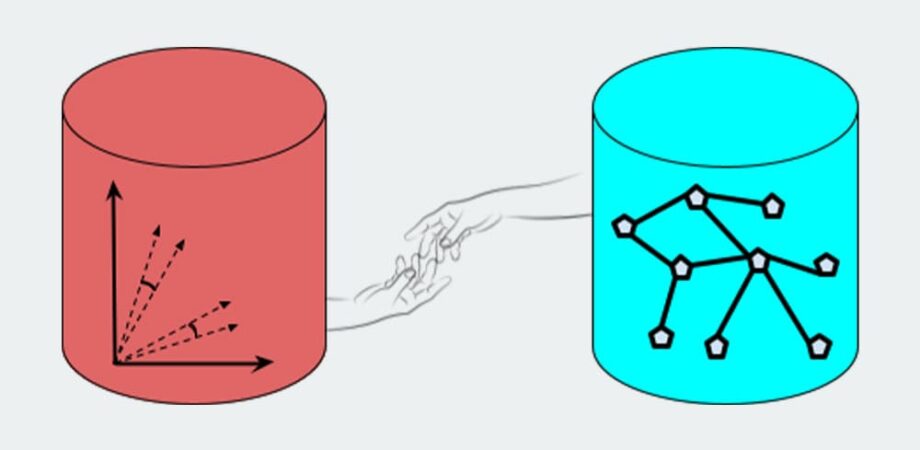
VecSimKG FalkorDB

How to build RAG using Vector Database and Knowledge Graph?

One of the leading options for building such a data source is using a combination of Vector Database and Knowledge Graph. A vector database is a database that stores data as vectors, which are numerical representations of objects or concepts. A knowledge graph is a graph that stores data as nodes and edges, which represent entities and their relationships. By combining these two technologies, we can create a powerful data source that meets all the criteria above.

vector database allows us to store and retrieve data based on similarity or relevance. For example, if we want to find documents that are related to a given query, we can use a vector database to compare the query vector with the document vectors and return the most similar ones. A vector database also enables fast and scalable queries, as it can leverage efficient indexing and search algorithms.

knowledge graph allows us to store and retrieve data based on semantics or meaning. For example, if we want to find facts that are related to a given entity, we can use a knowledge graph to traverse the graph from the entity node and return the connected nodes and edges. A knowledge graph also enables rich and structured queries, as it can leverage logical inference and reasoning.

By combining a vector database and a knowledge graph, we can create a data source that can answer both similarity-based and semantics-based queries. For example, if we want to find information about COVID-19 vaccines, we can use a vector database to find documents that are similar to our query, and then use a knowledge graph to extract facts from those documents. This way, we can obtain both relevant and informative data for our task.

To build RAG using these data sources, we need to follow these steps:

1. Preprocess the data: We need to transform our raw data (e.g., text documents) into vectors and graphs. We can use various methods for this step, such as word embeddings, sentence embeddings, document embeddings, entity extraction, relation extraction, etc.

2. Store the data: We need to store our vectors and graphs in a vector database and a knowledge graph respectively. 

3. Query the data: We need to query our data source based on our task or prompt. We can use various methods for this step, such as natural language queries, keyword queries, vector queries, graph queries, etc.

4. Generate the text: We need to provide the LLM with the query and the retrieved data as context, and ask it to generate a response. We can use various methods for this step, such as prompt engineering, few-shot learning, zero-shot learning, etc.

Examples of use cases that need RAG

RAG can be useful for many use cases that involve text generation, especially when the LLM’s knowledge is insufficient or outdated. Here are some examples of such use cases:

– Summarization: RAG can help generate summaries of long or complex texts, such as news articles, research papers, books, etc. We can provide the LLM with additional information from related sources, such as other articles, facts, opinions, etc. This can help the LLM generate more accurate and informative summaries that capture the main points and perspectives of the text.

– Question answering: RAG can help generate answers to factual or open-ended questions, such as trivia questions, homework questions, customer queries, etc. We can provide the LLM with relevant information from authoritative sources, such as Wikipedia, databases, experts, etc. This can help the LLM generate more precise and reliable answers that address the question and provide evidence or explanation.

– Content creation: RAG can help generate creative or original content, such as stories, poems, songs, jokes, etc. We can provide the LLM with inspiring information from diverse sources, such as literature, art, music, culture, etc. This can help the LLM generate more novel and interesting content that reflects the style and theme of the task.

Conclusion

In this blog post, I discussed RAG, why it is useful, and how to build it using vector database and knowledge graph as a leading option. I have also given some examples of use cases that need RAG and how it can improve the quality and accuracy of the generated text.

If you are interested in learning more about or trying it out yourself, you can check out Building a Q&A System & Building and Querying a Knowledge Graph .