

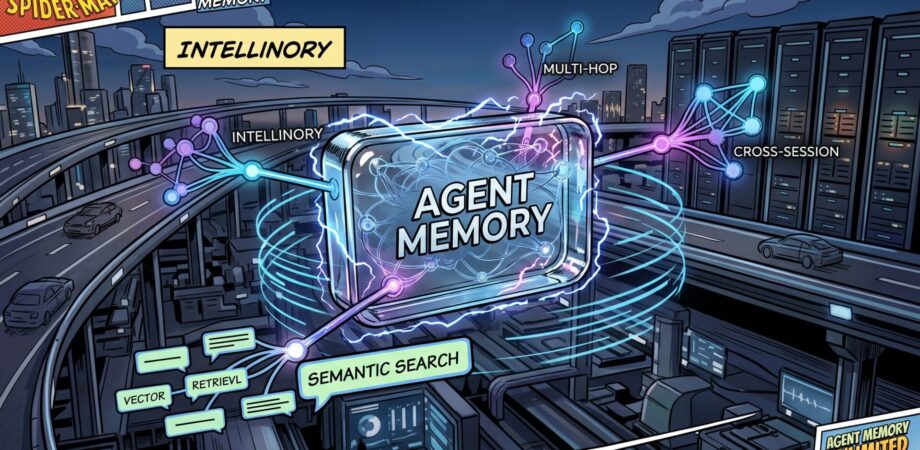
Your AI agent ships. Testing looks fine. Then production hits: multi-turn conversations degrade, the agent contradicts itself across sessions, and accuracy on anything relational collapses. The instinct is to blame the model. The real culprit is almost always the retrieval architecture underneath it.
The core problem is relational recall failure, not raw speed. Lettria, a knowledge graph vendor and AWS Partner, benchmarked graph-structured RAG against vector-only retrieval across four domain corpora (financial filings, COVID vaccine studies, aeronautical specifications, and EU environmental directives) and reported correctness improving from roughly 50% to above 80%. Those are document QA benchmarks rather than agent memory workloads, but the shape of the failing query is the same: multi-entity and relational. Microsoft’s GraphRAG evaluation (Edge et al., arXiv:2404.16130) shows the same pattern on complex, connected questions. Vector search wins on single-fact lookups. Graph wins on everything else.
This guide explains why vector RAG fails as agent memory, what a graph-based hybrid retrieval layer does differently, and how to implement one with FalkorDB.
Key takeaways
- Vector similarity search retrieves similar text. It does not retrieve connected facts.
- Multi-hop queries, the kind agents make constantly, require graph traversal to answer correctly.
- Graph retrieval costs more per query than vector lookup and underperforms on single-hop fact retrieval. The hybrid router exists to pay that cost only where it pays off.
- Hybrid retrieval (vector for semantic discovery + graph for relational context) is the production-grade default.
- FalkorDB combines both in a single Redis-based in-memory store: OpenCypher graph traversals plus native vector similarity search, with no network hop between the two operations.
Why Vector RAG Was Never Designed to Be Agent Memory
Retrieval-augmented generation was designed to answer questions from a static knowledge base. The pattern is simple: embed a query, find the most similar text chunks, inject them into the prompt. For document Q&A, it works well enough.
Agent memory is a fundamentally different problem. Agents make dozens of retrieval calls per user interaction. They need to recall not just similar text but connected facts: what decision was made in session 3, which entity was involved, what changed since then, and how those facts relate to the current step. Vector search has no concept of relationship. It retrieves by proximity, not by structure.
The three failure modes vector-only retrieval produces
1. Multi-hop accuracy collapse. Ask your agent a question that requires connecting two or three prior facts and vector retrieval degrades sharply on multi-entity queries. Microsoft’s GraphRAG research (Edge et al., 2024) shows community-based graph retrieval substantially outperforms vector-only baselines on complex, global sensemaking questions. The gap compounds with every relational hop.
2. Relational amnesia across sessions. Vector stores treat each memory as an independent embedding. There is no edge between “User A approved Budget V2” and “Budget V2 replaced Budget V1 after Agent B’s objection.” The agent can retrieve both facts but cannot reason about how they connect. Over a multi-session workflow, this produces contradictions and context drift.
3. Retrieval calls that accumulate. Agents issue far more retrieval calls than human users, often several per reasoning step. The problem is not any single lookup’s latency; it is that every wrong-context result forces additional calls to recover. Graph traversal costs more per query than a vector index lookup, which is exactly why the hybrid router in this architecture escalates to graph only when relational signals demand it.
A 2025 systematic evaluation of RAG vs. GraphRAG puts it plainly: “RAG excels at single-hop, detail-oriented retrieval, while GraphRAG shines in multi-hop reasoning.” The failure mode is architectural, not a model capability gap.
The diagnostic test is straightforward: ask your agent a question that requires connecting information from two or three distinct prior exchanges. If accuracy degrades noticeably compared to single-source queries, you have a retrieval architecture problem, not a model problem.
How Graph Memory Fixes the Retrieval Problem
Graph-based memory stores conversational context as nodes and edges, not flat text. Each entity becomes a node. Each relationship between entities becomes a typed, directional edge. Retrieval is traversal: the agent follows edges to assemble multi-hop context in a single query pass.
The structural difference matters because it maps to how agents actually reason. An agent tracking a multi-session sales workflow does not need “text similar to this query.” It needs: “who approved this, what changed since the last session, and which prior decisions are still active.” That is a graph traversal, not a cosine similarity search.
What graph memory enables that vector search cannot
| Capability | Vector-only | Graph-based |
|---|---|---|
| Single-fact semantic lookup | Strong | Moderate (use vector here) |
| Multi-hop relational queries | Degrades sharply | Strong |
| Cross-session entity tracking | Weak (independent embeddings) | Native (persistent nodes) |
| Relationship-aware context | None | Core feature |
| Multi-tenant isolation | Application-layer only | Graph-per-tenant keying |
The three memory tiers agents actually need
A production agent memory stack spans three layers, and graph handles two of them:
- Short-term working memory. The current conversation and active task context, living in the context window. Expires with the session. This is not a storage problem.
- Long-term relational memory. Entity facts, relationships, decisions made, and outcomes observed that persist across sessions. This is where graph wins, because the relationship is stored rather than inferred at query time.
- Semantic surface area. Unstructured content (documents, notes, transcripts) where fuzzy similarity search is the right tool. This is where vector search earns its keep.
The architecture that production fleets converge on is hybrid: graph carries structure, vector carries semantic surface area, both indexed by the same canonical entity IDs so a query can hop from one to the other.
The Hybrid Retrieval Architecture: How It Works in Practice
Hybrid retrieval is not two separate databases stitched together with application glue. Done correctly, it is a single retrieval layer where vector search and graph traversal share the same canonical entity IDs and escalate based on query type.
The routing logic follows a clear pattern. Simple semantic lookups, “find documents similar to this prompt,” go straight to vector search. The moment a query involves multiple entities or relational intent, it escalates to graph traversal. The router is what keeps graph cost proportional to the value it delivers: cheap lookups never pay for a traversal they do not need.
The five-step hybrid retrieval flow
- Classify the query. Count entities and detect relational intent before touching any store. A query referencing one entity is a vector lookup. A query referencing three or more entities with a relational verb is a graph traversal candidate.
- Run vector recall first. For single-fact lookups, vector search returns results fastest. This is the cheap, low-latency path.
- Escalate to graph traversal when needed. When entity count crosses three, or when the query asks “who,” “how,” or “what changed,” traverse the graph. This captures the relationships vector search drops.
- Fuse and re-rank the candidate set. Combine results from both stores, apply a cross-encoder re-ranker, and select the most contextually appropriate context for injection.
- Compress the winning context into the prompt window. Trim tokens before generation. Only inject what the current step actually needs.
What to write when a new artifact arrives
Every artifact an agent produces (a research note, a decision log, a session summary) should trigger three writes:
- Entity extraction. Parse the artifact for entities. Resolve them against the graph; create new nodes for new entities, merge into existing ones for known entities.
- Graph write. Add edges between the artifact node, the entities it references, the agent that produced it, and any prior artifacts it builds on.
- Vector write. Embed the full artifact text and write embeddings to the vector store with metadata containing the canonical entity IDs from the graph.
This bidirectional indexing is what makes retrieval fast in both directions: start in the graph to find structured relationships, end in vectors for context expansion. Or start in vectors for semantic discovery, end in the graph for structural enrichment.
The result: routing cheap queries to vectors and escalating only relational ones keeps median latency flat while concentrating graph cost on the queries where it actually changes the answer.
Implementing Agent Memory with FalkorDB
FalkorDB is purpose-built for this hybrid retrieval pattern. It is a Redis-based graph database that combines OpenCypher graph traversals with native vector similarity search in a single store, eliminating the integration overhead of running a separate graph database alongside a vector database. The architecture matters here: in-memory graph traversal and vector lookup happen in the same process, with no network hop between the two operations.
FalkorDB’s GraphRAG SDK provides a dedicated abstraction layer for building knowledge graphs from unstructured text and integrating graph-based reasoning into AI applications, without writing raw Cypher for every retrieval pattern.
Tenant isolation: pick this before you design the schema
FalkorDB’s multi-tenancy model isolates tenants at the graph level. Each tenant gets its own named graph within the same instance, with independent data, queries, and access controls. A query issued against one tenant’s graph cannot traverse into another tenant’s graph by construction. Multi-Graph and Graph Access Control are included on all tiers, including Free.
graph = falkor.select_graph(f"tenant_{tenant_id}")
That one line is the isolation boundary. Everything downstream is simpler for it, and the queries in this section assume it.
The alternative is a shared graph with a tenant_id property on every node and a filter on every pattern. It works, but it has two real costs. Every query becomes a place where an isolation bug can hide, and FalkorDB’s vector index does not combine well with property filters, so the vector recall step cannot be tenant-scoped inside the index call. Under graph-per-tenant, that limitation never comes up.
Setting up the graph schema for agent memory
The schema for agent memory follows a consistent pattern. Every context record should carry at minimum:
(Agent)-[:PRODUCED]->(Artifact)
(Artifact)-[:REFERENCES]->(Entity)
(Entity)-[:RELATED_TO]->(Entity)
(Session)-[:CONTAINS]->(Artifact)
(User)-[:HAS_SESSION]->(Session)
Each node carries agent_id, created_at, and confidence as mandatory properties. If you chose the shared-graph model above, add tenant_id to that list and treat it as non-nullable.
A graph traversal query
This pattern retrieves artifacts referencing a known entity and expands to related entities within two hops. A few notes on how it is written. OPTIONAL MATCH keeps artifacts whose entity has no neighbors, rather than silently dropping the row. collect(DISTINCT ...) prevents duplicate names arriving via multiple traversal paths. The undirected *1..2 expansion should be bounded tighter, or given a direction, on dense graphs where fanout is a concern.
MATCH (e:Entity {name: $entity_name})<-[:REFERENCES]-(a:Artifact)
OPTIONAL MATCH (e)-[:RELATED_TO*1..2]-(related:Entity)
WITH a, collect(DISTINCT related.name) AS context_entities
RETURN a.content, context_entities
ORDER BY a.created_at DESC
LIMIT 10
Note that a is carried into the aggregating WITH as a grouping key, which is what keeps ORDER BY a.created_at in scope after the collect(). Ordering on a property that is not projected or grouped is a common source of errors here.
On a shared graph, the same query needs the tenant filter applied to every matched node, not just the artifact:
MATCH (e:Entity {name: $entity_name, tenant_id: $tenant_id})<-[:REFERENCES]-(a:Artifact)
WHERE a.tenant_id = $tenant_id
OPTIONAL MATCH (e)-[:RELATED_TO*1..2]-(related:Entity)
WHERE related.tenant_id = $tenant_id
WITH a, collect(DISTINCT related.name) AS context_entities
RETURN a.content, context_entities
ORDER BY a.created_at DESC
LIMIT 10
Miss the filter on related and the query leaks entity names across tenants while still looking correct.
The hybrid query: vector search into graph traversal in one store
This is the pattern that eliminates the second database. FalkorDB’s vector index uses HNSW with either cosine similarity or euclidean distance, and db.idx.vector.queryNodes yields both the matched node and a score. That result feeds directly into a graph traversal in the same query.
Create the index first, with the dimension matching your embedding model:
CREATE VECTOR INDEX FOR (a:Artifact) ON (a.embedding)
OPTIONS {dimension: 1536, similarityFunction: 'cosine', M: 32, efConstruction: 200}
With a cosine index the score is a similarity, ranging from -1 to 1, where higher means more similar. ORDER BY score DESC therefore puts the best matches first. If you switch to euclidean, the score becomes a distance and the ordering reverses. Worth knowing before you copy this: efRuntime defaults to 10 candidates evaluated per search, so requesting k=10 sits at the floor. Raise efRuntime if recall is thin.
from falkordb import FalkorDB
from openai import OpenAI

falkor = FalkorDB(host="localhost", port=6379)
graph = falkor.select_graph(f"tenant_{tenant_id}")

openai_client = OpenAI()
query_text = "what did we decide about the budget last session?"
embedding = openai_client.embeddings.create(
    input=query_text, model="text-embedding-3-small"
).data[0].embedding

# Vector recall into graph traversal, single query, single store
hybrid_query = """
CALL db.idx.vector.queryNodes('Artifact', 'embedding', 10, vecf32($embedding))
YIELD node AS artifact, score
WITH artifact, score
ORDER BY score DESC
LIMIT 5
OPTIONAL MATCH (artifact)-[:REFERENCES]->(e:Entity)
OPTIONAL MATCH (e)-[:RELATED_TO*1..2]-(related:Entity)
WITH artifact, score,
     collect(DISTINCT e.name) AS entities,
     collect(DISTINCT related.name) AS related_entities
RETURN artifact.content AS context, score, entities, related_entities
ORDER BY score DESC
"""

results = graph.query(hybrid_query, {"embedding": embedding})
Three details in that query are easy to get wrong. score is carried through both WITH clauses so the final ORDER BY is legal and the ranking survives the aggregation; drop it from the second WITH and the rows come back in arbitrary order regardless of what you did upstream. The entity join uses OPTIONAL MATCH so a semantically relevant artifact is not discarded for lacking graph structure, which is exactly the artifact vector recall exists to find. And there is no similarity threshold, deliberately: the right cutoff depends on your corpus and embedding model, and returning score lets you calibrate one against real data rather than guessing.
Integrating with LangChain and LangGraph
FalkorDB integrates natively with LangChain and LangGraph, which means agent memory can be wired into existing LangGraph workflows without replacing the orchestration layer. The FalkorDB graph store acts as the persistent memory backend; LangGraph handles the agent state machine and tool routing above it.
FalkorDB also backs several dedicated agentic memory frameworks. Mem0 handles the memory management layer (entity extraction, conflict resolution, TTL-based forgetting) while FalkorDB stores the resulting graph and serves retrieval queries. The split works well for teams that want Mem0’s opinionated memory API without giving up control over the retrieval store. Cognee and Graphiti offer similar layering with different tradeoffs in how aggressively they structure incoming text.
Deployment options
| Option | Cloud providers | Notes |
|---|---|---|
| FalkorDB Cloud (managed) | AWS, GCP | All tiers. Azure is Enterprise BYOC only. |
| Self-hosted | AWS, GCP, Azure, on-prem | Full control, data residency |
| Snowflake Native App | Snowflake | Integrated with Snowflake compute |
FalkorDB’s free tier includes Multi-Graph, Multi-Tenancy, and Graph Access Control at no cost, on 100MB RAM. It is sufficient for prototyping and validating the hybrid retrieval architecture before committing to production infrastructure. The Startup tier starts at $73/month for 1GB. TLS, VPC, high availability, and cluster deployment require Startup or above. See the cloud tier documentation for a tier-by-tier breakdown.
One sizing note specific to this architecture: vector indexes are memory-intensive. A million vectors at 768 dimensions needs roughly 3GB, and the index documentation gives the formula. Budget for the embeddings, not just the graph.
When to Use Graph Memory and When Not To
Graph memory is not the right answer for every agent workload. The decision depends on the query shapes your agent actually produces.
Use graph memory when your agent needs to:
- Track relationships between entities across sessions (user profiles, organizational structures, decision histories)
- Answer multi-hop questions: “who approved this, and what changed since?”
- Maintain consistent context across long-running, multi-turn workflows
- Support multiple agents reading and writing to a shared context pool
- Enforce multi-tenant isolation with provenance at the data layer
Stick with vector-only when your agent:
- Answers questions from a static document corpus with no relational structure
- Makes one-shot lookups with no cross-session memory requirement
- Operates in a single-session, ephemeral context where nothing needs to persist
The practical heuristic: if your agent ever needs to ask “what did we decide last time” or “who is connected to this entity,” you have a graph memory problem. Vector search cannot answer those questions reliably. If your agent only ever asks “what text is most similar to this prompt,” vector search is sufficient and simpler.
Most production agent teams discover they have a graph memory problem only after shipping with vector-only retrieval and watching hallucination rates spike on exactly the relational queries their users care most about. The earlier you instrument retrieval accuracy separately from model quality, the cheaper the fix.
Getting Started
The fastest path from a vector-only agent to a hybrid graph+vector architecture is to add FalkorDB as the persistent memory layer without replacing the existing retrieval stack.
Start with the three concrete steps that close the multi-hop accuracy gap immediately:
- Instrument retrieval accuracy separately from model quality. Log the failure cases. Most teams find that relational and cross-session queries account for a disproportionate share of hallucinations. Quantify the problem before refactoring.
- Add a hybrid router. Route single-entity semantic lookups to your existing vector store. Route multi-entity, relational queries to FalkorDB graph traversal. The router can be as simple as an entity count threshold.
- Annotate entities and relationships deliberately. Graph structure only lifts precision if the graph is well-populated. Define your entity types, relationship types, and mandatory node properties before writing the first record.
You can spin up a free instance in a few minutes to validate the architecture before committing to production infrastructure. The GraphRAG SDK documentation covers the full implementation pattern from entity extraction to hybrid query execution.
Gartner forecasts that 40% of enterprise applications will include task-specific AI agents by end of 2026, up from less than 5% in 2025. At that scale, recall failures are no longer a prototype problem. They are a production incident waiting to happen. The fix is architectural, not a prompt engineering tweak.
Author
-

Guy Korland serves as CEO at FalkorDB, where he drives graph database architecture for generative AI and retrieval-augmented generation workflows. He holds a PhD in Computer Science from Tel Aviv University and brings over 20 years of experience in database engineering. He previously led Redis’ incubation arm as SVP & CTO, oversaw platform architecture as GM & CTO at Stor.ai (Self-Point), co-founded and served as CTO of Shopetti, and directed R&D as VP at GigaSpaces.
