


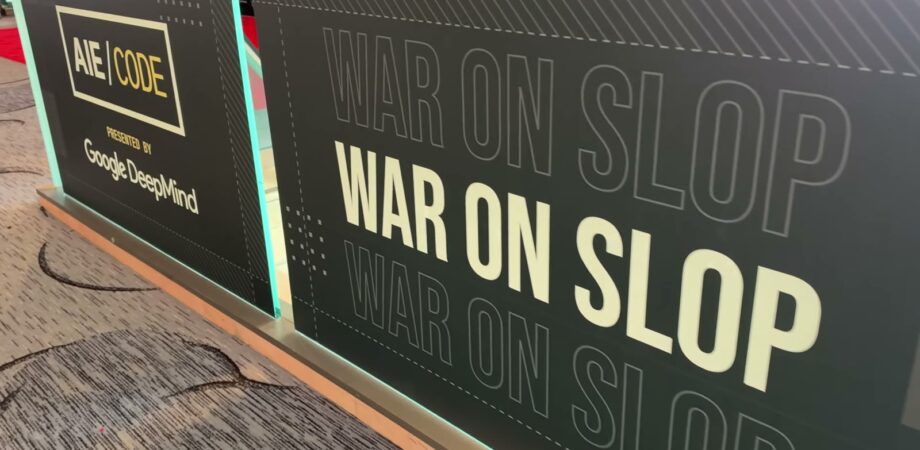
Software factories were the main topic at AI Engineer Code Summit 2026 (November 10-12, San Francisco), and the theme of the year was the fight against AI slop. One team merged about 800 pull requests in a week, and its agent wrote 99% of them. The summit's manifesto names the catch: "The cost of producing a thousand-line PR or a ten-page doc is approaching zero, while the cost of reviewing it remains constant." Signs at the venue said "WAR ON SLOP" and "NO MORE SLOP".
I was there for all 3 days and came back with 251 photos and videos. This recap covers what the factories of the top tech companies ship, the best tips to keep slop out, and where it piles up in the least expected places. The numbers come from the slides I photographed and the words from the official stream. At the end there is a list of 8 talks to watch first.
Key takeaways. Software factories were the main topic at AI Engineer Code Summit 2026: 16 of the 33 main-stage talks used the word "factory", and it came up 190 times on the 2 streams. Factory merged about 800 PRs in 1 week with 99% written by its agent, and PostHog's agents opened 66k+ PRs for customers in 4 months. The summit's answer to that volume was a war on slop and a "No AI Slop" manifesto. Teams keep slop out with checks the agent can't talk its way past. ZoomInfo measured its LLM judge and it was right 65% of the time. Slop also piles up in agent memory, so Anthropic and Databricks each run a cleanup pass over it.
What stood out at AI Engineer Code Summit 2026?
The summit ran for 3 days. Tuesday was workshops and workshop talks. Wednesday and Thursday were the main stage, about 9 hours each day, and both days are on YouTube as full streams. The schedule lists about 80 talks, breakouts and workshops.
A word count of the official captions for the 2 main-stage streams shows it. The word "factory" or "factories" came up 190 times, and 16 of the 33 main-stage talks used it at least once. (A few of those mentions are the company named Factory.) 8 sessions on the schedule have software factories in the title. It was also the topic I photographed most: 58 of my 251 files.
"Slop" came up 62 times on the 2 streams, most of them in 8 talks. Lauren Tan of SpaceXSI titled her talk "All Code Is Slop (Except Mine)". Steve Yegge titled his "Software Factories: Escape from Trash Mountain". On the last afternoon, Dexter Horthy of Factory introduced his talk as "12 factor factories" and "the war on slop", and announced a manifesto against slop.
What is a software factory?
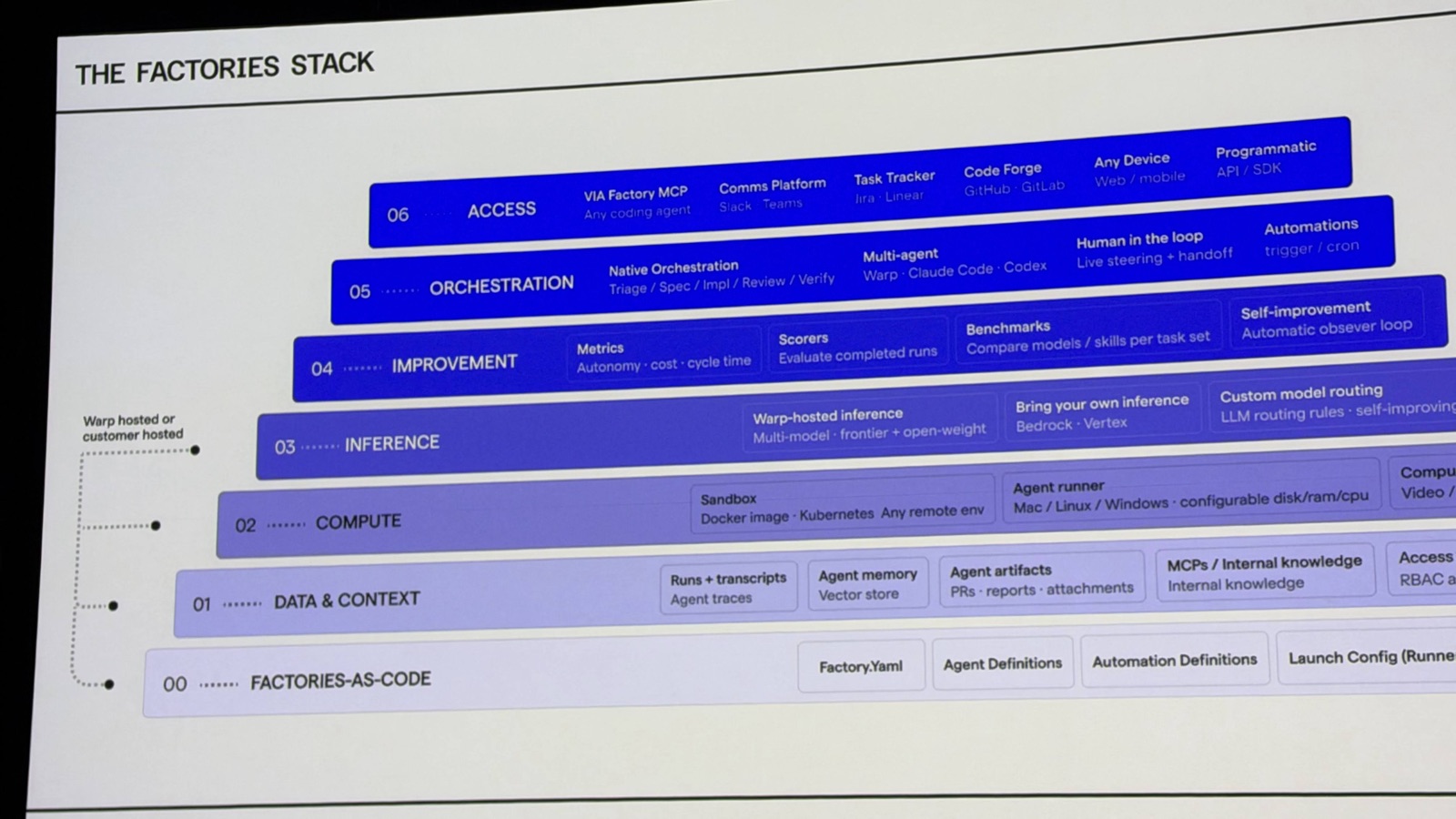
A software factory is a system where agents write, review and ship code in a loop, and people set the goals and check the evidence. Zach Lloyd, founder and CEO of Warp, said software engineering is "becoming factory engineering". When he asked who in the room was building or using an internal software factory, he looked at the hands and said, "that's almost more than the interactive agents at this point." His slide, "The Factories Stack", has 7 layers, numbered 00 to 06.
Luke Alvoeiro of Factory gave a test for whether you have one: "There's just one question that tells you whether you have a software factory or faster engineers, and that is can you name and track your signals?"
Justin McCarthy, founder and CEO of Diffusion, drew a line around where a factory fits. His talk was "Brownfield Factories", about running a factory on a product that already exists. For new ideas he told the room, "please stop building software factories." He called that "a little bit tongue in cheek here, but also serious", and gave his reason: "a lot of the time we're creating something new, we don't yet know what we want."
How much code do software factories ship?
These are the numbers speakers gave on stage.
| Team | Number | Where it comes from |
|---|---|---|
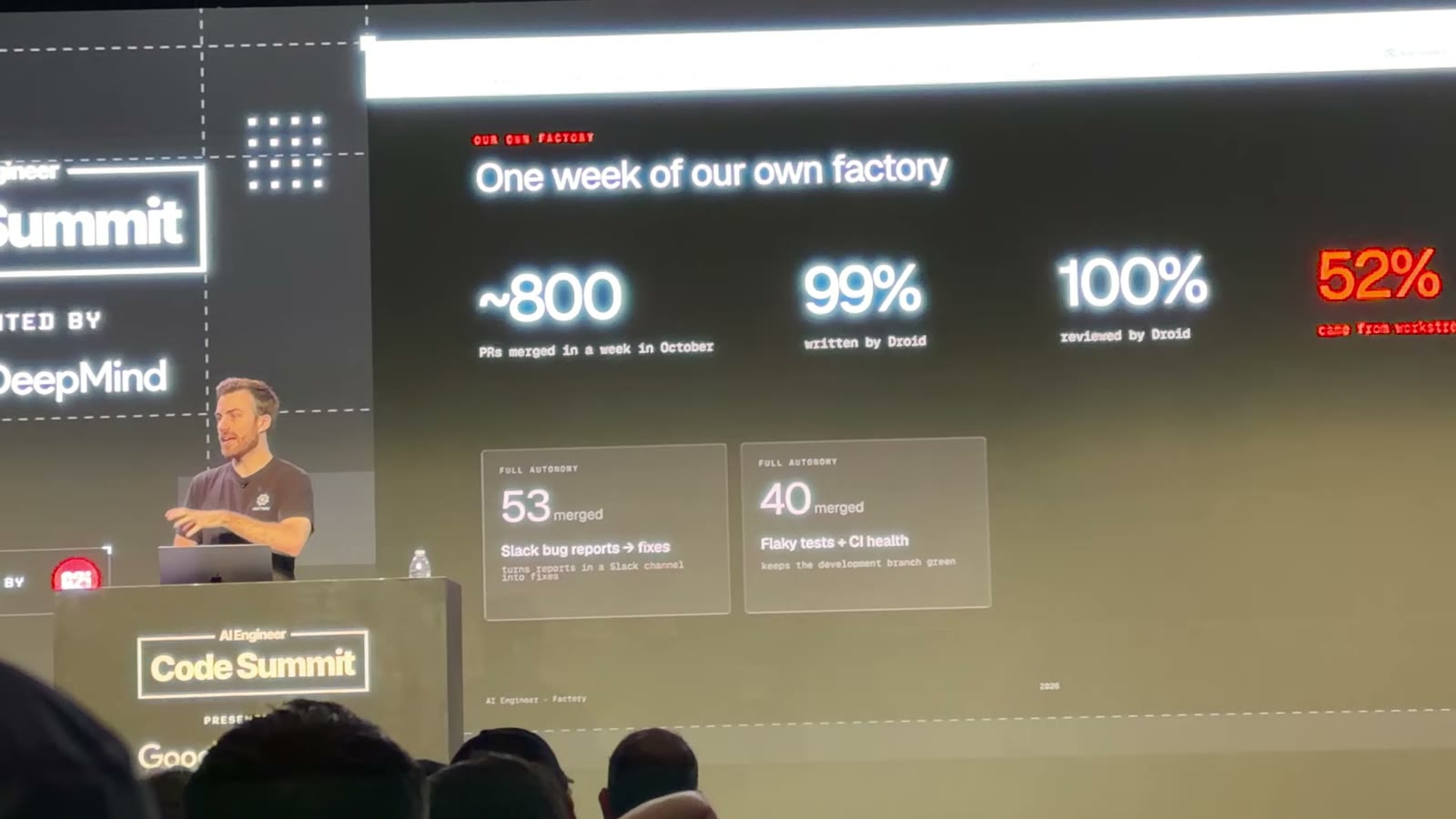
| Factory | About 800 PRs merged in 1 week in October. 99% written by Droid, 100% reviewed by Droid | Slide |
| Cognition | On Devin for Android, 999 of 1,134 PRs merged with no human approval. Merged PRs on its engineering team grew 40x in 12 months | Slide, and spoken for the 40x |
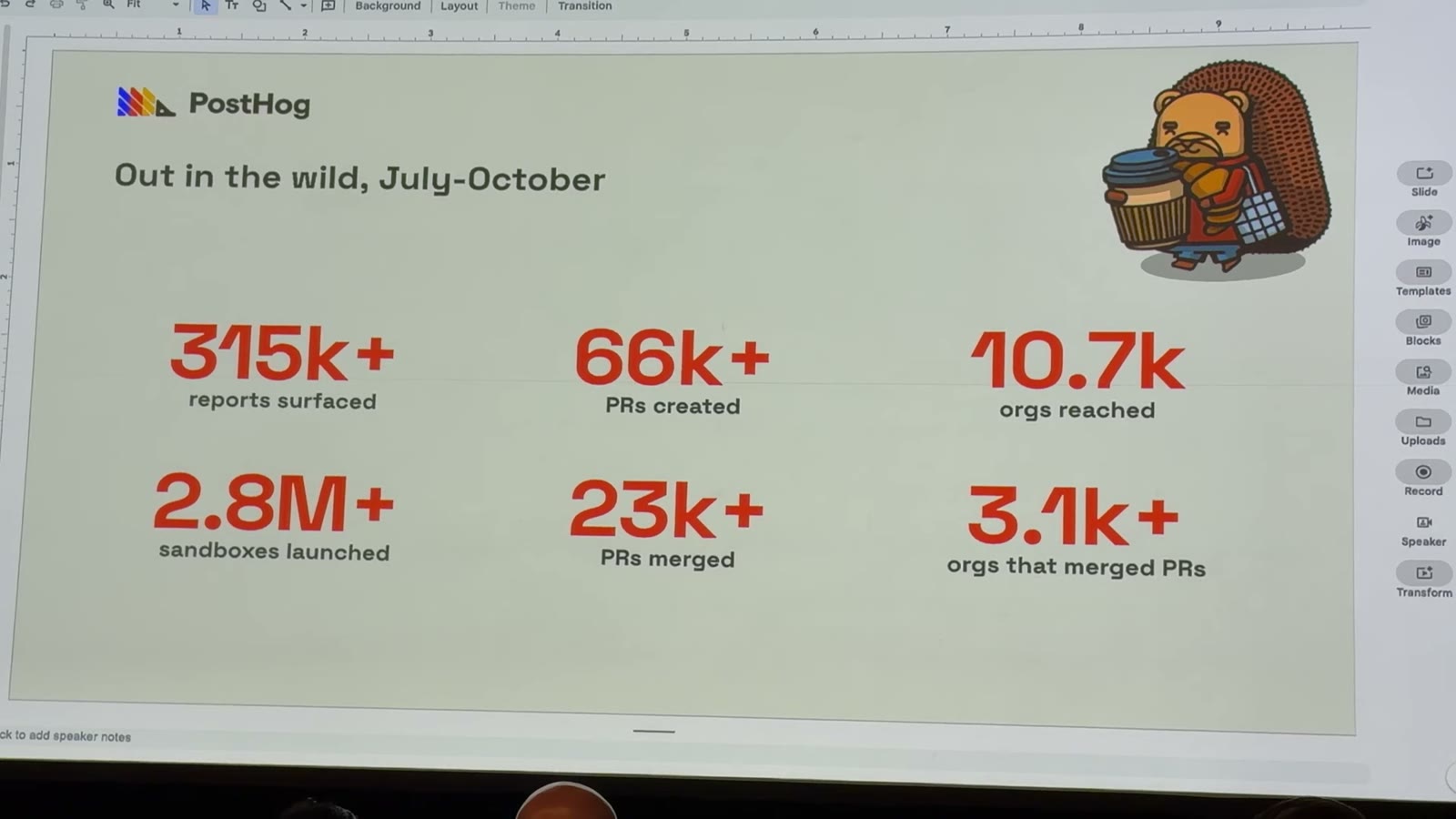
| PostHog | 66k+ PRs created and 23k+ merged for customers, July to October. 3.1k+ organizations merged one | Slide |
| AWS Kiro Crew | About 16,500 PRs merged since launch, and over 3,000 in a single week | Spoken |
| SpaceXSI | 11,000 PRs shipped to production by one team in a month | Spoken |
| Ramp | Around 75% of all code written and shipped by its agent, Inspect | Spoken |
| AI writes about 75% of new code, up from under 25% a few years ago | Spoken |
A second Cognition slide showed what the Android project took from the engineer steering it: 183 messages (1,961 words), and 22 days without a single message. The slide did the math: 6 pull requests merged for every message.
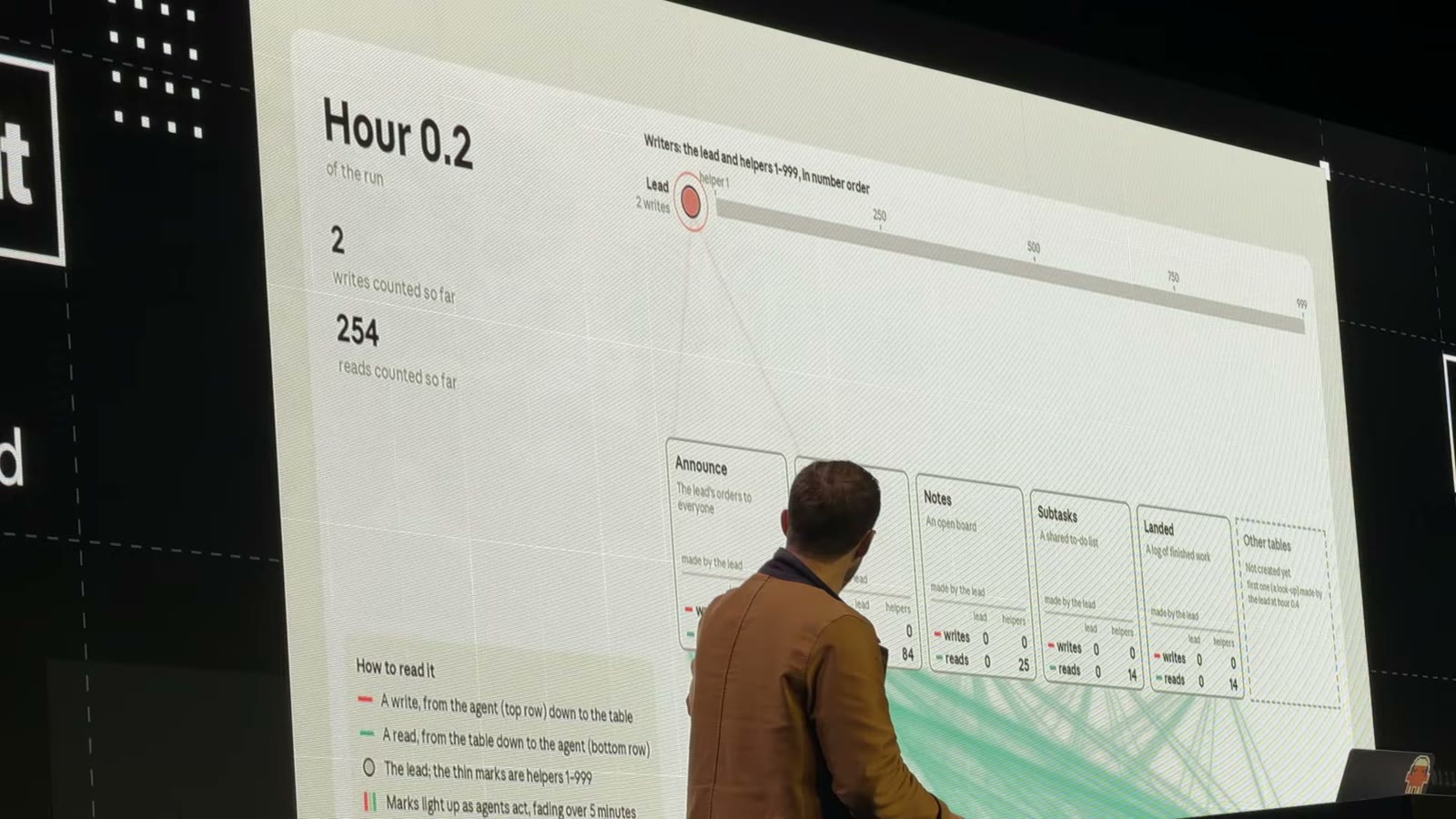
The largest team on stage was a team of agents. Lance Martin of Anthropic showed how 1 lead agent and 999 helpers worked on a proof for around 30 hours. "They can connect to two different things. Git and a SQL database. That's it," he said. About 5 minutes into the run, the lead created its own tables to coordinate the team: Announce, Assign, Notes, Subtasks and Landed. At hour 2.1 the counter on the slide showed 5,490 writes and 83,337 reads.
McCarthy summed up the volume: "There's a lot of code coming out. Even worse, it's working."
Why did AI Engineer Code Summit declare a war on slop?
Horthy announced the No AI Slop manifesto on the main stage and read it aloud. Speakers and attendees of the summit wrote it. It defines the word: "Slop is when we put less effort into producing something than we ask the consumer to spend understanding it."
The manifesto gives 2 reasons slop is a problem now. The first is cost: "Slop is asymmetric. The cost of producing a thousand-line PR or a ten-page doc is approaching zero, while the cost of reviewing it remains constant." The second is that it spreads: "Slop compounds. The more slop sits in our knowledge base, in chat, in code, the more of it the next agent reads and copies."
It lists 5 values:
- Outcomes over output
- Understanding over speed
- Our own thinking over a model's first draft
- Better work over easier work
- Improving the system over patching the output
Other speakers made the same points in their own talks. Jason Liu of OpenAI put the question directly: "are we going to ship more slop, right? And probably the answer is yes." His answer was "owning the work that you ship." Armin Ronacher, CTO of Earendil, said in his talk "The Software Atelier" that starting a project has become easy, "but maintaining them has not really gotten easier."
How do teams keep slop out of a software factory?
Andrew Finch of Sonar quoted his CEO: "code is abundant, confidence is not." These were the methods with numbers behind them.
Measure your LLM judge. Brian Kennedy of ZoomInfo took 500 real agent steps from production, each with a decision from the LLM judge that approves steps. A larger model regraded them and the team hand-checked every grade. The judge had been right 65% of the time, and it had accepted 118 steps it should have sent back.
ZoomInfo then ran a second check next to the judge in shadow mode, where the second check is recorded and does not decide anything. The second check is Jev, a small decision model from TypeSafe. It makes 1 choice (accept, redo or stop) and answers 7 yes or no questions about each step.
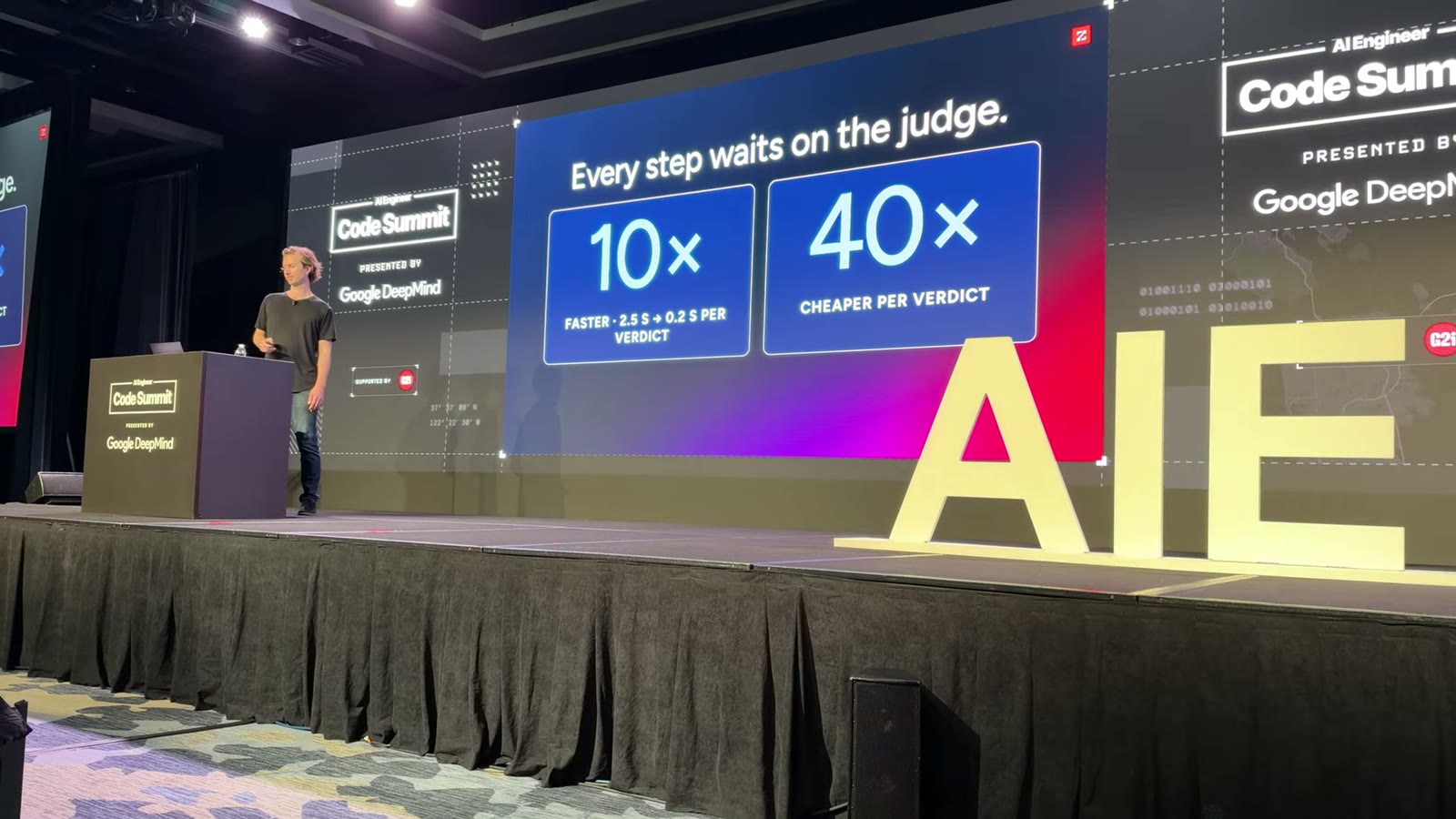
One step, where the agent said it had scheduled an email and had not, ran 1,081 times. The LLM judge caught it once, and Jev caught it 876 times. Each Jev verdict was 10x faster and 40x cheaper.
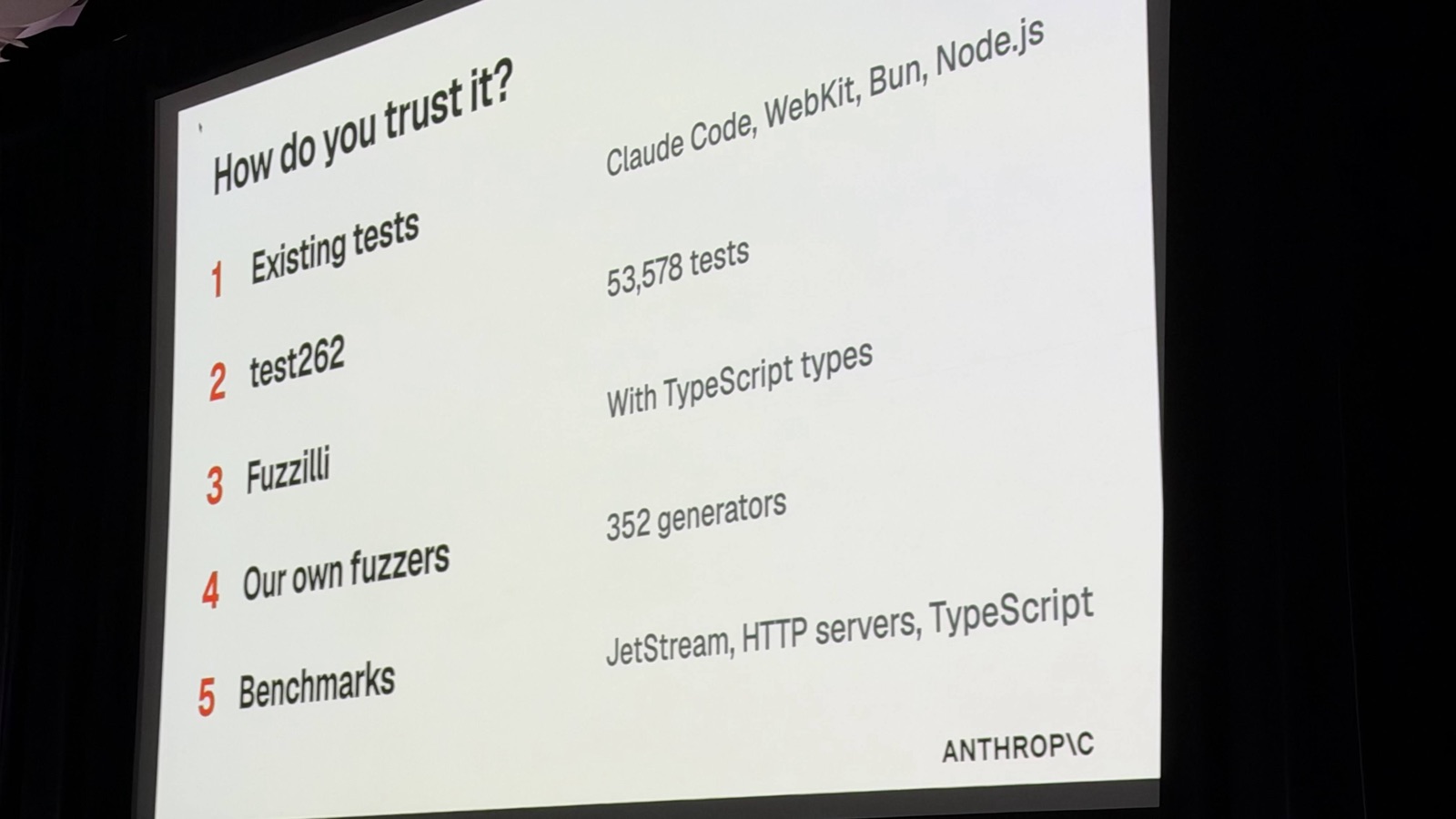
Use tests the agent did not write. Jarred Sumner, the founder of Bun, now at Anthropic, showed a slide titled "How do you trust it?" with 5 layers: existing tests (Claude Code, WebKit, Bun, Node.js), test262 with 53,578 tests, Fuzzilli, 352 of their own fuzz generators, and benchmarks. Earlier in the talk he explained why Bun was a good project to rewrite in Rust and Claude Code was not. Bun's tests are in TypeScript, so the same tests ran on the old version and the new one. Claude Code's tests would have needed a port, and "as soon as you're rewriting the tests then you can't really trust the tests anymore."
Turn corrections into checks. Lauren Tan, whose team shipped the 11,000 PRs above, gave this rule: "whenever you're correcting your agent, think about how you can make that a deterministic check instead of adding another line to your rules or your agents.md because it's far more reproducible when it's in code and it lets you trust it more." Her team also banned 99% of code comments, because comments go stale and nothing enforces them.
Keep people on the risky parts. Finch described 4 verification loops around a factory and where people still step in. "I like to say the factory runs dim, not dark," he said.
Where does slop pile up when nobody looks?
The manifesto names 3 places: the knowledge base, chat and code. For an agent, the knowledge base includes its own memory.
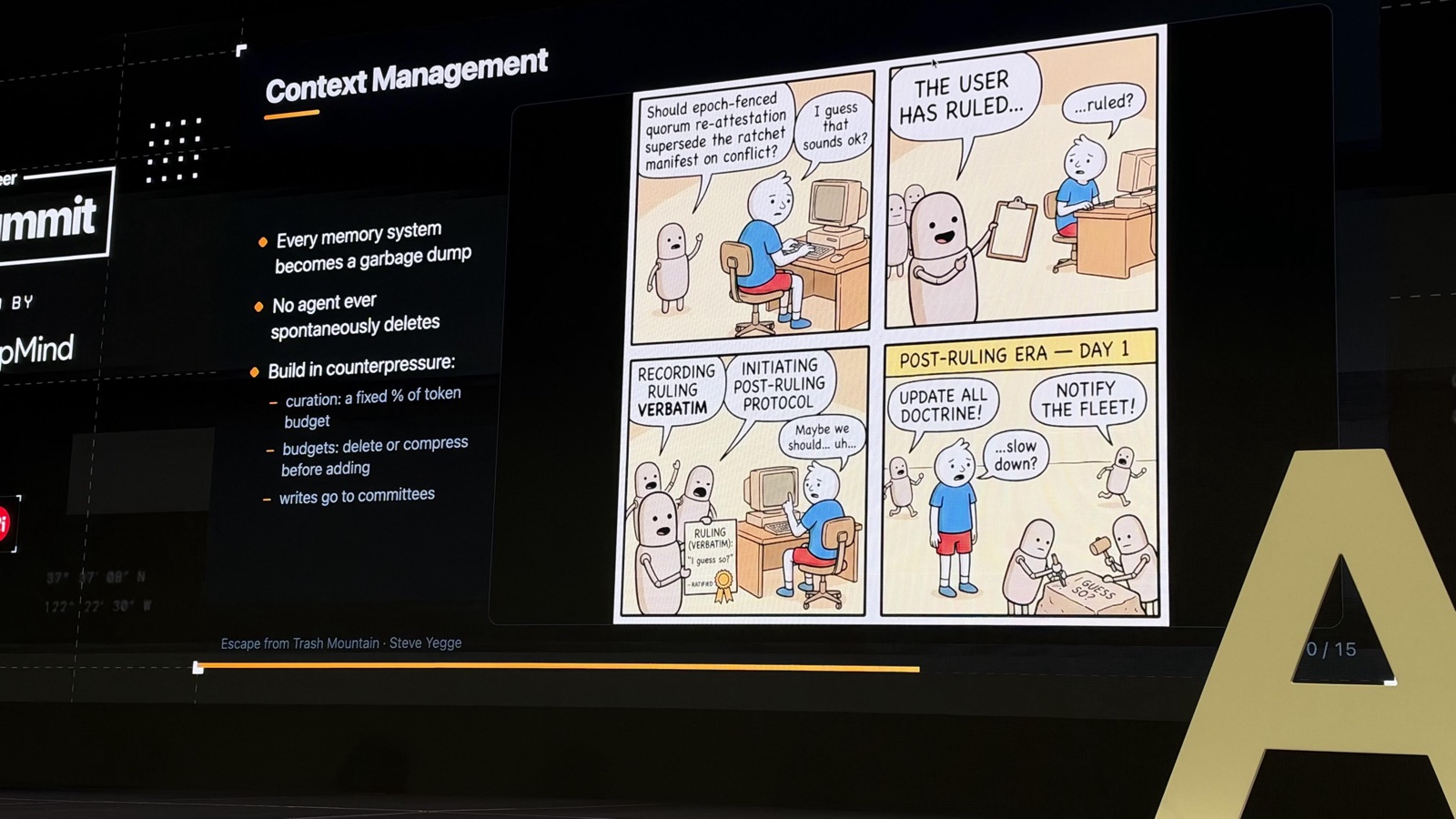
Steve Yegge, in his software factories talk, put the problem on a slide: "Every memory system becomes a garbage dump. No agent ever spontaneously deletes." His fix is a budget. Delete or compress before adding.
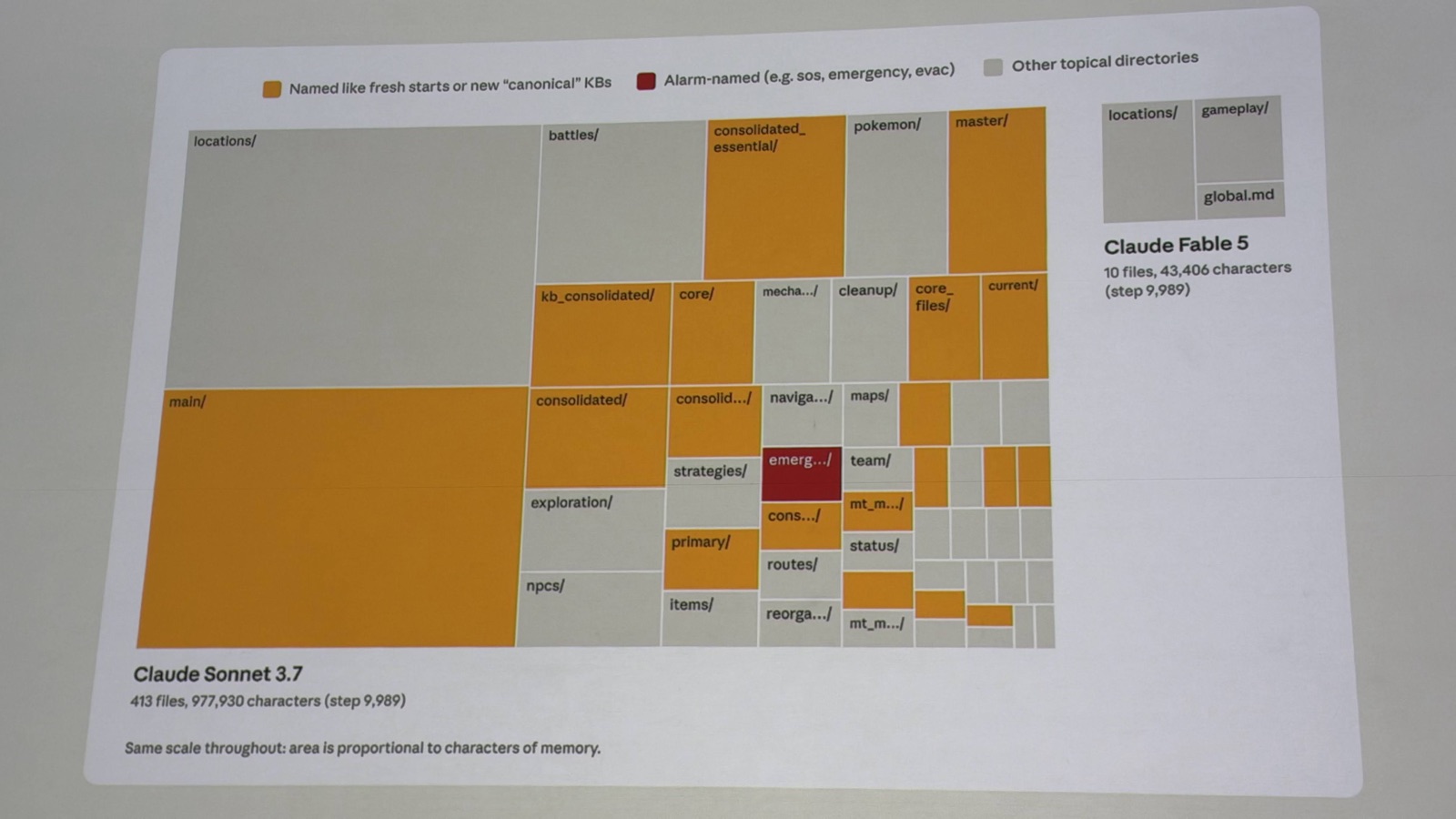
Anthropic showed the memory folders of 2 models at the same step of a long Pokémon run. Claude Sonnet 3.7 had written 413 files (977,930 characters). Claude Fable 5 had written 10 files (43,406 characters) and got further in the game. "Better models have much better instincts for salience and what to write to memory," Lance Martin said.
Anthropic still adds a second pass it calls dreaming, which merges and links what the agent wrote between sessions. Databricks uses the same word for a job that cleans up a team's shared notes. Ankit Mathur: "So we have this thing that basically dreams overnight." Monaco has a pass it calls reflections that adds to memory, and its speaker said others call this dreaming.
I covered the storage layers under agent memory in AI Agent Memory System Design at Scale.
What is left for the humans in a software factory?
The manifesto's line on ownership, which Horthy read on stage: "We own the intent, taste, and consequences of what we ship, however much AI helps us make it." Other talks filled in taste, judgment and ambition.
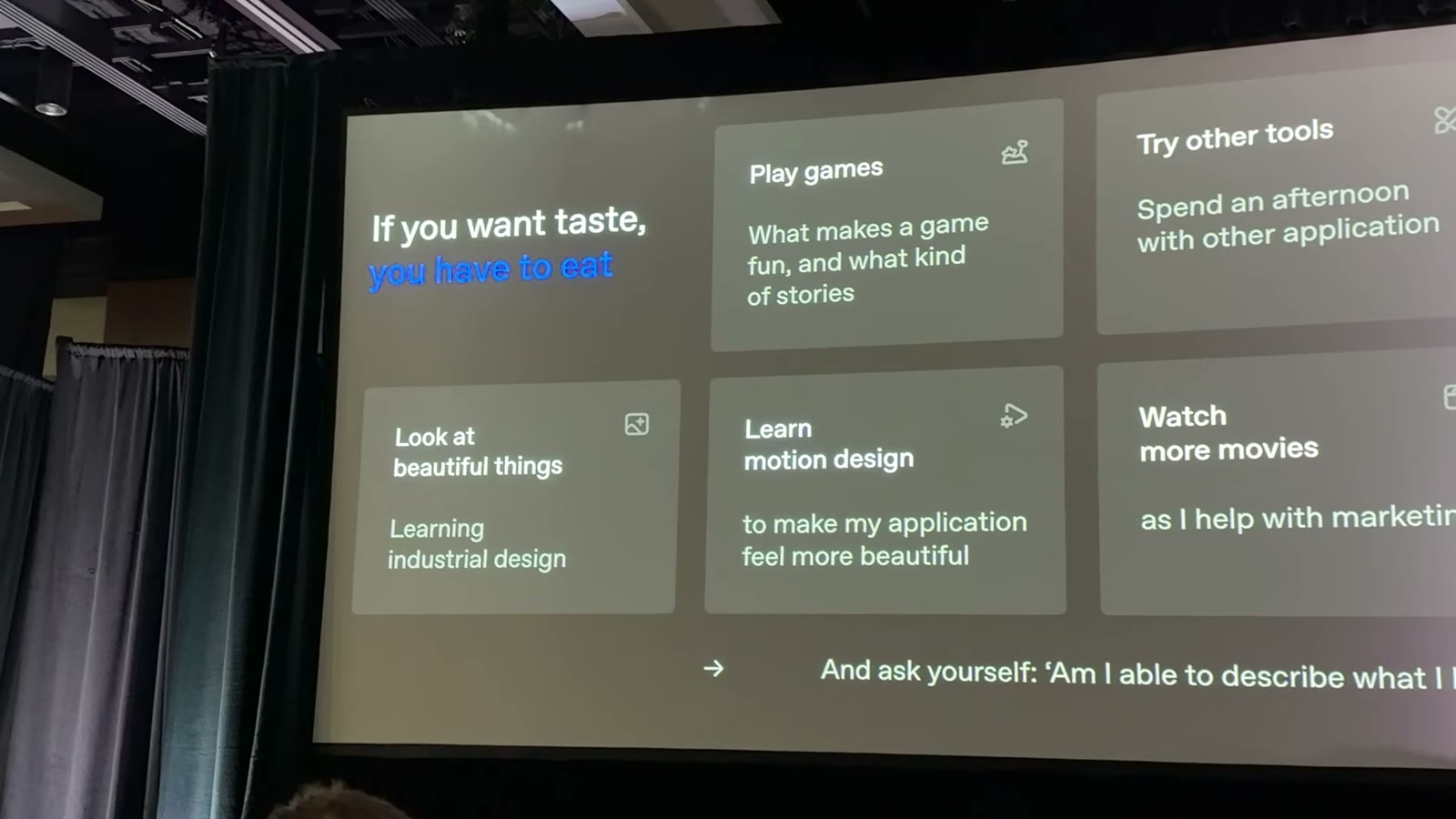
Jason Liu defined taste: "taste is the ability to describe what you like and predict what others will like." His slide on how to get it was titled "If you want taste, you have to eat", with cards like "Look at beautiful things" and "Play games".
Ishaan Dey of Google DeepMind titled his talk "Judgement is the Last Job". Doug Clauson of AWS warned about doing that job by hand: "if you make yourself the feedback loop, you are now the bottleneck."
The MC opened Thursday by saying "one of the big themes of today is ambition." Simon Willison had set that up the evening before. "The easy stuff is all handled now," he said, then quoted the cyclist Greg LeMond, "It doesn't get easier. You just get faster", and added: "we have to be more ambitious." Walden Yan, co-founder and Chief Product Officer of Cognition, closed his talk with "most teams are limited by the amount of ambition they have."
Steve Yegge called this next part good news: "the more agents I deploy, the more humans I need. Isn't that nice?"
Which AI Engineer Code Summit talks should you watch first?
Each link opens the official AI Engineer Code Summit 2026 stream at or near the start of the talk.
| Talk | Speaker | Watch it for |
|---|---|---|
| Software Factories: Escape from Trash Mountain | Steve Yegge | Why agent-built software turns into a trash mountain, and how to slow it |
| Software Engineering Is Becoming Factory Engineering | Zach Lloyd, Warp | The 7 layers of a software factory |
| 12-Factor-Factories: Design Patterns for Agentic Coding | Dexter Horthy, Factory | The war on slop and the No AI Slop manifesto |
| Your Judge Is Hallucinating Too | Brian Kennedy, ZoomInfo | Real numbers on how often an LLM judge approves made-up work |
| Jarred Sumner, Founder of Bun | Jarred Sumner, Anthropic | How to trust a large agent-written codebase |
| Exploring Claude's frontier | Lance Martin, Anthropic | 1,000 agents on Git and a SQL database, then agent memory and dreaming |
| Ambition in AI | Jason Liu, OpenAI | Slop, ownership and a working definition of taste |
| The Software Atelier | Armin Ronacher, Earendil | What a year with the same agent harness showed him |
Frequently asked questions
What is AI Engineer Code Summit?
AI Engineer Code Summit is a conference about building software with AI coding agents. The 2026 edition ran November 10 to 12 at the Hilton San Francisco Union Square, with 1 day of workshops and 2 days of main-stage talks.
What is a software factory?
A software factory is a system where AI agents write, review and ship code in a loop, and people set the goals and check the evidence. Factory said about 800 PRs merged in 1 week of its own factory, with 99% written by its agent.
What is AI slop in software?
The No AI Slop manifesto from the summit defines it: "Slop is when we put less effort into producing something than we ask the consumer to spend understanding it." It covers code, docs, plans and messages. The manifesto warns that "slop compounds", because the next agent reads it and copies it.
What is the No AI Slop manifesto?
The No AI Slop manifesto is a short statement written by speakers and attendees of AI Engineer Code Summit 2026 and announced on stage by Dexter Horthy. It lists 5 values, including "Outcomes over output" and "Understanding over speed", and is published at slopmanifesto.com.
Where can I watch the AI Engineer Code Summit 2026 talks?
The 2 main-stage days are on the AI Engineer YouTube channel as full-day streams. The table above links 8 talks at their start times.
Where should you start your own war on slop?
Start with the code nobody has time to read. Factory merged about 800 PRs in 1 week. Cognition merged 999 of 1,134 PRs on Devin for Android with no human approval, and Sonar keeps people on the risky code. That split only works if you can see what a change reaches. A diff shows the lines that changed. It does not show the code that depends on them.
That is the job we built Auryn for. Auryn is FalkorDB's open source code graph. It reads your repo (16 languages plus SQL) into a graph of functions, types, tables and endpoints, and the calls between them. Your coding agent, whether Claude Code, Cursor, Codex or another, asks the graph over MCP. In Auryn's sample payments app, ask "What breaks if I change charge_card?" and the agent finds the 1 function that calls it and the POST /charges endpoint behind that function, with file and line. On hard structural questions about Django, Claude Code with Auryn covered 92% of the key facts, against 22% without it, in a third of the time (70 seconds instead of 208).
Try it on your own repo with 2 commands: pip install falkordb-auryn, then auryn quickstart path/to/your/repo. A factory runs many agents at once, and they should all ask 1 graph that can update on every commit, not a copy on each laptop. Point Auryn's remote backend at a free FalkorDB Cloud instance, and every person and agent on your team shares it.
Join the FalkorDB Discord to get help from our engineers and share what you build.
