

TL;DR
- FalkorDB excels in real-time AI: Optimized for ultra-low latency and seamless LLM integration, making it ideal for AI-driven knowledge retrieval.
- FalkorDB is built for GraphRAG and for massive scale: Supports multi-graph architectures and AI-specific workloads efficiently.
- Neo4j is tuned for general-purpose use: It offers a mature platform with a large community and proven track record across various industries.
Both graph databases are proven: Can be used in real-world enterprise applications to handle complex, large-scale data relationships.
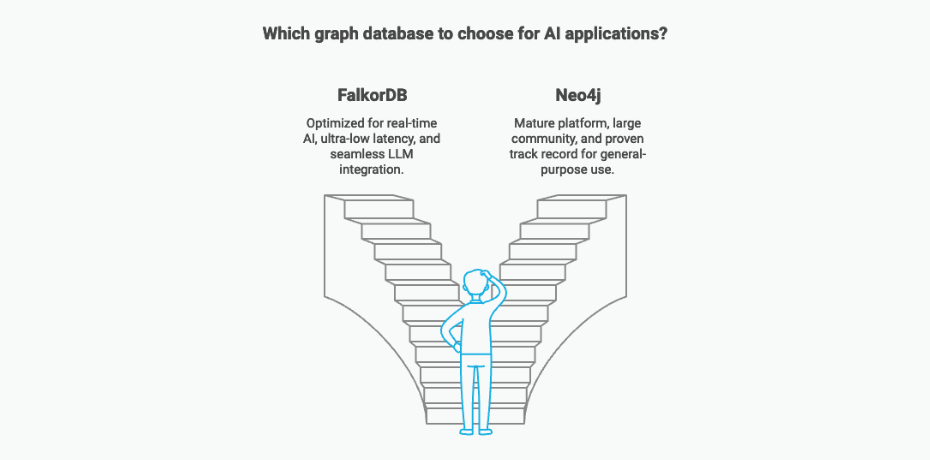
In the world of AI, data is king, but how you organize and query that data can make all the difference. As AI applications evolve, the need to represent complex relationships within the data becomes more crucial, and that’s where graph databases come into play. Graph databases excel at representing and querying complex relationships within data, making them an essential tool for AI and ML systems.
In this article, we will compare two leading graph database technologies — FalkorDB and Neo4j — exploring their strengths, key features, and how they meet the specific demands of AI applications. Whether you’re developing a Retrieval-Augmented Generation (RAG) system, or building a recommendation engine, or creating a graph-based reranking algorithm, understanding the differences between these two solutions will help you make an informed decision for your next project.
FalkorDB: Architecting the Future of AI with GraphRAG

FalkorDB is a low-latency graph database explicitly designed to meet the demanding performance and accuracy requirements of real-time AI, knowledge retrieval, and GraphRAG. Positioned as the “data backbone of intelligent AI solutions,” FalkorDB distinguishes itself by being a purpose-built solution for the future of AI, offering unmatched performance, seamless LLM integration, and the flexibility required to scale GraphRAG applications to enterprise levels.
FalkorDB is also the first graph database to use sparse matrices to represent the adjacency matrix in graphs and linear algebra to query the graph. There are several key reasons why FalkorDB may be an excellent choice for your application:
RedisGraph Legacy
While FalkorDB, founded in 2023, is a relatively new entrant, it is a direct successor to RedisGraph, and builds upon a foundation known for performance. This lineage can be particularly appealing to teams familiar with RedisGraph, offering a clear migration path to a more AI-focused solution.
Low Latency and Speed
FalkorDB is known for its ultra-low latency and high-performance architecture, making it at least 50 times faster than any other available solution in the market. This exceptional speed ensures the efficient handling of both large datasets and complex queries, allowing developers to scale their AI applications without compromising performance.

Multi-Graph Architecture for Massive Scale
FalkorDB can support up to 10K+ multi-graph tenants within a single instance, enabling the management of vast, interconnected datasets with superior performance. Multi-tenancy allows you to isolate different data domains or client applications within the same database instance, which is especially powerful for SaaS applications or RAG systems that need to separate multiple users or datasets for security, performance optimization, and scalability, all while ensuring efficient resource allocation.
Built for Enterprise-Scale Workloads
FalkorDB’s graph technology is used by businesses like Xfinity and AdaptX. This real-world adoption highlights FalkorDB’s capability to manage large-scale enterprise workloads, and explains why it is a leading choice for organizations that need to efficiently handle vast, complex datasets.
OpenCypher Support
FalkorDB offers comprehensive support for OpenCypher, a popular query language for working with graph databases. This support allows developers to leverage Cypher’s expressive query capabilities to create, read, update, and delete graph data with ease. OpenCypher’s syntax, designed for querying property graphs, simplifies complex queries, and is intuitive for both newcomers and experienced users when modeling relationships and traversing large datasets.
Vector Index and Similarity Search Support
FalkorDB includes vector indexing and similarity search capabilities, allowing you to find nodes using high-dimensional vector search. It supports cosine similarity and Euclidean distance metrics for similarity search, which is particularly useful if you’re working with vector embeddings or other vectorized data in your AI applications. This feature allows for sophisticated queries that combine vector similarity searches with traditional graph traversal, facilitating the development of advanced recommendation algorithms or RAG applications.
BOLT Protocol Support (Experimental)
FalkorDB also supports the Bolt protocol (experimental feature), which means that if you’re already using Neo4j, you can transition to FalkorDB without changing your existing code or data models. The Bolt protocol in FalkorDB enables developers to use familiar Neo4j drivers and tools while benefiting from FalkorDB’s scalability and performance optimizations, simplifying the migration and maintenance of graph database systems in your existing applications.
FalkorDB’s architectural choices directly address the challenges of building and deploying real-world AI applications. It goes one step further with its GraphRAG-SDK and LLM integration. Let’s take a closer look at how.
Understanding GraphRAG: The Future of Reliable AI
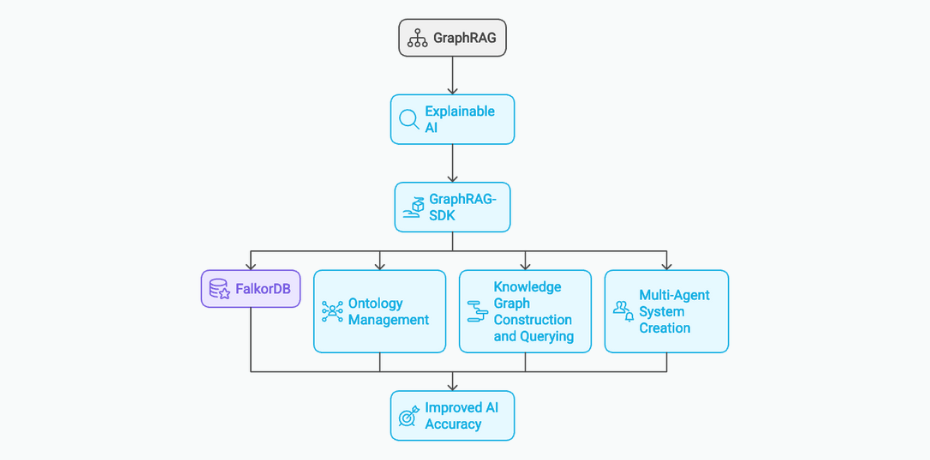
GraphRAG (Graph Retrieval Augmented Generation) is an emerging approach that addresses the limitations of traditional vector-based methods for knowledge-grounded AI. Instead of relying solely on semantic similarity, GraphRAG leverages the structured relationships within a knowledge graph to provide more accurate and contextually relevant information to LLMs.
One of the key differentiating factors of GraphRAG is its ability to create explainable AI. Vector-based RAG systems are extremely opaque, as they require you to convert your data into high-dimensional vectors, which are impossible to accurately visualize or debug. In GraphRAG systems, you instead use knowledge graphs, which can be easily visualized and explored. This helps you model the underlying graph better, and improve the accuracy of the retrieval step in your RAG application.
To simplify the process of building a GraphRAG system, FalkorDB has launched the GraphRAG-SDK. GraphRAG-SDK is a powerful tool that integrates seamlessly with FalkorDB and Large Language Models (LLMs) like OpenAI’s GPT models, enabling advanced querying and construction of knowledge graphs.
This SDK offers features such as ontology management, which allows you to manage ontologies either manually or automatically from unstructured data sources, as well as the ability to construct and query knowledge graphs for efficient data retrieval. Additionally, the SDK supports the creation of multi-agent systems, enabling the orchestration of specialized agents that handle different tasks within a complex AI ecosystem.
Alongside the GraphRAG-SDK, FalkorDB also integrates seamlessly with LangChain and LlamaIndex.
Neo4j: A Mature Platform for General-Purpose Graph Use Cases
Neo4j is a well-established and widely adopted graph database solution known for its maturity and versatility.
Its key features include:
Graph Modeling
Neo4j’s graph data model and Cypher query language are designed to make it relatively straightforward to represent and query complex relationships, even for users less familiar with graph databases. The system leverages the property graph model, allowing for an intuitive representation of nodes, relationships, and their respective properties.
Established Community and Ecosystem
Neo4j has a highly active and well-established community, providing access to an ecosystem of resources including documentation, tutorials, plugins, and extensions. Additionally, Neo4j offers integrations with popular programming languages and frameworks, alongside a marketplace for third-party tools and solutions.
Proven Track Record
Neo4j has a proven track record across a wide range of industries and use cases. It has been deployed by companies in sectors such as finance, telecommunications, healthcare, and retail to address challenges in fraud detection, recommendation engines, and network management. With over a decade of development, Neo4j is a mature platform supporting production-level graph deployments at scale.
Support for Vector Index
Neo4j recently introduced vector index support, enabling vector similarity search in addition to graph queries. This feature allows users to store and query vector embeddings, supporting both cosine similarity and Euclidean distance metrics.
Multitenancy and Multi-Database Support
Neo4j offers multitenancy by allowing the segregation of data across different tenants within a single database environment. This is achieved using role-based access control (RBAC) and namespaces, ensuring that each tenant’s data remains isolated and secure while sharing the same underlying infrastructure. With multi-database support, Neo4j enables the creation of multiple databases within the same instance, allowing each tenant to have its own dedicated database, thereby reducing overhead.
Neo4j is a strong contender for general-purpose graph database needs. However, its architecture and design choices may not be ideally suited for the specific demands of real-time AI and GraphRAG applications. Let’s explore why.
FalkorDB vs Neo4j: AI Performance
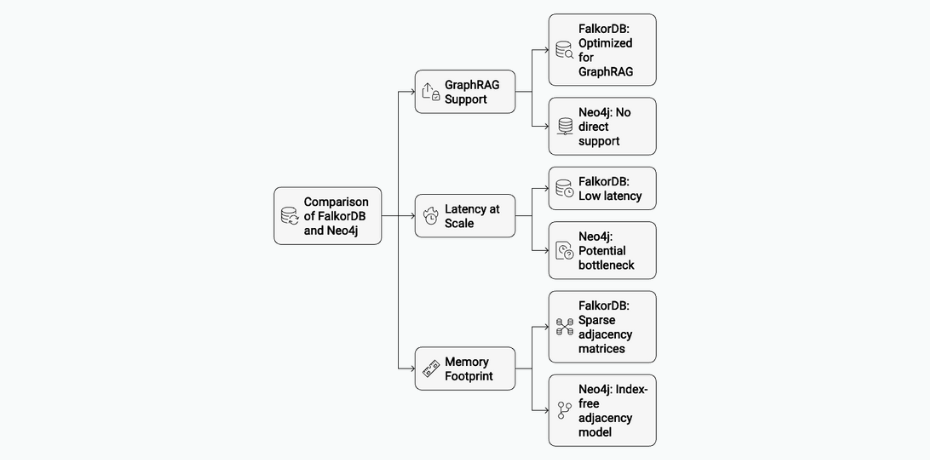
For general-purpose graph database applications, both FalkorDB and Neo4j offer all the essential features, including support for Cypher queries and the ability to create multi-tenant and multi-database applications. Both databases have been used in enterprise production environments and can handle real-world workloads.
However, there are a few features that set FalkorDB apart when it comes to building AI or GraphRAG applications. Let’s take a look at them:
GraphRAG Support
FalkorDB is highly optimized for building GraphRAG applications, offering seamless integration with LLMs for real-time, AI-driven knowledge retrieval through frameworks like GraphRAG-SDK. It is ideal for developing dynamic, large-scale AI applications that use knowledge graphs. To enhance its graph operations, FalkorDB uses advanced techniques like GraphBLAS. To build GraphRAG applications using FalkorDB, you can either use the GraphRAG-SDK framework, or frameworks like LangChain or LlamaIndex.
Latency at Scale
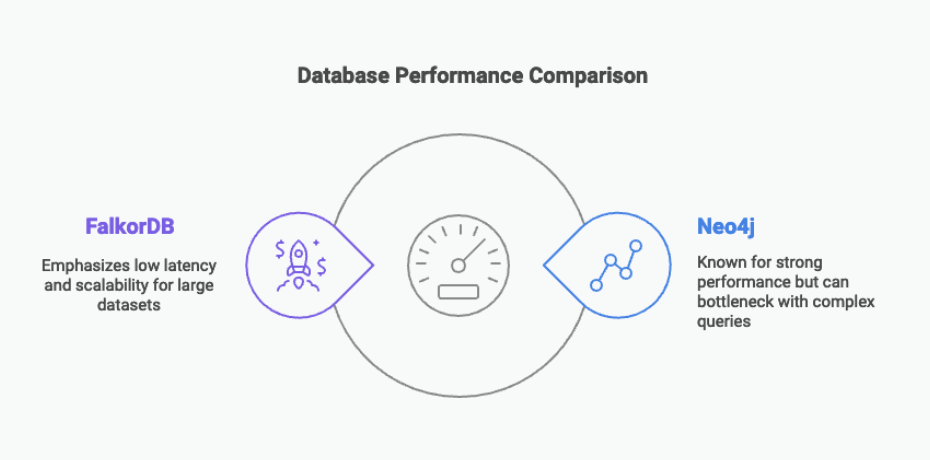
Neo4j is built using Java/Scala, and sources indicate that while Neo4j’s performance is generally strong, it can become a bottleneck when handling complex queries on massive datasets. FalkorDB, primarily written in C, and with its emphasis on low latency and a multi-graph architecture designed for horizontal scaling, offers a potential performance advantage, particularly as data volumes and query complexity increase.
Memory Footprint
FalkorDB represents its graphs using sparse adjacency matrices, which optimizes memory efficiency by focusing only on non-zero relationships between nodes. This allows FalkorDB to perform graph traversal using matrix multiplication, making it extremely efficient for real-time applications with large datasets. In contrast, Neo4j uses a native graph engine with an index-free adjacency model, where each node stores direct references to its adjacent nodes. This approach can end up consuming more memory, especially with complex, highly connected graphs.
Feature | FalkorDB | Neo4j |
Database Model | Graph DBMS | Graph DBMS |
License | Open Source (SSPLv1) | Community (GPLv3), Enterprise (Commercial) |
Query Language | Cypher | Cypher |
Performance and Latency | Ultra-low latency, designed for real-time AI | Good performance and low latency, but may bottleneck on complex queries |
Memory Efficiency | Sparse adjacency matrices for speed and memory optimization | Index-free adjacency model, potentially higher memory consumption |
In-memory Capabilities | Yes, with efficient memory structures | Limited to caching |
Replication | Yes | Yes* (*Enterprise) |
GraphRAG Support | Yes, optimized for GraphRAG applications | No direct GraphRAG support |
Bolt Protocol Support | Yes | Yes |
Community and Ecosystem | Growing ecosystem, RedisGraph legacy | Well-established community, wide integrations |
Selecting the Right Tool for the Job
Your choice of graph database depends on the kind of application you are looking to build. For general-purpose graph applications, both Neo4j and FalkorDB offer the capabilities you need.
However, when it comes to building AI applications, you should choose FalkorDB if:
- Ultra-low latency and high accuracy are paramount: FalkorDB’s architecture is specifically optimized for real-time AI tasks with minimal delay and high precision. This is crucial for AI applications designed as chat interfaces, where users expect real-time interaction
- Your workload heavily relies on GraphRAG and LLM integrations: FalkorDB’s seamless integration with LLMs and its efficient graph traversal methods make it an ideal choice for applications requiring fast, context-aware AI responses and knowledge graph-driven reasoning. The GraphRAG-SDK by FalkorDB simplifies the process of building GraphRAG applications. Additionally, FalkorDB offers integrations with LlamaIndex and LangChain if you plan to use a framework to build your AI application.
- You need to handle massive multi-graph architectures: FalkorDB’s support for 10K+ multi-graph tenants allows you to efficiently manage large, isolated datasets, which is crucial for AI and SaaS applications. With FalkorDB, you can achieve higher performance and resource efficiency.

- You need a mature database with a large community:Neo4j has an extensive ecosystem, an active user base, and a proven track record across industries, offering ample resources and support for developers.
- Your use case doesn’t demand extreme performance: Neo4j is ideal for general-purpose graph applications where specialized real-time capabilities or ultra-low latency are not required, as with FalkorDB.
Conclusion
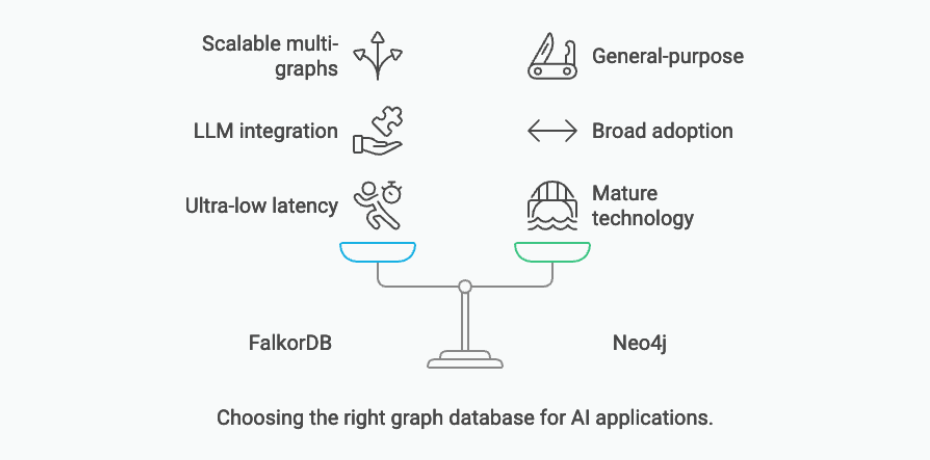
In conclusion, selecting the right graph database technology can significantly impact the success of your AI applications. While both FalkorDB and Neo4j offer powerful features for graph data management, your choice should align with the specific demands of your project. If you’re building AI-driven systems that require ultra-low latency, seamless integration with LLMs, and scalable multi-graph architectures, FalkorDB’s specialized architecture makes it the ideal choice. On the other hand, if you’re looking for a mature, general-purpose graph database with a large community and broad industry adoption, Neo4j remains a strong contender.
Ready to supercharge your AI applications with the right graph database? Explore FalkorDB’s advanced GraphRAG capabilities, or sign up to the FalkorDB cloud.
