
Frequently Asked Questions

Graph Clustering Algorithms & Concepts

What is graph clustering and why is it important?

Graph clustering is the process of partitioning a graph into distinct clusters, where nodes within the same cluster are more similar or strongly connected to each other than to nodes in other clusters. This technique is crucial for uncovering hidden patterns, communities, or functional modules in complex networks, enabling deeper insights and actionable analytics in domains like social networks, bioinformatics, and recommendation systems.

What are the main types of graph clustering algorithms?

The main types of graph clustering algorithms include hierarchical clustering, modularity-based algorithms (such as Louvain and Girvan-Newman), label propagation, spectral clustering, edge betweenness clustering, and graph neural network-based clustering. Each method has unique strengths for different graph structures and analysis goals.

How do I choose the right graph clustering algorithm for my data?

Choosing the right algorithm depends on factors like graph size, structure, analysis goals, and computational resources. Hierarchical clustering is best for small, interpretable datasets; label propagation excels with large graphs; modularity-based methods are ideal for community detection; and spectral clustering is suited for complex or weighted graphs. Consider domain-specific needs and technical constraints when selecting an algorithm.

What is graph projection and how does it help with clustering?

Graph projection creates a focused view of a subset of the graph, isolating specific nodes and relationships for targeted analysis. This approach improves computational efficiency, enhances clarity, and enables deeper analysis of relevant clusters without processing the entire network.

What are the practical considerations when selecting a graph clustering algorithm?

Key considerations include graph size, computational efficiency, memory requirements, interpretability of results, data characteristics (such as weighted or directed edges), scalability needs, and ease of implementation. For example, label propagation is efficient for large graphs, while hierarchical clustering offers high interpretability for smaller datasets.

How does label propagation work in graph clustering?

Label propagation is an iterative algorithm where each node initially has a unique label. During each iteration, nodes adopt the most frequent label among their neighbors. The process continues until labels stabilize, efficiently identifying communities in large-scale graphs.

What is spectral clustering and when should it be used?

Spectral clustering uses the Laplacian matrix of a graph and its eigenvalues to group similar nodes, even if they are not directly connected. It is especially useful for sparse or weighted graphs with complex structures, such as transportation networks or social graphs with indirect relationships.

How do modularity-based algorithms detect communities in graphs?

Modularity-based algorithms optimize a modularity metric that measures the quality of graph partitions. Methods like Louvain and Girvan-Newman identify communities by maximizing intra-cluster connections and minimizing inter-cluster links, revealing underlying community structures in networks.

What are the strengths and limitations of hierarchical clustering?

Hierarchical clustering provides a nested, interpretable structure of clusters, making it ideal for small or structured datasets. However, it struggles with scalability for large graphs due to high computational overhead and is less suitable for densely connected networks.

How are graph neural networks (GNNs) used in clustering?

Graph Neural Networks (GNNs) generate node embeddings that capture complex graph structures. These embeddings can be clustered using traditional methods like k-means or advanced techniques such as contrastive clustering, enabling community detection and functional module identification in large, dynamic graphs.

Applications & Use Cases

What are the main applications of graph clustering algorithms?

Graph clustering algorithms are used in social network analysis (community detection, influencer marketing), bioinformatics (identifying protein complexes and gene clusters), recommendation systems (personalized product or content suggestions), and transportation networks (traffic optimization and route planning).

How is graph clustering used in social networks?

In social networks, graph clustering identifies communities such as friend groups or professional networks. This enables targeted advertising, recommendation systems, and analysis of information spread or influence within the network.

How does graph clustering benefit bioinformatics research?

Graph clustering in bioinformatics helps identify protein complexes, gene clusters, and functional modules. This enables researchers to predict gene functions, understand disease mechanisms, and discover potential therapeutic targets by analyzing interaction patterns in biological networks.

How do recommendation systems use graph clustering?

Recommendation systems use graph clustering to group users with similar preferences, enabling personalized product or content suggestions. By analyzing user-item interaction graphs, platforms like Amazon, Netflix, and Spotify can enhance engagement and sales through targeted recommendations.

How does graph clustering optimize transportation networks?

In transportation networks, clustering algorithms identify patterns such as traffic bottlenecks, high interchange stations, and optimal delivery routes. This helps city planners and logistics companies improve traffic management, transit schedules, and package routing efficiency.

What are some real-life examples of graph clustering in action?

Examples include detecting influencer communities for marketing on social media, mapping gene expression data to discover disease biomarkers, grouping shoppers for targeted recommendations on e-commerce platforms, and optimizing logistics for companies like FedEx.

How does FalkorDB support advanced graph clustering and analytics?

FalkorDB provides a high-performance graph database optimized for advanced analytics, including graph clustering. Its ultra-low latency, scalability, and support for AI-driven applications make it ideal for real-time analysis of complex networks in domains such as healthcare, media, and AI development. Learn more at FalkorDB's website.

What industries benefit from using FalkorDB for graph clustering?

Industries such as healthcare (e.g., AdaptX for clinical data analysis), media and entertainment (e.g., XR.Voyage for immersive experiences), and artificial intelligence (e.g., Virtuous AI for ethical AI development) benefit from FalkorDB's advanced graph clustering and analytics capabilities. See case studies for details.

How does FalkorDB help reduce false positives in cybersecurity analytics?

FalkorDB's graph database capabilities enable security teams to prioritize and correlate alerts effectively, reducing false positives and improving threat detection. This helps analysts focus on high-value tasks and prevents burnout. Source: FalkorDB.

FalkorDB Features & Capabilities

What are the key features of FalkorDB?

FalkorDB offers ultra-low latency (up to 496x faster than Neo4j), 6x better memory efficiency, support for over 10,000 multi-graphs, open-source licensing, linear scalability, advanced AI integration (GraphRAG, agent memory), and flexible deployment (cloud & on-prem). Source: FalkorDB.

How does FalkorDB perform compared to other graph databases?

FalkorDB delivers up to 496x faster latency and 6x better memory efficiency than competitors like Neo4j. It supports flexible horizontal scaling, multi-tenancy in all plans, and is optimized for AI applications. For benchmarks, visit FalkorDB Benchmarks.

Does FalkorDB support AI and machine learning use cases?

Yes, FalkorDB is optimized for AI use cases such as GraphRAG, agent memory, and intelligent chatbots. It combines graph traversal with vector search, enabling real-time adaptability and personalized user experiences for advanced AI workflows.

What integrations does FalkorDB offer?

FalkorDB integrates with frameworks like Graphiti (by ZEP), g.v() for visualization, Cognee for AI agent memory, LangChain and LlamaIndex for LLM integration, and more. For details, see FalkorDB Integrations.

Is FalkorDB open source?

Yes, FalkorDB is open source, encouraging community collaboration and transparency. This differentiates it from proprietary solutions like AWS Neptune. Source: FalkorDB.

Does FalkorDB provide an API and technical documentation?

Yes, FalkorDB offers a comprehensive API and technical documentation, including setup guides and advanced configuration references. Access the documentation at docs.falkordb.com and the latest releases on GitHub.

What security and compliance certifications does FalkorDB have?

FalkorDB is SOC 2 Type II compliant, meeting rigorous standards for security, availability, processing integrity, confidentiality, and privacy. This ensures protection against unauthorized access and compliance with privacy regulations. Learn more at FalkorDB Demo.

How easy is it to implement FalkorDB and get started?

FalkorDB is designed for rapid deployment, allowing teams to go from concept to enterprise-grade solutions in weeks. Users can sign up for FalkorDB Cloud, try a free instance, run locally with Docker, or schedule a demo. Comprehensive documentation and community support are available for onboarding. Source: FalkorDB.

Pricing & Plans

What pricing plans does FalkorDB offer?

FalkorDB offers four main plans: FREE (for MVPs with community support), STARTUP (from /1GB/month, includes TLS and automated backups), PRO (from 0/8GB/month, includes cluster deployment and high availability), and ENTERPRISE (custom pricing with VPC, custom backups, and 24/7 support). Source: FalkorDB.

What features are included in the FalkorDB FREE plan?

The FREE plan is designed for building a powerful MVP and includes community support. It is ideal for early-stage projects and experimentation. Source: FalkorDB.

What features are included in the FalkorDB PRO plan?

The PRO plan starts at 0/8GB/month and includes advanced features such as cluster deployment, high availability, and enhanced support for production workloads. Source: FalkorDB.

Does FalkorDB offer enterprise-grade features and support?

Yes, the ENTERPRISE plan provides tailored pricing and features such as VPC, custom backups, and 24/7 support, making it suitable for large organizations with advanced requirements. Source: FalkorDB.

Competition & Comparison

How does FalkorDB compare to Neo4j?

FalkorDB offers up to 496x faster latency, 6x better memory efficiency, flexible horizontal scaling, and multi-tenancy in all plans, while Neo4j provides multi-tenancy only in premium plans. FalkorDB is open source and supports full on-prem deployment. For details, see FalkorDB vs. Neo4j.

How does FalkorDB compare to AWS Neptune?

FalkorDB is open source, supports multi-tenancy, and delivers better latency performance compared to AWS Neptune, which is proprietary and closed-source. FalkorDB also supports the Cypher query language and offers more efficient vector search. For more, see FalkorDB vs. AWS Neptune.

How does FalkorDB compare to TigerGraph and ArangoDB?

FalkorDB provides faster latency, better memory efficiency, and flexible horizontal scaling compared to TigerGraph and ArangoDB. It is rated as 'fast' for latency and supports efficient multi-tenancy and vector search. Source: FalkorDB.

Why should a customer choose FalkorDB over alternatives?

Customers choose FalkorDB for its exceptional performance (up to 496x faster latency), open-source licensing, built-in multi-tenancy, advanced AI integration, and proven success in industries like healthcare and AI. It addresses trust, scalability, and compliance challenges more effectively than many competitors. Source: FalkorDB.

Customer Success & Support

Who are some of FalkorDB's customers?

Notable customers include AdaptX (healthcare analytics), XR.Voyage (media and entertainment), and Virtuous AI (ethical AI development). Read their success stories at FalkorDB Case Studies.

What feedback have customers given about FalkorDB's ease of use?

Customers like AdaptX and 2Arrows have praised FalkorDB for its rapid access to insights, ease of running complex queries, and user-friendly dashboards. AdaptX highlighted its ability to uncover hidden clinical data insights, while 2Arrows called it a 'game-changer' for performance and usability. See case studies for details.

What support and training resources does FalkorDB provide?

FalkorDB offers comprehensive documentation, community support via Discord and GitHub Discussions, access to solution architects, and practical tutorials and blog guides. Users can also schedule demos for personalized onboarding. Source: FalkorDB.

Who is the target audience for FalkorDB?

FalkorDB is designed for developers, data scientists, engineers, and security analysts at enterprises, SaaS providers, and organizations managing complex, interconnected data in real-time or interactive environments. Source: FalkorDB.

FalkorDB Header Menu

Graph Clustering Algorithms: Usage and Comparison

How to choose the right graph clustering algorithm

Highlights

Today, knowledge graphs have emerged as a powerful framework for organizing and linking information. By visualizing relationships between entities, they unlock deeper insights, enhance decision-making, and fuel applications like semantic search, recommendation systems, and AI-driven analytics.

At the heart of knowledge graph analysis lies graph clustering algorithms—essential tools for uncovering hidden patterns and relationships within complex networks. These algorithms break down large graphs into smaller, more meaningful clusters based on criteria like edge density or node similarity. Their applications span diverse domains, from social network analysis to bioinformatics, making it easier to interpret and extract value from vast datasets.

In this article, we’ll get into research on graph clustering algorithms, explore their underlying mechanisms, and highlight their real-world impact.

Graph Clustering Explained by FalkorDB
Source: https://medium.com/@nmani.1191/need-of-graphical-clustering-in-information-extraction-on-it-support-tickets-part-1-introduction-9fb2e5c01f18

Graph Clustering Explained

Let’s first take a high-level look at what graph clustering means. 

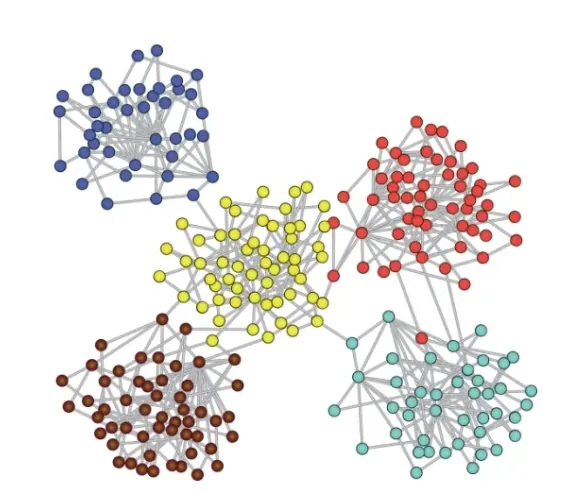
Graph clustering is the process of partitioning a graph into distinct clusters, where nodes within the same cluster exhibit higher similarity or stronger connectivity than those in different clusters. This approach operates on the principle that closely connected nodes often share common properties or roles.

For instance, in a social network graph, individuals (nodes) who interact frequently (edges) are likely to form clusters representing friend groups or communities. The key objective of graph clustering is to maximize intra-cluster edge density—ensuring that nodes within a cluster are tightly connected—while minimizing inter-cluster connections, reducing links between separate groups.

Using Graph Projection for Targeted Clustering

Sometimes, analyzing an entire graph isn’t practical. Especially with large, heterogeneous networks teeming with different types of nodes and relationships. This is where graph projection comes in handy. By creating a focused view or “projection” of a section of the graph, you can isolate specific subsets for analysis.

Think of it as drawing a spotlight over only the region you want to explore, like zooming in on IT support tickets related to a particular product line, or zeroing in on a subset of users within a sprawling social network. With this focused subset, you can run clustering algorithms on just the relevant nodes and edges. This approach can:

  • Improve computational efficiency by reducing the graph size
  • Enhance clarity by cutting out unrelated data
  • Enable deeper analysis of individual clusters or specific areas of interest

In practice, graph projection lets you tailor your clustering analysis to whatever slice of the network matters most, without the noise or performance penalty of processing the entire dataset.

Applications of Graph Clustering Algorithms

Since graph clusters help identify network clusters, they find applications in a number of domains. Here are some:

1. Social Networks

Graph clustering helps identify communities, such as friend groups or professional networks. This information is valuable for recommendation systems, targeted advertising, and understanding the spread of information or influence within a network. 

Real-Life Uses:

  • It can help detect influencer communities for marketing campaigns on platforms like Instagram or Twitter.
  • Identifying groups of users with shared interests for personalized content delivery on streaming services.
  • Analyzing social media graphs to track the spread of misinformation and design intervention strategies.

2. Bioinformatics

In biological networks, graph clustering is used to identify protein complexes, gene clusters, or functional modules, enabling insights into cellular processes. By clustering genes or proteins based on interaction patterns, researchers can predict functions of uncharacterized genes, understand disease mechanisms, and identify potential therapeutic targets.

Real-Life Uses:

  • It can help map gene expression data to discover biomarkers for specific diseases, such as cancer.
  • Clustering protein interaction networks to predict protein functions or identify drug targets.
  • Analyzing metabolic networks to study pathways affected in genetic disorders.

3. Recommendation Systems

E-commerce platforms use graph clustering to group users with similar preferences, enhancing personalized recommendations. By analyzing user-item interaction graphs, these systems can suggest products that similar users have liked, thereby increasing user engagement and sales.

Real-Life Uses:

  • It can help group shoppers on Amazon to provide targeted product recommendations based on past purchases.
  • Enhancing movie recommendations on Netflix by clustering users with similar viewing histories.
  • Optimizing music playlist suggestions on Spotify by analyzing user preferences and listening patterns.

4. Transportation Networks

Clustering algorithms optimize traffic flow and route planning by identifying patterns in transportation graphs. 

Real-Life Uses:

  • It can help identify traffic bottlenecks in urban areas and optimize city traffic management systems.
  • Grouping train or bus stations with high passenger interchange rates to design better transit schedules.
  • Analyzing delivery networks for logistics companies like FedEx to improve package routing efficiency.

Common Graph Clustering Methods

Graph clustering methods vary based on the structure and properties of the graph. The choice of the algorithm depends on factors such as graph size, edge density, node attributes, and connectivity patterns.

Below, we have listed some of the key clustering methods and the methodology they use: 

Hierarchical Clustering

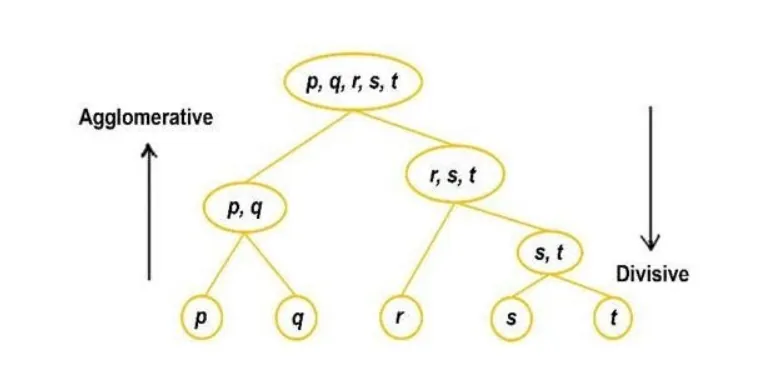
Hierarchical clustering groups nodes into a tree-like structure based on their connectivity or similarity. Unlike flat clustering methods, it provides a nested hierarchy of clusters, making it useful for applications where multi-level clustering is required.

This method follows two main approaches:

Agglomerative:

  • Each node starts as its own cluster.
  • The algorithm iteratively merges the two most similar clusters based on a similarity measure (e.g., shortest path, edge weight, or connectivity).
  • This merging continues until all nodes belong to a single cluster or a predefined number of clusters is reached.
  • Example similarity measures include single linkage (minimum distance), complete linkage (maximum distance), and average linkage.
Hierarchical Clustering from FalkorDB
Source: https://www.kdnuggets.com/2019/09/hierarchical-clustering.html

Divisive: 

  • The entire graph is initially treated as a single cluster.
  • It is recursively split into smaller clusters using a graph partitioning technique (e.g., min-cut algorithms).
  • The process stops when each cluster meets a stopping criterion, such as a maximum number of clusters or minimum intra-cluster similarity.
Divisive graph clustering algorithm illustration from falkordb
Source: https://www.kdnuggets.com/2019/09/hierarchical-clustering.html

Modern large-scale hierarchical clustering methods use:

  • Sparse similarity matrices to reduce memory usage.
  • Approximate nearest neighbor (ANN) techniques to avoid computing all pairwise similarities.
  • Parallel and distributed implementations (e.g., Google’s trillion-edge clustering method) to handle massive datasets efficiently.

Scaling hierarchical clustering for trillion-edge graphs requires advanced methods such as graph sparsification, scalable linkage strategies, and distributed computing frameworks (Google Blog, 2024).

Modularity-Based Algorithms

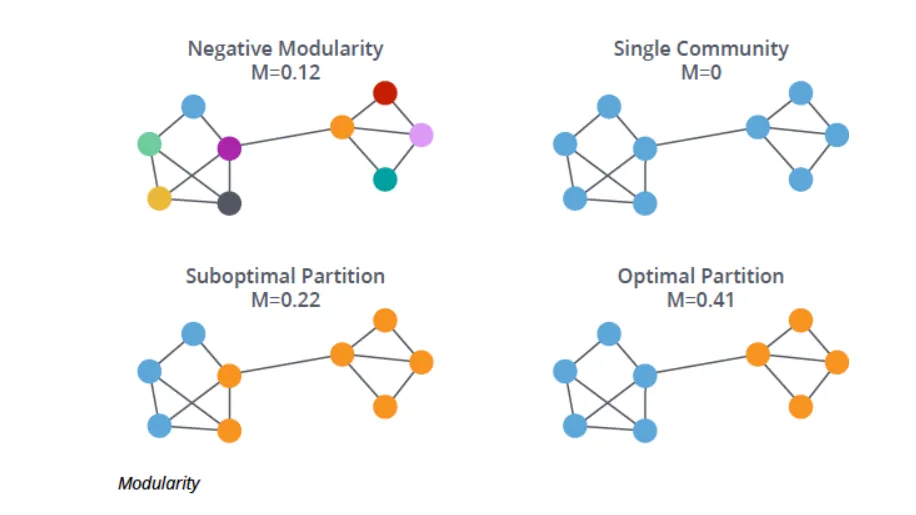
Modularity-based algorithms aim to optimize modularity, a metric that evaluates the quality of graph partitions. For instance, the Girvan-Newman algorithm identifies communities by iteratively removing edges with the highest betweenness centrality, effectively revealing the underlying structure of the graph.

Modularity-Based graph clustering Algorithms
Source: https://neo4j.com/blog/graph-algorithms-neo4j-louvain-modularity/

Here are some well-known modularity-based community detection algorithms:

  1. Louvain Method
    As one of the most popular and efficient algorithms for community detection, it employs a hierarchical approach to optimize modularity in a greedy manner. Known for its speed and scalability, it is well-suited for analyzing large networks.
  2. Girvan-Newman Algorithm
    This method detects communities by iteratively removing edges with the highest betweenness centrality. While effective at identifying community structures, it is computationally expensive and does not scale well to large networks.
  3. Newman’s Fast Algorithm (Newman-Girvan)
    This method is an extension of the Girvan-Newman algorithm and optimizes modularity more efficiently. It uses a greedy approach for dividing the graph into communities by examining the modularity score of different partitions.
  4. Blondel et al. (Louvain-like) Algorithm
    This algorithm builds on the Louvain method but uses a refinement step where nodes are first aggregated into communities, and then the modularity is optimized for the new, coarser graph.
  5. Fast Modularity Optimization (FM) Algorithm
    A faster variant of modularity optimization, this algorithm leverages local moves and community merging to enhance the speed of the Louvain algorithm, making it more suitable for very large graphs.

A detailed exploration of modularity optimization for scalable signed graph clustering can be found in the work of Hausberger et al., 2022.

Label Propagation

Label Propagation (LP) is a simple, efficient, and scalable iterative algorithm primarily used for community detection in networks, though it can also be applied to tasks like node classification and clustering. 

In this algorithm, each node initially holds a unique label, and during each iteration, nodes adopt the most frequent label from their neighbors. This process continues until the labels stabilize and no further changes occur. Label propagation is widely used for large-scale graphs due to its speed and ability to handle vast networks, making it a popular choice for both unsupervised and semi-supervised learning tasks.

graph clustering algorithms Label Propagation FalkorDB
Source: https://medium.com/geekculture/semi-supervised-learning-using-label-propagation-2f2d69b8f3ae

Summarizing the Fundamental Concepts

Graph Representation

A graph G = (V, E) consists of nodes (V), edges (E), and optionally, weights (w) assigned to the edges.

Labels

Each node starts with a label:

  • In an unsupervised setting, each node is initialized with a unique label.
  • In a semi-supervised setting, some nodes are assigned predefined labels.
  • Propagation

    During each iteration, a node adopts the most frequent label among its neighbors, following the principle that nodes in the same cluster should share the same label.

    Convergence

    The process stops when labels no longer change or when a predefined number of iterations is reached.

    Advanced Graph Clustering Methods

    Spectral Clustering

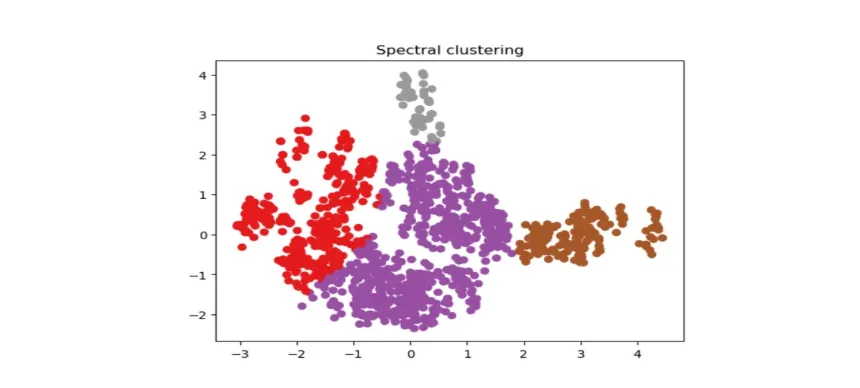
    Spectral clustering is a technique used to group similar entities (in this case, nodes in a graph) into clusters or groups. Instead of relying solely on direct connections between nodes, it utilizes the Laplacian matrix, which summarizes the graph and mathematically represents how nodes are connected.

    Here’s how it works in simple terms:

    1. Spectral clustering converts a graph into a matrix and analyzes its eigenvalues—special numbers that capture the structure of the graph.
    2. These eigenvalues help the algorithm understand the overall “shape” of the graph.
    3. Based on this information, the algorithm groups similar nodes into clusters.
    Advanced Graph Clustering Methods Spectral Clustering FalkorDB
    Source: https://www.geeksforgeeks.org/spectral-clustering-a-comprehensive-guide-for-beginners/

    It’s especially helpful for complex graphs where the structure isn’t straightforward. For example, in a sparse graph (where many nodes aren’t directly connected), spectral clustering can still identify meaningful groups by considering indirect relationships between nodes.

    In short, spectral clustering uses mathematics—specifically the Laplacian matrix and eigenvalues—to group similar nodes, even if they aren’t directly connected. This makes it a powerful tool for understanding complex networks.

    Edge Betweenness Clustering

    This method is a way of finding communities or groups in a network (like people in a social network or devices in a communication network). It works by looking at the edges (connections between nodes) and focusing on those that are the most important in terms of “bridging” different parts of the graph. This importance is measured using betweenness centrality, which tells us how often a particular edge acts as a shortcut or bridge between different groups of nodes.

    Here’s how the method works step by step:

    • Betweenness centrality identifies edges that are “critical” for connecting different parts of the graph.
    • Edges with high betweenness are removed one by one, essentially cutting the graph into pieces.
    • By repeating this process, the graph gradually breaks into smaller clusters or communities where the nodes within each cluster are more connected to each other than to nodes in other clusters.
    Advanced Graph Clustering Methods Edge Betweenness Clustering
    Source: https://www.yworks.com/pages/clustering-graphs-and-networks

    This approach is great for finding community structures in networks, where we want to discover groups of nodes that are more tightly connected internally but less so with other groups. It’s especially useful when you want to detect structural communities where nodes are interconnected in complex ways.

    A more detailed explanation can be found in the work of UIowa, 2023.

    Graph Neural Network-Based Clustering

    Graph Neural Networks (GNNs) are primarily used for node classification, edge prediction, and graph classification, but they can also be adapted for unsupervised clustering. While GNNs do not directly perform clustering, their node embedding techniques provide representations that can be clustered using traditional methods like k-means or advanced techniques like contrastive clustering.

    Several deep graph clustering approaches leverage GNNs:

    1. Graph Autoencoders (GAE, VGAE) – These use GNN encoders to learn latent node representations, which can then be clustered using spectral or k-means clustering.
    2. Contrastive Graph Clustering – Techniques like AGE, MVGRL, and HeCo refine node embeddings using contrastive learning, making clusters more separable.
    3. Graph Pooling for Clustering – Methods like DiffPool and MinCutPool aggregate node features to create hierarchical cluster structures within the graph.
    Graph Neural Network Based Clustering FalkorDB
    Source: https://distill.pub/2021/gnn-intro/

    Choosing the Right Graph Clustering Algorithm

    Domain-Specific Factors

    Selecting an algorithm often depends on the specific domain and its requirements. For example, in bioinformatics, modularity-based algorithms may be preferable for detecting functional modules.

    1. Hierarchical Clustering: Suitable for smaller datasets or applications where interpretability is critical, such as biological datasets.
    2. Modularity-Based Algorithms: Effective for community detection in social networks and bioinformatics.
    3. Label Propagation: Scales well for large graphs (millions to billions of nodes) like web graphs, where nodes are web pages and edges are hyperlinks. It is used in spam detection and topic classification.
    4. Spectral Clustering: Captures complex cluster structures in sparse or weighted graphs, such as transportation networks, where traffic flows link stations.
    5. Edge Betweenness Clustering: Detects well-separated communities in smaller networks (up to tens of thousands of nodes), like academic or corporate networks.

    A survey on graph clustering highlights the importance of domain-specific criteria in algorithm selection (UIowa, 2023).

    Technical Factors

    Technical considerations like computational efficiency, scalability, and compatibility with hardware resources also influence the choice. For instance, hierarchical clustering can be computationally expensive for large graphs, making label propagation a better alternative for scalability.

    Additionally, the complexity of the graph structure matters. Sparse graphs might benefit from spectral clustering, while dense graphs could be better handled by modularity-based algorithms. Another critical aspect is whether the algorithm should work in an unsupervised manner or leverage pre-existing labels (semi-supervised learning).

    Factors to consider:

    1. Hierarchical Clustering:
      1. Struggles with scalability for large datasets due to high computational overhead.
      2. Offers high interpretability, making it suitable for small, structured datasets.
      3. Requires significant processing time for densely connected graphs.
    2. Modularity-Based Algorithms:
      1. Computationally intensive for larger graphs, especially with high-edge density.
      2. Works well for undirected graphs with clear community structures.
      3. Less suitable for weighted or directed graphs without modifications.
    3. Label Propagation:
      1. Scales efficiently for very large datasets.
      2. Simple to implement and computationally lightweight.
      3. Lacks fine-grained control over cluster size and boundaries.
    4. Spectral Clustering:
      1. Computationally expensive due to eigenvalue decomposition.
      2. Effective for sparse and weighted graphs with complex structures.
      3. Requires a predefined number of clusters, limiting adaptability for exploratory tasks.
    5. Edge Betweenness Clustering:
      1. Inefficient for large-scale graphs due to the need for recalculating edge centrality.
      2. Excels in detecting well separated, distinct communities.
      3. Not ideal for dense or highly interconnected graphs.

    Practical considerations

    Graph Size

    Algorithms like label propagation are efficient for very large graphs.

    Result Interpretability

    Modularity-based approaches often yield clusters that are easy to interpret.

    Data Characteristics

    For weighted or directed graphs, specialized algorithms may perform better.

    Scalability Needs

    For real-time applications, computational efficiency becomes paramount.

    Ease of Implementation

    Label propagation is straightforward to implement and interpret, making it practical for quick clustering.

    Interpretability

    Hierarchical clustering provides a clear structure that is easy to explain, while modularity-based approaches also offer good interpretability.

    Specialized Use Cases

    Spectral clustering is advantageous for weighted or directed graphs, whereas GNNs are versatile for applications requiring dynamic adaptability.

    Summary

    Graph clustering algorithms play a crucial role in uncovering intricate relationships within interconnected systems. Each of the seven clustering methods offers unique strengths, catering to diverse requirements across domains, technical constraints, and practical applications. By carefully evaluating domain-specific factors, technical requirements, and practical considerations, practitioners can select the most suitable algorithm to address their specific challenges.

    In this article, we have explored how to effectively leverage these clustering methods, highlighting the strengths and limitations of each approach in different scenarios. This knowledge enables better decision-making when analyzing complex networks, driving innovation and actionable insights in fields such as bioinformatics, social networks, recommendation systems, and more.

    Future Scope

    As graph data continues to grow in complexity and scale, innovations such as Graph Neural Networks (GNNs) are expected to lead the way in addressing advanced clustering challenges. Researchers and developers are encouraged to explore the diverse range of graph clustering techniques to gain deeper insights and drive impactful solutions across industries.

    For a comprehensive understanding of current methods and future trends, the survey “A Survey of Deep Graph Clustering” (Liu et al., 2022) serves as an excellent resource.

    What are the main types of graph clustering algorithms?

    Key types include hierarchical, modularity-based, label propagation, spectral, and edge betweenness. Each has strengths for specific graph structures and analysis goals.

    How do I choose the right graph clustering algorithm?

    Consider graph size, structure, analysis goals, and computational resources. Hierarchical works for small datasets, label propagation for large graphs, and spectral for complex structures.

    What are the applications of graph clustering algorithms?

    Applications span social network analysis, bioinformatics, recommendation systems, and transportation network optimization. They reveal communities, functional modules, and network patterns.

    Build fast and accurate GenAI apps with GraphRAG SDK at scale

    FalkorDB offers an accurate, multi-tenant RAG solution based on our low-latency, scalable graph database technology. It’s ideal for highly technical teams that handle complex, interconnected data in real-time, resulting in fewer hallucinations and more accurate responses from LLMs.