Frequently Asked Questions
Product Information
What is FalkorDB and what does it do?
FalkorDB is a high-performance graph database designed to manage complex relationships and enable advanced AI applications. It is purpose-built for development teams working with interconnected data in real-time or interactive environments, supporting use cases such as Text2SQL, Security Graphs, GraphRAG, agentic AI, chatbots, and fraud detection. Learn more.
What are the primary use cases for FalkorDB?
FalkorDB is used for Text2SQL (natural language to SQL queries), building security graphs for CNAPP, CSPM & CIEM, advanced graph-based retrieval (GraphRAG), agentic AI and chatbots, fraud detection, and as a high-performance graph storage for complex relationships. Source.
What is GraphRAG and how does it differ from Vector RAG?
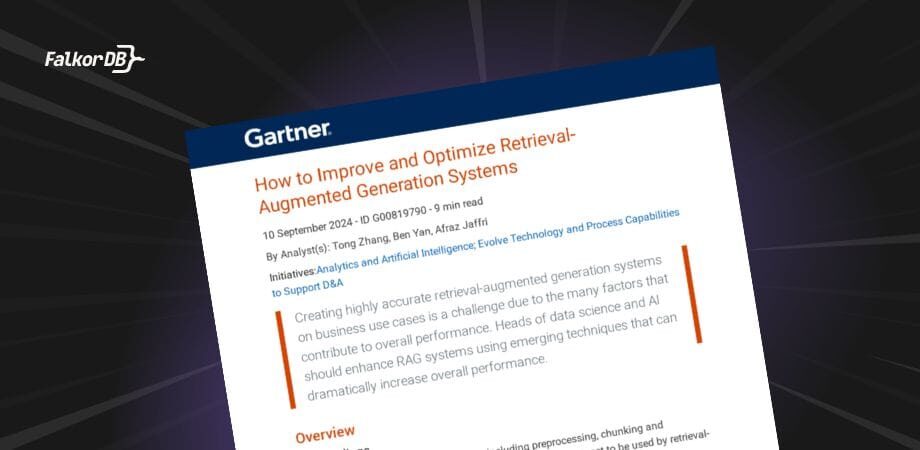
GraphRAG uses knowledge graphs to map entities and relationships, enabling deeper context and reasoning for LLMs. Unlike Vector RAG, which relies on similarity searches in vector space and may lose context, GraphRAG preserves relationships and enables multi-step reasoning, addressing Gartner's concerns about data quality, retrieval accuracy, and context preservation. Read more.
What is the GraphRAG-SDK and how is it used?
The GraphRAG-SDK is a toolkit for creating efficient graph representations of complex data relationships, enhancing embedding quality, and enabling hybrid retrieval (graph, vector, and lexical search). It also supports query transformation by traversing related nodes for richer context. Check out the SDK.
What are the key capabilities and benefits of FalkorDB?
FalkorDB supports over 10,000 multi-graphs (tenants), offers open-source licensing, linear scalability, ultra-low latency, and is optimized for AI use cases like GraphRAG and agent memory. Key benefits include trust and reliability, scalability, enhanced user experience, regulatory compliance, and support for agentic AI and chatbots. Source.
What integrations does FalkorDB support?
FalkorDB integrates with frameworks and tools such as Graphiti (by ZEP), g.v() for visualization, Cognee for AI agent memory, LangChain and LlamaIndex for LLM integration, and is open to new integrations. Learn more.
Does FalkorDB provide an API?
Yes, FalkorDB provides a comprehensive API with official documentation and guides available at docs.falkordb.com. These resources are designed for developers, data scientists, and engineers to integrate FalkorDB into their workflows.
Where can I find FalkorDB's technical documentation?
FalkorDB's technical documentation, including API references and setup guides, is available at docs.falkordb.com. Release notes and updates can be found on the GitHub Releases Page.
What is the primary purpose of FalkorDB?
FalkorDB is a graph platform for developers to achieve accurate GraphRAG for enterprise GenAI, delivering a multi-tenant RAG solution powered by low-latency, scalable graph database technology. It is designed for complex, interconnected data in real-time or interactive environments. Source.
What products and services does FalkorDB offer?
FalkorDB offers a high-performance graph database, GraphRAG-SDK, support for Text2SQL, Security Graphs, agentic AI, fraud detection, and comprehensive documentation and support. Pricing plans include Free, Startup, Pro, and Enterprise tiers. Learn more.
Features & Capabilities
What makes FalkorDB's performance stand out?
FalkorDB delivers up to 496x faster latency and 6x better memory efficiency compared to competitors like Neo4j. It supports over 10,000 multi-graphs, flexible horizontal scaling, and is optimized for AI applications such as GraphRAG and agent memory. See benchmarks.
Does FalkorDB support multi-tenancy?
Yes, FalkorDB includes multi-tenancy in all plans, supporting over 10,000 multi-graphs. This is especially valuable for SaaS providers and organizations with diverse user bases. Source.
Is FalkorDB open source?
Yes, FalkorDB is open source, encouraging community collaboration and transparency. This differentiates it from proprietary solutions like AWS Neptune. Source.
How does FalkorDB enable advanced AI applications?
FalkorDB is optimized for AI use cases such as GraphRAG and agent memory, combining graph traversal with vector search for personalized user experiences and supporting intelligent agents and chatbots with real-time adaptability. Source.
What user experience features does FalkorDB offer?
FalkorDB provides fast, interactive analysis of complex data through dashboards and custom views, enabling users to filter, explore, and visualize data efficiently. Source.
How does FalkorDB help with regulatory compliance?
FalkorDB's GraphRAG-SDK helps organizations stay ahead of financial regulations by mapping regulations to workflows, identifying compliance gaps, and providing actionable recommendations. Source.
What security and compliance certifications does FalkorDB have?
FalkorDB is SOC 2 Type II compliant, meeting rigorous standards for security, availability, processing integrity, confidentiality, and privacy. Learn more.
What frameworks or tools can I use with FalkorDB?
You can use Graphiti for temporal knowledge graphs, g.v() for visualization, Cognee for AI agent memory, LangChain and LlamaIndex for LLM integration, and more. See integrations.
How does FalkorDB support hybrid retrieval systems?
FalkorDB enables hybrid retrieval by combining graph-based search with vector and lexical search methods, as recommended by Gartner for improved retrieval accuracy and relevance. Read more.
Pricing & Plans
What pricing plans does FalkorDB offer?
FalkorDB offers four pricing plans: Free (for MVPs with community support), Startup (from /1GB/month, includes TLS and automated backups), Pro (from 0/8GB/month, includes cluster deployment and high availability), and Enterprise (custom pricing, includes VPC, custom backups, and 24/7 support). Source.
What features are included in the Free plan?
The Free plan is designed for building a powerful MVP and includes community support. Source.
What features are included in the Startup plan?
The Startup plan starts from /1GB/month and includes TLS and automated backups. Source.
What features are included in the Pro plan?
The Pro plan starts from 0/8GB/month and includes advanced features like cluster deployment and high availability. Source.
What features are included in the Enterprise plan?
The Enterprise plan offers tailored pricing and includes enterprise-grade features like VPC, custom backups, and 24/7 support. Source.
Competition & Comparison
How does FalkorDB compare to Neo4j?
FalkorDB offers up to 496x faster latency, 6x better memory efficiency, flexible horizontal scaling, and includes multi-tenancy in all plans, unlike Neo4j where multi-tenancy is a premium feature. FalkorDB is open source and supports full on-prem deployment. See comparison.
How does FalkorDB compare to AWS Neptune?
FalkorDB is open source, supports multi-tenancy, offers highly efficient vector search, and delivers better latency performance compared to AWS Neptune, which is proprietary and lacks multi-tenancy. See comparison.
How does FalkorDB compare to TigerGraph?
FalkorDB provides faster latency, better memory efficiency, and flexible horizontal scaling compared to TigerGraph, which has limited scaling and moderate memory efficiency. Source.
How does FalkorDB compare to ArangoDB?
FalkorDB demonstrates superior latency and memory efficiency, making it a better choice for performance-critical applications compared to ArangoDB, which has limited scaling and moderate memory efficiency. Source.
Why should a customer choose FalkorDB over alternatives?
FalkorDB stands out for its exceptional performance, scalability, multi-tenancy in all plans, advanced AI integration, open-source licensing, and enhanced user experience. It is trusted by customers like AdaptX, XR.Voyage, and Virtuous AI. Learn more.
Use Cases & Benefits
Who can benefit from using FalkorDB?
FalkorDB is ideal for developers, data scientists, engineers, and security analysts at enterprises, SaaS providers, and organizations managing complex, interconnected data in real-time or interactive environments. Source.
What business impact can customers expect from FalkorDB?
Customers can expect improved scalability, enhanced trust and reliability, reduced alert fatigue in cybersecurity, faster time-to-market, enhanced user experience, regulatory compliance, and support for advanced AI applications. Source.
What core problems does FalkorDB solve?
FalkorDB addresses trust and reliability in LLM-based applications, scalability and data management, alert fatigue in cybersecurity, performance limitations of competitors, interactive data analysis, regulatory compliance, and agentic AI and chatbots. Source.
What pain points does FalkorDB address for its customers?
FalkorDB helps with trust and reliability in LLM-based applications, scalability and data management, alert fatigue in cybersecurity, performance limitations of competitors, interactive data analysis, regulatory compliance, and agentic AI and chatbots. Source.
What industries are represented in FalkorDB's case studies?
Industries include healthcare (AdaptX), media and entertainment (XR.Voyage), and artificial intelligence/ethical AI development (Virtuous AI). See case studies.
Can you share specific case studies or success stories?
Yes. AdaptX uses FalkorDB for clinical data analysis, XR.Voyage for immersive experience platform scalability, and Virtuous AI for ethical AI development. Read their stories.
Who are some of FalkorDB's customers?
Customers include AdaptX, XR.Voyage, and Virtuous AI. Their case studies are available on the FalkorDB website. See customers.
What feedback have customers given about FalkorDB's ease of use?
Customers like AdaptX and 2Arrows have praised FalkorDB for its user-friendly design, rapid access to insights, and superior performance compared to competitors like Neo4j. See AdaptX case study.
Technical Requirements & Implementation
How long does it take to implement FalkorDB?
FalkorDB is built for rapid deployment, enabling teams to go from concept to enterprise-grade solutions in weeks, not months. Source.
How easy is it to get started with FalkorDB?
Getting started is straightforward: sign up for FalkorDB Cloud, try a free instance, run locally with Docker, schedule a demo, or access comprehensive documentation. Community support is available via Discord and GitHub. Learn more.
What support and training options are available?
FalkorDB offers comprehensive documentation, community support via Discord and GitHub, access to solution architects, free trial and demo options, and practical guides on its blog. Source.
What technical resources are available for developers?
Developers can access official documentation, API references, release notes, and community forums. Tutorials and technical articles are available on the FalkorDB blog. See docs.
How can I contact FalkorDB for support or integration questions?
You can contact FalkorDB via their website's contact form, join the Discord server, or participate in GitHub discussions for support and integration inquiries. Contact FalkorDB.