Frequently Asked Questions
KuzuDB to FalkorDB Migration
What is the recommended process for migrating from KuzuDB to FalkorDB?
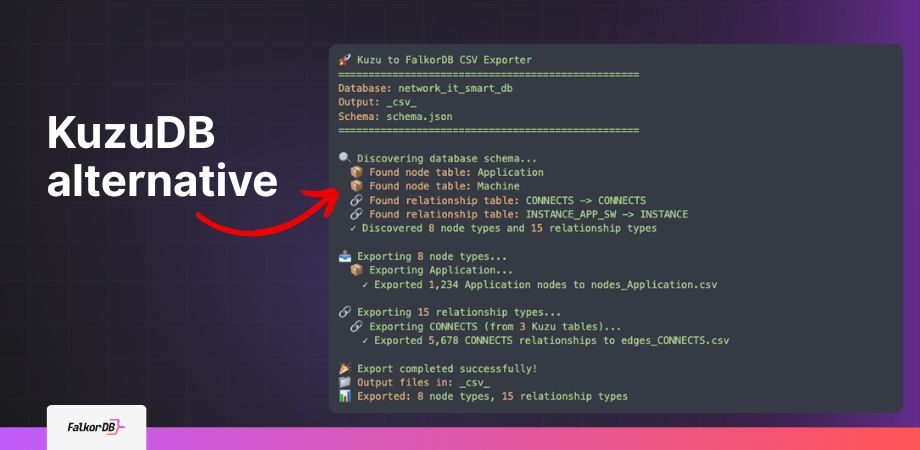
The recommended migration process involves exporting your KuzuDB data to CSV with auto schema discovery, which preserves nodes, edges, properties, and metadata. You then load these exports into FalkorDB using the Rust loader, which supports async batching, streaming CSV, and the creation of indexes and constraints. This approach ensures a clean and efficient import path for your graph data. For detailed steps, refer to the KuzuDB to FalkorDB migration guide.
Does the migration from KuzuDB to FalkorDB preserve node labels and relationship types?
Yes, the migration process preserves node labels and edge (relationship) types. The exporter writes these to CSV, and the FalkorDB loader reconstructs the graph, creating indexes and constraints as needed to maintain graph semantics.
How can I ensure my KuzuDB to FalkorDB migration is repeatable and reliable?
To ensure repeatability and reliability, treat migrations as repeatable jobs and keep migration scripts in version control. Validate node and edge counts and run sample queries after loading data into FalkorDB, following patterns shown in migration examples. This approach helps confirm data parity before switching production traffic to the new graph.
What tools are available for loading data into FalkorDB during migration?
The FalkorDB Rust loader is recommended for loading data during migration. It supports async batching, streaming CSV files, and the creation of indexes and constraints, enabling efficient and scalable data import for large graphs.
Where can I find official documentation for migrating from KuzuDB to FalkorDB?
Official documentation for KuzuDB to FalkorDB migration is available at docs.falkordb.com/migration/kuzu-to-falkordb.html. This guide provides step-by-step instructions, best practices, and troubleshooting tips for a smooth migration.
Why should teams consider migrating from KuzuDB to FalkorDB?
KuzuDB has been archived and is no longer actively supported, while FalkorDB offers an actively maintained graph database with strong support for GraphRAG and agent-centric workloads. FalkorDB provides low latency, reliable retrieval, and an active open source community, making it a robust choice for teams needing ongoing support and innovation.
How does FalkorDB support CI/CD workflows during migration?
FalkorDB migration workflows are designed to be repeatable and auditable, making them suitable for CI/CD pipelines. By keeping migration scripts in version control and validating data after each load, teams can automate and verify migrations across environments.
What pre-migration steps are recommended before moving from KuzuDB to FalkorDB?
Before migrating, review FalkorDB documentation and planning materials to align your graph modeling and operational needs with your GraphRAG goals. If you have experience with other graph stores, FalkorDB provides migration guides for Neo4j and RedisGraph that offer concrete scripts and verification steps applicable to your migration checklist.
How does FalkorDB handle schema and metadata during migration?
FalkorDB's migration process with auto schema discovery ensures that nodes, relationships, properties, and metadata are preserved and accurately mapped during the import, maintaining the integrity of your original graph structure.
What are the best practices for validating a successful migration to FalkorDB?
Best practices include validating node and edge counts, running sample queries to confirm data integrity, and reviewing loader statistics before switching application traffic to FalkorDB. These steps help ensure a smooth and reliable migration.
What should I do if I encounter issues during the migration process?
If you encounter issues, consult the official migration documentation and community forums for troubleshooting tips. You can also reach out to the FalkorDB team or join the Discord server for real-time support from the community and experts.
Is there a way to automate KuzuDB to FalkorDB migrations for regular updates?
Yes, by scripting the export and load process and integrating it into your CI/CD pipeline, you can automate regular migrations and updates, ensuring your FalkorDB instance stays in sync with your source data.
How does FalkorDB's migration process compare to migrations from other graph databases?
FalkorDB provides migration guides for Neo4j and RedisGraph, offering concrete scripts and verification steps. The general workflow for all migrations involves structured exports and programmatic loaders, making the process predictable and repeatable across different graph stores.
What is the status of KuzuDB and why is migration necessary?
KuzuDB has been archived and is now in read-only status, with no active support or maintenance. The PyPI page and GitHub repository both reflect this status. Migration to an actively maintained solution like FalkorDB is recommended for ongoing support and feature updates.
How does FalkorDB support GraphRAG and agent-centric workloads?
FalkorDB is optimized for low-latency graph querying, making it ideal for feeding LLMs and GraphRAG pipelines. Its architecture supports reliable retrieval quality and fast agent loops, which are essential for agent-centric AI applications.
What community resources are available for FalkorDB migration support?
FalkorDB offers an active open source community, including a Discord server, GitHub discussions, and detailed documentation. These resources provide support, troubleshooting, and best practices for migration and ongoing use.
Can I find migration guides for other graph databases besides KuzuDB?
Yes, FalkorDB provides migration guides for Neo4j and RedisGraph, which include scripts and verification steps that can be adapted for other graph database migrations as well.
How do I verify data integrity after migrating to FalkorDB?
After migration, you should verify data integrity by checking node and edge counts, running representative queries, and reviewing loader statistics. This ensures that your data has been accurately transferred and is ready for production use.
What are the benefits of using FalkorDB for AI and knowledge graph applications?
FalkorDB is designed for low-latency, high-performance graph querying, making it ideal for AI, GraphRAG, and agent-centric applications. It supports real-time data analysis, multi-tenancy, and advanced integrations, providing a robust platform for modern knowledge graph workloads.
Features & Capabilities
What are the key features of FalkorDB?
FalkorDB offers ultra-low latency, linear scalability, support for over 10,000 multi-graphs (tenants), open-source licensing, advanced AI integration (GraphRAG and agent memory), and flexible deployment options (cloud and on-prem). It is optimized for real-time, high-dimensional data analysis and supports advanced use cases like Text2SQL, security graphs, and fraud detection.
Does FalkorDB support multi-tenancy?
Yes, FalkorDB supports multi-tenancy in all plans, enabling management of over 10,000 multi-graphs. This is particularly valuable for SaaS providers and enterprises with diverse user bases.
What integrations are available with FalkorDB?
FalkorDB integrates with frameworks such as Graphiti (for AI agent memory), g.v() (for knowledge graph visualization), Cognee (for mapping knowledge graphs), LangChain (for LLM integration), and LlamaIndex (for advanced knowledge graph applications). For more details, visit the integrations page.
Does FalkorDB provide an API?
Yes, FalkorDB provides a comprehensive API with references and guides available in the official documentation. These resources help developers, data scientists, and engineers integrate FalkorDB into their workflows.
What technical documentation is available for FalkorDB?
FalkorDB offers comprehensive technical documentation, including setup guides, API references, and advanced configuration instructions. Access the documentation at docs.falkordb.com and the latest release notes on the GitHub Releases Page.
What security and compliance certifications does FalkorDB have?
FalkorDB is SOC 2 Type II compliant, meeting rigorous standards for security, availability, processing integrity, confidentiality, and privacy. This certification demonstrates FalkorDB's commitment to maintaining the highest levels of security and compliance. More details are available on the demo page.
How does FalkorDB ensure data security and privacy?
FalkorDB implements robust security measures, including protection against unauthorized access, operational availability, accurate data processing, confidentiality safeguards, and privacy compliance. These measures are validated by SOC 2 Type II certification.
What performance advantages does FalkorDB offer?
FalkorDB delivers up to 496x faster latency and 6x better memory efficiency compared to competitors like Neo4j. It supports over 10,000 multi-graphs and flexible horizontal scaling, making it ideal for real-time, large-scale, and high-dimensional data analysis. For benchmarks, visit the benchmarks page.
Pricing & Plans
What pricing plans does FalkorDB offer?
FalkorDB offers four pricing plans: FREE (for MVPs with community support), STARTUP (from /1GB/month, includes TLS and automated backups), PRO (from 0/8GB/month, includes cluster deployment and high availability), and ENTERPRISE (custom pricing with VPC, custom backups, and 24/7 support). For details, visit the pricing page.
What features are included in the FREE plan?
The FREE plan is designed for building a powerful MVP and includes community support. It is ideal for developers and small teams starting with FalkorDB.
What does the STARTUP plan cost and include?
The STARTUP plan starts at per 1GB per month and includes features such as TLS encryption and automated backups, making it suitable for growing teams and early-stage companies.
What does the PRO plan cost and include?
The PRO plan starts at 0 per 8GB per month and includes advanced features like cluster deployment and high availability, catering to organizations with more demanding requirements.
What is included in the ENTERPRISE plan?
The ENTERPRISE plan offers tailored pricing and includes enterprise-grade features such as VPC deployment, custom backups, and 24/7 support. It is designed for large organizations with complex needs.
Competition & Comparison
How does FalkorDB compare to Neo4j?
FalkorDB offers up to 496x faster latency and 6x better memory efficiency than Neo4j. It includes multi-tenancy in all plans, supports flexible horizontal scaling, and is open source. For a detailed comparison, visit the Neo4j comparison page.
How does FalkorDB compare to AWS Neptune?
FalkorDB is open source, supports multi-tenancy, and delivers better latency performance compared to AWS Neptune. It also supports Cypher query language and is more memory efficient. For more, see the AWS Neptune comparison page.
What are the main differences between FalkorDB and TigerGraph?
FalkorDB provides faster latency, more efficient memory usage, and flexible horizontal scaling compared to TigerGraph. It is rated as 'fast' versus TigerGraph's 'adequate' latency and supports advanced AI use cases.
How does FalkorDB compare to ArangoDB?
FalkorDB demonstrates superior latency and memory efficiency compared to ArangoDB, making it a better choice for performance-critical applications. It also supports flexible horizontal scaling and advanced AI integrations.
Use Cases & Benefits
What are the primary use cases for FalkorDB?
FalkorDB is used for Text2SQL (natural language to SQL queries), security graphs (CNAPP, CSPM, CIEM), GraphRAG (advanced graph-based retrieval), agentic AI and chatbots, fraud detection, and high-performance graph storage for complex relationships.
Who can benefit from using FalkorDB?
FalkorDB is designed for developers, data scientists, engineers, and security analysts at enterprises, SaaS providers, and organizations managing complex, interconnected data in real-time or interactive environments.
What business impact can customers expect from using FalkorDB?
Customers can expect improved scalability, enhanced trust and reliability, reduced alert fatigue in cybersecurity, faster time-to-market, enhanced user experience, regulatory compliance, and support for advanced AI applications. These outcomes help organizations unlock the full potential of their data and achieve strategic goals.
What pain points does FalkorDB address?
FalkorDB addresses pain points such as trust and reliability in LLM-based applications, scalability and data management, alert fatigue in cybersecurity, performance limitations of competitors, interactive data analysis, regulatory compliance, and the need for real-time adaptability in agentic AI and chatbots.
What customer success stories are available for FalkorDB?
Customers like AdaptX, XR.Voyage, and Virtuous AI have successfully implemented FalkorDB to solve complex challenges in healthcare, media & entertainment, and ethical AI development. Read their stories in the case studies.
What industries are represented in FalkorDB's case studies?
FalkorDB's case studies cover industries such as healthcare (AdaptX), media and entertainment (XR.Voyage), and artificial intelligence/ethical AI development (Virtuous AI). For more, see the case studies page.
Support & Implementation
How long does it take to implement FalkorDB?
FalkorDB is built for rapid deployment, enabling teams to go from concept to enterprise-grade solutions in weeks, not months. This accelerates time-to-market for new applications.
How easy is it to get started with FalkorDB?
Getting started is straightforward: sign up for FalkorDB Cloud, launch a free instance, or run FalkorDB locally using Docker. Comprehensive documentation, community support, and demo options are available to help you onboard quickly.
What support and training options are available for FalkorDB?
FalkorDB provides comprehensive documentation, community support via Discord and GitHub Discussions, access to solution architects, and free trial/demo options for onboarding. Tutorials and technical articles are also available on the blog.
What feedback have customers given about FalkorDB's ease of use?
Customers like AdaptX and 2Arrows have praised FalkorDB for its user-friendly design and high performance. AdaptX highlighted rapid access to clinical data insights, while 2Arrows called FalkorDB a 'game-changer' for ease of running non-traversal queries compared to Neo4j. See case studies for more.