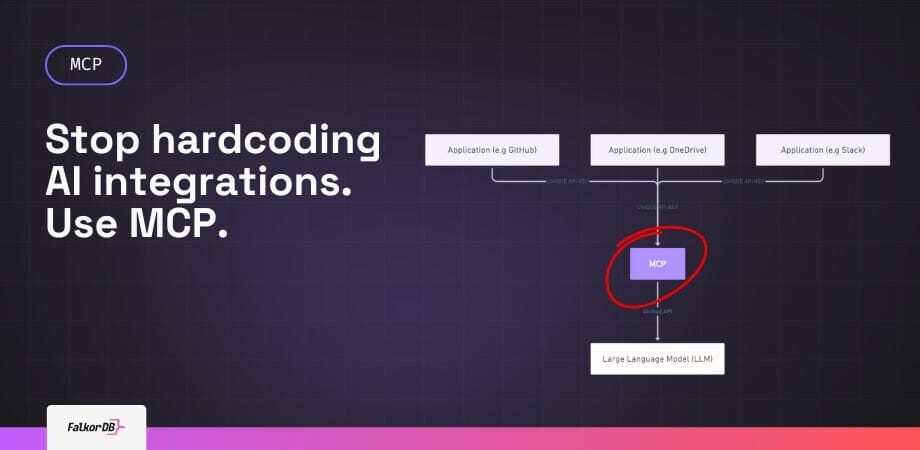

The Model Context Protocol (MCP) is an open standard developed by Anthropic that provides a universal interface for AI models to access and interact with external data sources. FalkorDB has implemented an MCP server, enabling AI models to query and interact with its graph database efficiently. This integration supports advanced applications such as Graph Retrieval-Augmented Generation (GraphRAG), where understanding complex relationships within data is essential. [Anthropic MCP announcement]
FalkorDB's MCP server acts as a bridge between AI models and its graph database. It translates MCP requests into FalkorDB-specific queries (using Cypher), allowing AI systems to retrieve and manipulate graph data efficiently. This setup is instrumental in applications where understanding the relationships between data points is essential.
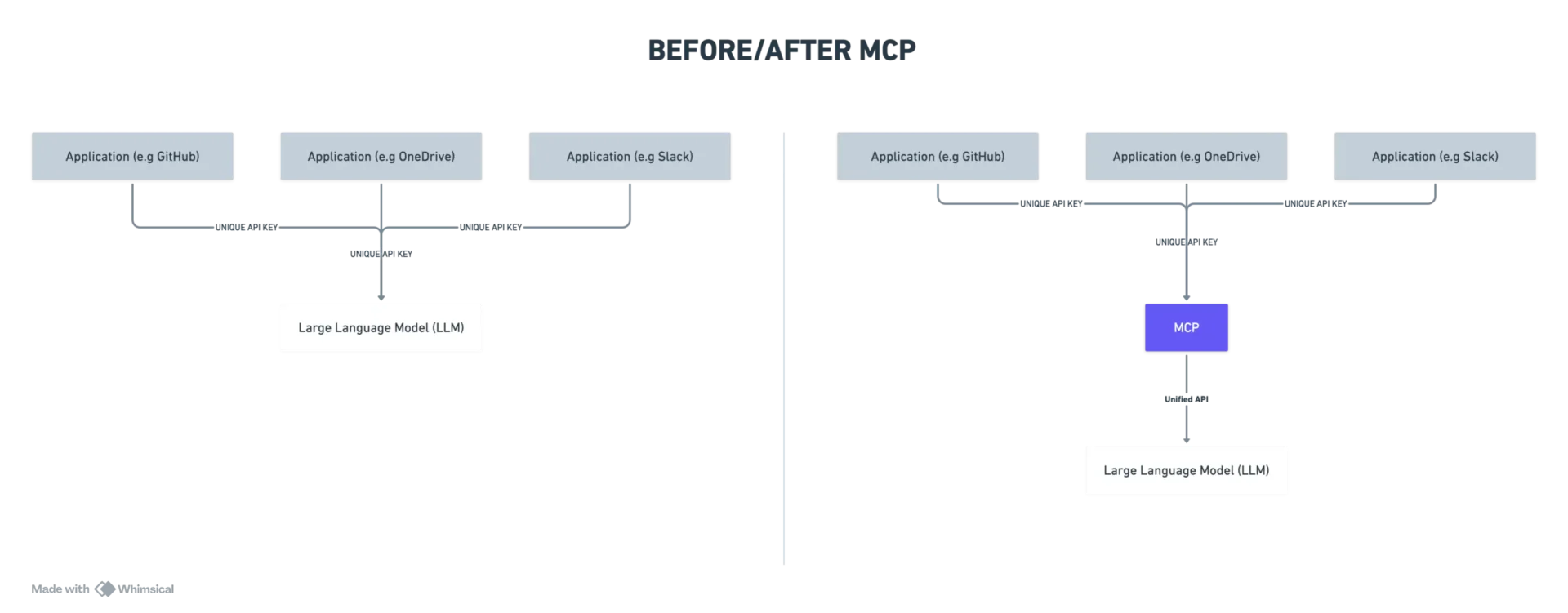
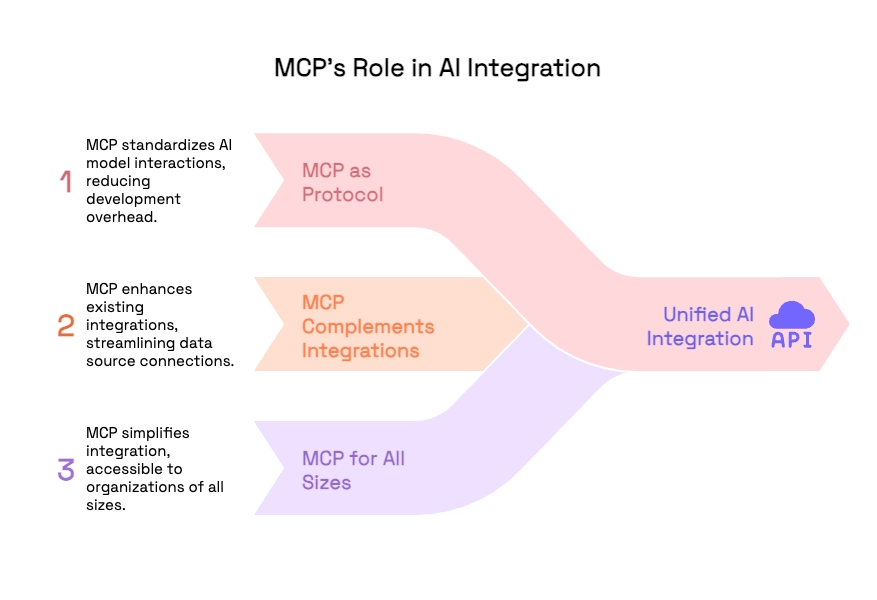
Integrating MCP with FalkorDB allows AI systems to access graph data through a standardized protocol, eliminating the need for custom connectors. This streamlines development, increases flexibility, and enables advanced use cases like GraphRAG, agentic AI, and real-time data analysis across diverse sources.
To set up FalkorDB's MCP server:
git clone https://github.com/falkordb/falkordb-mcpserver.gitnpm installcp .env.example .env.env with your configuration details.Common misconceptions include:
MCP does not define how authentication or error handling should be managed, leaving these aspects to the implementation. It also does not natively support real-time updates or event-driven architectures, which may be necessary for certain applications. Developers should consider these limitations when designing their solutions.
Ideal use cases include:
You should avoid using MCP for high-frequency event streams or use cases that require millisecond-level real-time data propagation, as MCP does not natively support real-time updates or event-driven architectures.
MCP abstracts tool integrations by providing a single, standardized interface for AI systems to query any supported data source. This eliminates the need for custom connectors for each source, reducing development overhead and increasing flexibility.
FalkorDB's MCP server translates incoming MCP requests into Cypher queries, leveraging the full schema and relationship context of the graph database. This enables AI models to perform complex graph operations efficiently and accurately.
FalkorDB offers ultra-low latency (up to 496x faster than Neo4j), 6x better memory efficiency, support for over 10,000 multi-graphs (tenants), open-source licensing, linear scalability, and is optimized for AI use cases like GraphRAG and agent memory. It also provides both cloud and on-prem deployment options. [Source]
Yes, FalkorDB supports multi-tenancy in all plans, enabling management of over 10,000 multi-graphs. This is especially valuable for SaaS providers and organizations with diverse user bases. [Source]
FalkorDB integrates with frameworks such as Graphiti (for AI agent memory), g.v() (for knowledge graph visualization), Cognee (for AI agent memory and knowledge mapping), LangChain (for LLM integration), and LlamaIndex (for advanced knowledge graph applications). FalkorDB is also open to new integrations. [Integrations]
Yes, FalkorDB provides a comprehensive API with references and guides available in the official documentation. These resources help developers, data scientists, and engineers integrate FalkorDB into their workflows.
FalkorDB offers comprehensive technical documentation and API references at docs.falkordb.com, as well as release notes on the GitHub Releases Page. These resources cover setup, advanced configurations, and integration guidance.
FalkorDB is optimized for advanced AI use cases such as GraphRAG and agent memory. It enables intelligent agents and chatbots with real-time adaptability, combining graph traversal with vector search for personalized user experiences. [Source]
GraphRAG (Graph Retrieval-Augmented Generation) is an approach that leverages graph databases to provide advanced retrieval capabilities for AI models. FalkorDB supports GraphRAG by enabling fast, schema-aware queries and real-time data analysis, resulting in more accurate and context-rich responses from LLMs. [GraphRAG SDK]
FalkorDB is SOC 2 Type II compliant, meeting rigorous standards for security, availability, processing integrity, confidentiality, and privacy. This demonstrates FalkorDB's commitment to maintaining the highest standards of security and compliance. [Source]
FalkorDB enables fast, interactive analysis of complex data through dashboards and custom views. Its ultra-low latency and efficient memory usage make it ideal for real-time data exploration and actionable insights. [Source]
FalkorDB offers four main pricing plans:
The PRO plan starts from 0/8GB/Month and includes advanced features such as Cluster Deployment, High Availability, and additional enterprise-grade capabilities. [Source]
Yes, FalkorDB offers a FREE plan designed for building a powerful MVP with community support. Users can also try FalkorDB for free by launching a cloud instance or running it locally using Docker. [Try Free]
You can get started by signing up for FalkorDB Cloud, launching a free instance, running FalkorDB locally with Docker, or scheduling a demo. Comprehensive documentation and community support are also available to help you onboard quickly. [Get a Demo]
FalkorDB is built for rapid deployment, enabling teams to go from concept to enterprise-grade solutions in weeks, not months. This accelerates time-to-market for organizations. [Source]
Primary use cases include Text2SQL (natural language to SQL queries), Security Graph (for CNAPP, CSPM & CIEM), GraphRAG (advanced graph-based retrieval), Agentic AI & Chatbots (intelligent agents), and Fraud Detection (real-time pattern detection across transaction networks). [Source]
FalkorDB is designed for developers, data scientists, engineers, and security analysts at enterprises, SaaS providers, and organizations managing complex, interconnected data in real-time or interactive environments. [Source]
Customers can expect improved scalability, enhanced trust and reliability, reduced alert fatigue in cybersecurity, faster time-to-market, enhanced user experience, regulatory compliance, and support for advanced AI applications. These outcomes empower businesses to unlock the full potential of their data and achieve strategic goals. [Source]
FalkorDB addresses pain points such as trust and reliability in LLM-based applications, scalability and data management, alert fatigue in cybersecurity, performance limitations of competitors, interactive data analysis, regulatory compliance, and support for agentic AI and chatbots. [Source]
Customers like AdaptX and 2Arrows have praised FalkorDB for its user-friendly design and high performance. AdaptX highlighted rapid access to clinical insights, while 2Arrows' CTO called FalkorDB a 'game-changer' for its superior performance and ease of running non-traversal queries compared to Neo4j. [AdaptX Case Study]
Industries include healthcare (AdaptX), media and entertainment (XR.Voyage), and artificial intelligence/ethical AI development (Virtuous AI). [Case Studies]
Yes.
Notable customers include AdaptX, XR.Voyage, and Virtuous AI. Their success stories are available on the FalkorDB case studies page.
FalkorDB offers up to 496x faster latency, 6x better memory efficiency, flexible horizontal scaling, and includes multi-tenancy in all plans. Neo4j uses an on-disk storage model, is written in Java, and offers multi-tenancy only in premium plans. [Comparison]
FalkorDB is open source, supports multi-tenancy, offers highly efficient vector search, and provides better latency performance compared to AWS Neptune, which is proprietary, closed-source, and lacks multi-tenancy support. [Comparison]
FalkorDB delivers faster latency, more efficient memory usage, and flexible horizontal scaling compared to TigerGraph, which has limited horizontal scaling and moderate memory efficiency. [Source]
FalkorDB demonstrates superior latency and memory efficiency, making it a better choice for performance-critical applications compared to ArangoDB, which has moderate memory efficiency and limited horizontal scaling. [Source]
FalkorDB stands out due to its exceptional performance (up to 496x faster latency), scalability, built-in multi-tenancy, advanced AI integration, open-source licensing, and enhanced user experience. It is trusted by customers in healthcare, media, and AI development. [Source]
FalkorDB solves problems such as trust and reliability in LLM-based applications, efficient management of large-scale data, reducing alert fatigue in cybersecurity, outperforming competitors in non-traversal queries, and enabling fast, interactive data analysis. [Source]
FalkorDB is unique for its ultra-low latency, high memory efficiency, built-in multi-tenancy, open-source model, advanced AI optimization, and proven success in demanding industries. Its ability to support over 10,000 multi-graphs and rapid deployment further distinguishes it from competitors. [Source]