


You’re probably dealing with the same kind of mess most AI teams hit early on. A workflow works in staging, then a vendor changes a response shape, a tool returns partial data, or a request arrives with one missing field, and the whole chain falls apart. That’s where agentic workflows stop being a buzzword and start being a practical design choice, because they let systems plan, act, observe results, and revise the next step instead of blindly following a brittle script.
The useful mental shift is simple. Fixed automation is a checklist, while an agentic workflow is more like a governed operator that can choose the next move based on what happened. That difference matters in data-heavy systems, especially when the work spans APIs, databases, human approvals, and changing context. For teams building this in production, the key questions aren’t just “what is agentic workflows” and “can it work,” but how do we keep it observable, secure, and memory-safe.
Table of Contents
- From Brittle Scripts to Intelligent Systems
- The Core Components of an Agentic Workflow
- Architecting Reliable Agentic Systems
- Agentic Workflows in Action
- Governance and Production Pitfalls to Avoid
- A Pragmatic Guide to Implementation
- Conclusion The New Frontier of Automation
From Brittle Scripts to Intelligent Systems
A lot of automation starts with a script that feels elegant on day one. It pulls a record, calls an API, transforms a payload, and writes the result somewhere else. Then a field name changes, an API returns an unexpected status, or the input includes edge-case data, and the entire flow stops because the script had no ability to recover.
That’s the limit of fixed automation. It follows instructions, but it doesn’t understand the task well enough to re-plan when the environment shifts. The UK government’s AI Insights guidance describes agentic workflows as systems where autonomous AI agents manage, coordinate, and execute tasks, make real-time decisions from predefined rules and context, and adapt dynamically to unexpected events without human intervention UK government AI Insights on agentic workflow.
Why the shift matters
The practical difference is that an agentic workflow doesn’t stop at execution. It can inspect what happened, decide whether the outcome is acceptable, and choose a different action path if the first attempt fails. That’s why the term became mainstream in the 2020s, when enterprises started pushing beyond static automation toward systems that can use tools, memory, and feedback loops to finish multi-step work.
Practical rule: if the task needs judgment at runtime, not just routing, you’re already in agent territory.
That said, not every problem should be solved this way. If a deterministic workflow plus a small AI step can do the job, that’s often the safer and cheaper path. The point isn’t to make everything autonomous, it’s to use autonomy only where the work is variable, cross-system, or hard to pre-script.
For teams trying to map this concept to their own systems, a useful starting point is graph database AI agents, because memory and relationship-aware retrieval become central once tasks span multiple steps and entities.
What changes in practice
The biggest change is control flow. Instead of writing a fixed sequence, you define a governed process and let the agent choose among permitted actions at runtime. That means the agent can retry, branch, or ask for more context when the environment doesn’t match the happy path.
For engineers, that sounds liberating until you have to debug it. Once the system becomes non-linear, you need traceability, memory design, and permission boundaries. Without those, autonomy quickly turns into a support burden.
The Core Components of an Agentic Workflow
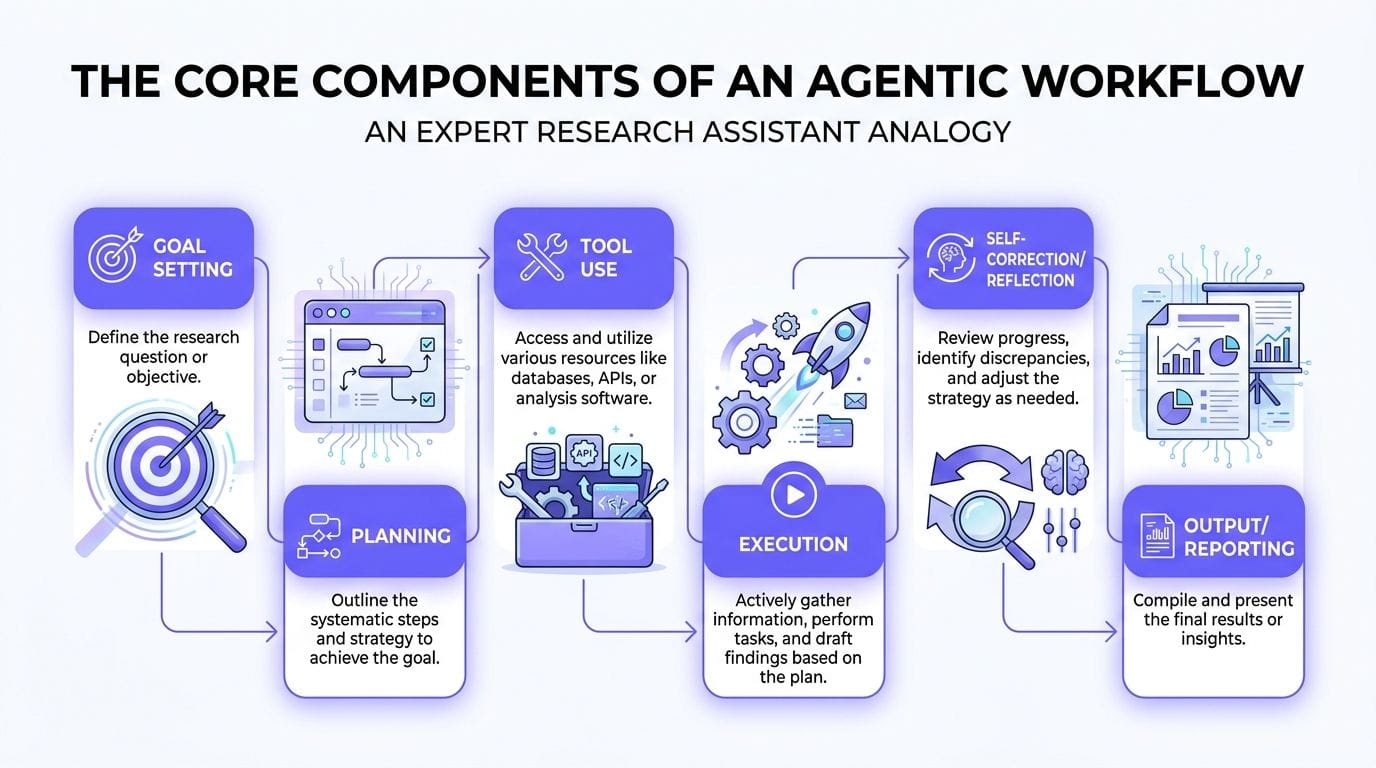
Think of an agentic workflow like an expert research assistant. You give it a goal, it figures out what to check first, it uses tools to gather evidence, and it revises its plan when the evidence doesn’t line up. The system is useful because it doesn’t confuse a goal with a script.
Goal, planner, and tools
The goal is the outcome you want, not the steps you want the model to follow. In a good setup, the goal is narrow enough to be testable but broad enough to let the agent decide how to get there.
The planner or orchestrator turns that goal into a sequence of steps. In practice, the system decides whether to search, retrieve, summarize, call an API, write a record, or pause for approval. The practical guide from Automation Anywhere describes the workflow as a continuous sense, reason, act loop in which agents can plan, execute, reflect, and retry until the goal is reached Automation Anywhere on agentic workflows.
Tools are the agent’s hands. They might be APIs, databases, file systems, code execution, or search services. If the tool layer is sloppy, the agent becomes dangerous quickly, because the model may reason well while still calling the wrong thing.
Memory and reflection
Memory is where many teams underestimate the problem. Short-term context lives in the model window, but long-running work needs durable state outside the model so the agent can remember progress without dropping earlier facts. That split between volatile context and persistent memory is what makes long tasks survivable in production Chrono Innovation on agentic AI workflows architecture.
Reflection is the part that separates an agent from a one-shot prompt. After each step, it evaluates whether the outcome matched the goal. If not, it loops back and retries with updated information.
Keep the model focused on reasoning, and keep state outside the prompt. That’s usually the difference between a workflow that survives a long task and one that collapses under its own context.
For teams dealing with data retrieval, relationship traversal, or multi-entity reasoning, a graph database gives that durable memory a structure the model can query. It’s especially relevant when the “memory” isn’t just chat history, but a web of linked facts, entities, and task state.
A useful companion read is web scraping for AI agents, because tool use often starts with controlled data collection before it ever reaches decision-making.
Output and feedback
The final piece is output. In agentic systems, output isn’t just a response, it can be a ticket, a record, a recommendation, a queued action, or a validated handoff to a human. The workflow should also emit enough feedback to show how it got there.
That feedback matters because engineers need to know whether the agent found the right evidence, chose the right branch, or failed safely. Without that, you can’t tune the system, and you can’t trust it.
Architecting Reliable Agentic Systems
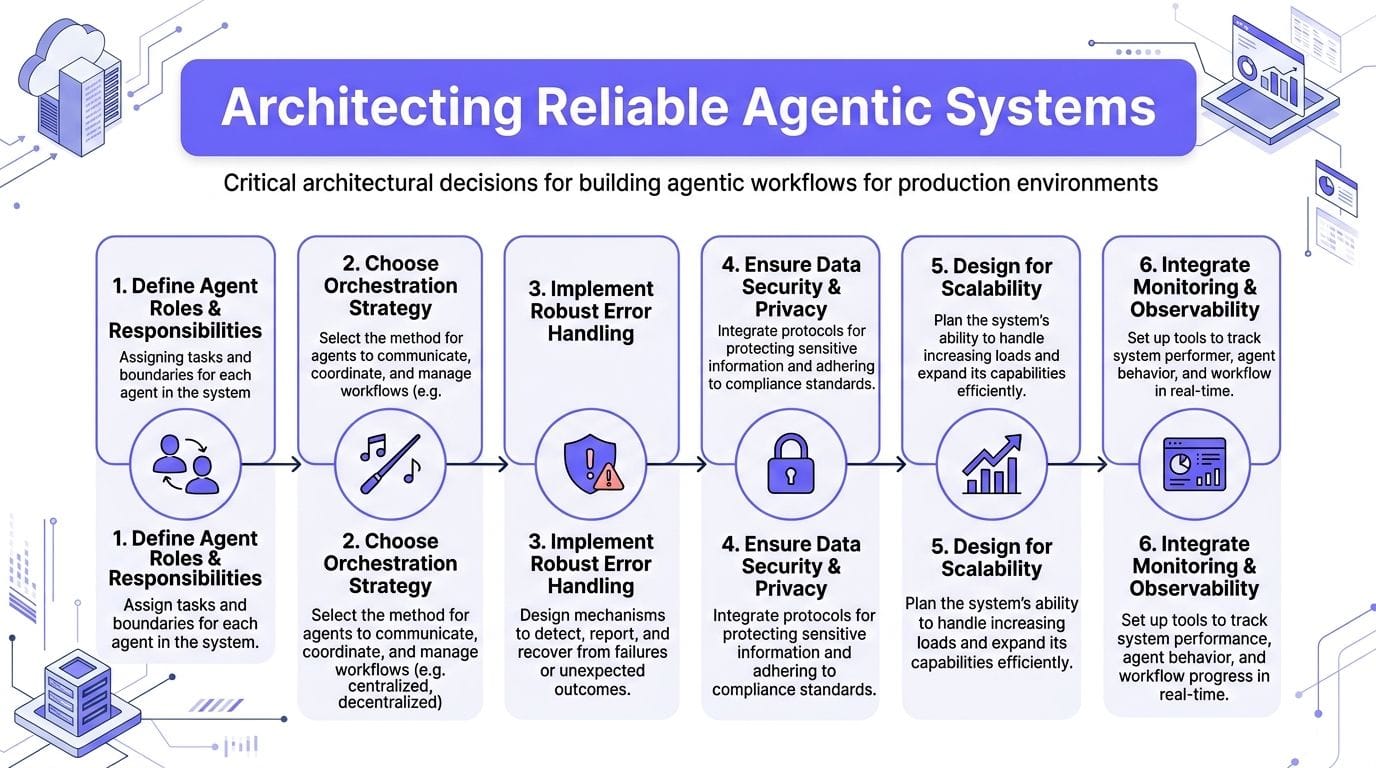
Reliable agentic systems start with a hard truth. The model is only one part of the stack. The architecture includes state, routing, validation, permissions, retries, and the audit trail that lets someone understand what happened later.
State belongs outside the prompt
The first production decision is where state lives. The model context window works for short-term reasoning, but it is the wrong place for durable memory, task progress, and relationship-heavy history. Production systems need external memory, along with scoped interfaces for retrieval and tool access so the agent cannot wander freely through every system it knows about Chrono Innovation on agentic AI workflows architecture.
That is where graph databases move from storage into system design. They help when the agent needs to traverse entities and relationships, not just search text. A graph can hold conversation state, linked records, provenance, and task dependencies in a form the model can query incrementally instead of trying to reread everything on every turn.
I have seen teams use flat memory stores and then wonder why their agents lose the thread on long jobs. The model is not failing because it cannot reason, it is failing because the architecture makes it hard to recover the right context at the right time.
Control plane over cleverness
The next decision is orchestration. A single-agent design is often easier to govern, while a multi-agent design can help when different responsibilities need isolation. The trade-off is straightforward, every additional agent adds routing, failure handling, and observability work.
Operational rule: keep the control plane simpler than the reasoning layer.
That matters because the production risk is not only bad answers, it is bad state transitions. Guardrails like retry limits, timeouts, permissions, and schema checks make runtime behavior predictable enough to debug. Without them, the workflow turns into a non-deterministic maze.
The governance gap is real. Many explanations focus on autonomy, but fewer explain how to keep it controlled at scale. Strong practical guidance centers least-privilege access, validation, layered testing, observability, and explicit override points. That same operating model shows up in the way teams build systems for Donely AI employees, where reliability depends on access boundaries and clear human control, not just model quality.
For graph-centric state and workflow memory, one option is Graphiti with FalkorDB for multi-agent performance. The point is not the product name, it is the pattern. Keep memory queryable, durable, and separate from the model’s temporary context.
Observability has to be structured
You cannot debug a workflow you cannot replay. Production guidance emphasizes structured trace events with task IDs, agent IDs, payloads, routing decisions, and token counts so the execution path can be reconstructed later. That is better than a plain text log, because logs do not explain branching behavior well YouTube discussion on agentic workflow observability.
For engineers building the first version of this stack, it helps to anchor traces in familiar standards and tools. OpenTelemetry is a practical baseline for cross-service tracing, while platforms such as LangSmith and Arize Phoenix can help teams inspect agent runs, compare trajectories, and spot where reasoning or tool use went off course.
Many teams underestimate cost and complexity. A multi-step agent can look small in a demo and become expensive in production once retries, validation, tool calls, and human review enter the loop. The workflow should be designed with those costs in mind before the first rollout, not after the budget starts drifting.
Agentic Workflows in Action
A lot of abstract descriptions of what is agentic workflows never make it clear how they behave under real workload. The easiest way to understand them is to watch how they move through data, tools, and state when the task is messy.
GraphRAG and relationship-heavy questions
In GraphRAG-style retrieval, the agent doesn’t just search for matching text. It follows relationships, checks connected entities, and composes an answer from linked facts. That’s a very different workload from keyword search, because the question often depends on several hops across data rather than one direct match.
A graph-backed memory layer works well here because it preserves context as relationships, not as isolated snippets. The agent can ask, “What’s related to this alert, user, asset, or document?” and then traverse outward to assemble a grounded answer. That makes the workflow better suited to provenance-sensitive use cases where the path to the answer matters as much as the answer itself.
Security and fraud investigations
Security workflows are a strong fit because investigators rarely get one clean signal. They get alerts, asset context, identity traces, unusual relationships, and a need to connect them fast. A graph-based agent can move from one clue to the next, follow the likely attack path, and keep the evidence linked instead of flattening it into a summary too early.
This is also where multi-agent patterns can help, but only if the system stays controlled. One agent can focus on collecting evidence, another on correlating entities, and a third on drafting the investigation note, but the handoffs need to be explicit. The more the workflow is about lineage and repeatability, the more important the state model becomes.
If you want a concrete product example of this pattern, Donely AI employees is worth skimming because it shows how task-oriented agents are packaged as operational workers rather than chat interfaces.
General-purpose task automation
The simplest mental model is a task agent that plans a multi-step job, checks each step, and adapts when an external API fails or a dependency comes back incomplete. Travel coordination is a good example, because the agent may need to query several systems, compare options, and re-plan after one tool returns no availability.
That’s the point where agents outperform a rigid script. A script can only continue if every assumption holds. An agentic workflow can revisit the plan, change the sequence, or ask for approval when the result isn’t good enough.
Governance and Production Pitfalls to Avoid
The first mistake teams make is treating autonomy like a feature and governance like paperwork. In production, the two are tied together. If an agent can call tools, write records, or trigger downstream actions, every one of those actions needs a policy, a trace, and a rollback path.
Control is the product
Controllability is the production requirement that keeps the system usable. Guardrails, least-privilege tool access, input and output validation, layered testing, and human override points are the practical controls that keep agentic workflows from drifting into unsafe behavior, as outlined in Neo4j on what are agentic workflows. Those controls are not decoration. They are what make the workflow acceptable once real users and real data are involved.
The difficult part is that non-deterministic systems fail in ways teams do not expect. A workflow may succeed three times and then produce a different result on the fourth run because the retrieval set changed, the tool response changed, or the model chose a different branch. Without structured traces, you cannot tell whether the problem came from state, policy, or the model itself.
Security and permission boundaries
Security has to be built into the workflow from the start. If the agent has broad access to tools and data, a prompt error or malformed input can turn into an internal security incident. Scoped interfaces, least privilege, and validation shrink the blast radius when something goes wrong.
Human approval checkpoints matter more than many teams first expect. High-stakes actions, especially those that affect money, credentials, records, or customer communication, should pause for review. That adds a bit of friction, but it prevents the system from making irreversible mistakes on its own.
If the action would be hard to explain in an incident review, it probably needs a checkpoint.
Cost and test burden
Agentic designs also increase orchestration cost. More steps mean more tool calls, more tokens, more branching, and more cases to test. The design has to earn that complexity by solving a problem that deterministic automation cannot handle cleanly.
Testing also gets harder once the workflow can take different paths on different runs. In practice, teams need more than unit tests. They need evals that check output quality, tool choice, and end-to-end trajectory quality over time. That can include continuous evaluation pipelines, LLM-as-a-judge scoring for bounded tasks, and trajectory testing to verify whether the agent followed an acceptable path even when the final answer looks correct.
Observability has to cover runtime behavior, not just success or failure. You need to know which tools were called, which branch was chosen, which input was used, and what memory was referenced. Without that visibility, you are running a system that looks intelligent but cannot be audited.
For teams building persistent memory into these workflows, the state model matters as much as the prompt. A practical pattern is to store relationships, prior actions, and entity links in a graph so the agent can recover context without flattening everything into a short summary. A good reference point is implementing agentic memory with graph-based state, because it shows how memory design affects retrieval, continuity, and control in production systems.
A Pragmatic Guide to Implementation
Start with one workflow, not a platform. The guidance that keeps showing up is to begin with a single agent and use agentic systems only where decision latency, variability, or cross-system coordination is a bottleneck CodeWave on building agentic workflows. That advice is boring, and it’s right.
Choose the smallest useful shape
If a deterministic workflow plus a narrow AI step solves the problem, use that first. Agentic systems bring orchestration overhead and testing burden, so they should earn their place by handling work that changes at runtime. That usually means tasks with multiple tools, uncertain inputs, or a need to revisit earlier steps.
For implementation, frameworks such as LangChain and LangGraph are common entry points because they help define tool use, branching, and stateful execution. A graph database like FalkorDB can sit underneath that workflow as durable memory and relationship-aware retrieval, which is useful when context has to survive beyond one prompt or one call.
Build for control, then expand
The safest path is a narrow workflow with one agent, one job, and one evaluation loop. Add memory only when the task needs it, add more agents only when responsibilities are distinct, and keep the workflow logic separate from the tool layer. That separation makes it much easier to swap components later without rewriting the whole system.
A good rollout pattern is simple.
- Define one bounded task: Pick a workflow where the inputs, outputs, and failure modes are easy to describe.
- Externalize state early: Store durable memory outside the prompt so the workflow can recover context safely.
- Instrument every step: Capture tool calls, routing decisions, and validation outcomes in structured traces.
- Add approvals where it matters: Keep humans in the loop for sensitive actions until the workflow proves itself.
For memory-centric implementations, implementing agentic memory with Graphiti is a useful reference point because it treats memory as a production design problem, not a prompt trick.
The final rule is simple. Don’t adopt agentic workflows because they’re fashionable. Adopt them when they solve a specific operational problem better than a deterministic system can, and only after the architecture can support the resulting complexity.
Conclusion: The New Frontier of Automation
Agentic workflows are a shift from fixed automation to systems that can plan, act, and revise their own steps inside a governed process. That makes them powerful, but only when the architecture includes durable memory, structured observability, scoped tools, and clear human control points.
The teams that win with this pattern won’t be the ones that make the most autonomous demo. They’ll be the ones that keep the workflow reliable when the data changes, the tools fail, and the audit trail matters.
