


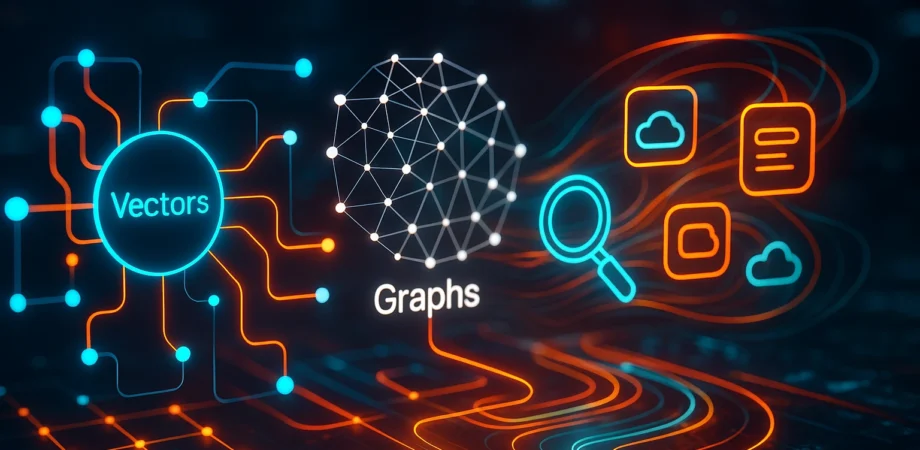
Most retrieval systems in production today rely on a single search modality, and each one fails in predictable ways. Keyword search misses semantic intent. Vector search loses structural context. Graph traversal cannot rank relevance at scale without an embedding layer. For teams building RAG pipelines, AI agents, or any system where retrieval quality directly determines output quality, these single-modal limitations translate into hallucinations, incomplete answers, and brittle context windows.
Understanding what is hybrid search in AI means recognizing that no single retrieval method covers every information need. Hybrid search combines two or more search paradigms, typically vector similarity, graph traversal, and keyword matching, into a unified retrieval pipeline. The result is a system that captures semantic meaning, structural relationships, and precise lexical matches simultaneously.
This article breaks down the three core search modalities, explains why combining them outperforms any single approach, walks through architecture patterns, and shows how FalkorDB enables hybrid vector-graph search for production RAG applications.
What Is Hybrid Search?
Hybrid search is a retrieval strategy that fuses multiple search paradigms into a single query pipeline. Rather than choosing between vector embeddings, keyword indexes, or graph traversals, hybrid search runs them in parallel or in sequence and merges the results using a scoring or re-ranking mechanism.
The core premise is straightforward: different data representations capture different types of information. A vector embedding encodes semantic similarity, “cardiac arrest” and “heart attack” land close together in embedding space. A keyword index captures exact terminology, critical when a user searches for a specific product SKU, error code, or regulation number. A knowledge graph encodes explicit relationships, which drug interacts with which enzyme, which microservice depends on which API.
Hybrid search does not simply concatenate results. Effective implementations use fusion algorithms such as Reciprocal Rank Fusion (RRF), weighted linear combination, or learned re-rankers to produce a single, unified ranking. The retrieval pipeline becomes a composite system where each modality compensates for the others’ blind spots.
In the context of AI applications, particularly retrieval-augmented generation, hybrid search directly improves the quality and completeness of the context passed to a language model. This is why understanding what is hybrid search in AI has become essential for any team building production-grade generative AI systems.
Vector Search vs Graph Search vs Keyword Search
Each search modality solves a specific class of retrieval problem. Choosing the right combination requires understanding what each one does well and where it breaks down.
Keyword Search
Keyword search uses inverted indexes and scoring functions like BM25 to match query terms against document terms. It excels at precision: when a user types an exact entity name, error code, or quoted phrase, keyword search returns the right document immediately. It fails on synonyms, paraphrases, and any query where the user’s vocabulary differs from the corpus vocabulary.
Vector Search
Vector search, also called nearest neighbor search, encodes queries and documents as dense embeddings and retrieves results by cosine similarity or dot product. It handles semantic similarity, matching intent rather than exact words. However, vector search treats every document as an isolated point in embedding space. It has no concept of relationships between entities, and it can return semantically similar but factually irrelevant results.
Graph Search
Graph search traverses nodes and edges in a knowledge graph to retrieve structured, relational information. A Cypher query can perform multi-hop traversal, “find all suppliers connected to this manufacturer that also supply components flagged in a recall.” Graph search preserves provenance, enforces logical constraints, and surfaces indirect relationships that neither keyword nor vector search can detect. Its limitation: without an embedding layer, graph search cannot rank by semantic relevance or handle unstructured natural-language queries directly.
The critical insight is that these modalities are complementary, not competing. A hybrid system uses keyword matching for exact-term precision, vector similarity for semantic coverage, and graph traversal for structural and relational context.
Why Hybrid Search Outperforms Single-Modal Retrieval
Single-modal retrieval creates systematic blind spots. Vector-only RAG pipelines frequently surface documents that are semantically adjacent but factually wrong, a phenomenon sometimes called “embedding hallucination.” Keyword-only systems miss relevant documents whenever terminology varies. Graph-only retrieval cannot handle unstructured queries or rank results by topical relevance.
Hybrid search eliminates these failure modes by cross-validating results across modalities. The concrete advantages include:
- Higher recall : Vector search captures paraphrased or conceptually related content that keyword search misses. Keyword search captures exact matches that fall outside the embedding model’s training distribution.
- Structural grounding : Graph traversal adds relational context, entity types, hierarchies, causal chains, that neither vector nor keyword search encodes. This is especially valuable for enterprise LLM accuracy where factual precision matters.
- Reduced hallucination : When a language model receives context that includes both semantically relevant passages and structurally validated entity relationships, it produces more grounded outputs.
- Query robustness : Hybrid systems degrade gracefully. If the vector index returns weak results for a highly specific query, the keyword and graph components still deliver precise answers.
The performance gap widens as query complexity increases. Simple factoid queries (“What is the boiling point of water?”) can be answered by any single modality. Multi-constraint queries (“Which FDA-approved drugs target the same pathway as Drug X but have fewer hepatotoxicity warnings?”) require keyword precision for drug names, vector similarity for pathway descriptions, and graph traversal for drug-pathway-adverse-event relationships.
Hybrid Search Architecture Patterns
There is no single “correct” hybrid search architecture. The right pattern depends on latency requirements, data structure, and the downstream consumer (human user vs. LLM). Three dominant patterns have emerged in production systems.
Parallel Fan-Out with Rank Fusion
The query is dispatched simultaneously to a vector index, a keyword index, and a graph database. Each returns a ranked result set. A fusion layer, typically Reciprocal Rank Fusion or a weighted score combination, merges the results into a single ranked list. This pattern minimizes latency because all retrievals run concurrently.
Sequential Pipeline (Graph-First or Vector-First)
One modality runs first to narrow the candidate set, and a second modality re-ranks or filters. For example, a graph traversal identifies all entities within two hops of a target node, then vector search ranks the associated text chunks by semantic relevance. This pattern is well-suited when the graph structure provides a strong structural prior, scoping computation to a relevant subgraph before running expensive similarity comparisons.
Unified Index with Multi-Modal Queries
Some databases natively support multiple index types on the same data. A single query can combine a vector similarity clause with a graph pattern match and a full-text predicate. This eliminates the need for external orchestration and reduces round-trip overhead. FalkorDB follows this pattern, allowing Cypher queries that incorporate vector similarity directly alongside graph traversal predicates.
Regardless of pattern, production systems need to address these operational concerns:
- Score normalization : Vector cosine scores, BM25 scores, and graph path weights operate on different scales. Normalization is required before fusion.
- Latency budgets : Graph traversals and vector searches have different latency profiles. Set per-modality timeouts and return partial results rather than blocking.
- Index synchronization : When the underlying data changes, all indexes, vector, keyword, graph, must update. Stale indexes in any modality degrade hybrid retrieval quality.
How FalkorDB Enables Hybrid Vector-Graph Search
FalkorDB is a graph database purpose-built for AI workloads that natively combines graph traversal with vector similarity search. Unlike architectures that require a separate vector database alongside a graph store, FalkorDB stores embeddings directly on graph nodes and edges, enabling a single Cypher query to perform both multi-hop traversal and vector nearest-neighbor search.
Key capabilities that make this practical:
- Native vector indexing on nodes : Embeddings are stored as node properties and indexed using approximate nearest-neighbor (ANN) algorithms. No external vector store is needed.
- Combined Cypher + vector queries : A single query can traverse a subgraph (e.g., all documents related to a specific project), then rank results by vector similarity within that scoped set.
- Sub-millisecond graph traversal : FalkorDB’s in-memory graph engine handles traversals at speeds that keep hybrid queries within interactive latency budgets.
- Multi-tenant isolation : Production RAG systems serving multiple customers can use multigraph topology to isolate graph workloads per tenant without sacrificing performance.
This unified approach eliminates the synchronization problem inherent in multi-system architectures. When a new document is ingested, its entities, relationships, and embeddings are written to a single store. There is no risk of the vector index and the graph diverging.
For teams exploring ontologies and knowledge graph schemas, FalkorDB’s schema-flexible graph model allows iterative refinement of entity types and relationships without migration overhead, a practical necessity when hybrid search requirements evolve during development.
Implementing Hybrid Search for RAG Applications
RAG pipelines are the primary consumer of hybrid search in AI systems. The retrieval step determines what context the language model sees, which directly controls output quality. Implementing hybrid search for RAG involves concrete engineering decisions at each stage.
- Build the knowledge graph : Extract entities and relationships from your corpus using NLP or LLM-based entity extraction. Store them as nodes and edges with properties. Use tools like the GraphRAG SDK to automate graph construction from documents.
- Generate and attach embeddings : Run an embedding model (e.g., text-embedding-3-small, BGE, or domain-specific models) over text chunks and entity descriptions. Store these embeddings directly on the corresponding graph nodes.
- Define retrieval queries : Write Cypher queries that combine structural constraints with vector similarity. Example: match nodes of type
Documentconnected to a specificProjectnode, then return the top-k most similar to the query embedding. - Add keyword fallback : For queries containing exact identifiers (part numbers, regulation codes, proper nouns), include a full-text search predicate as a parallel retrieval path or pre-filter.
- Fuse and re-rank : Apply Reciprocal Rank Fusion or a cross-encoder re-ranker to merge results from all modalities into a single context window for the LLM.
A practical starting point for teams new to this pattern is implementing a GraphRAG workflow using FalkorDB and LangChain, which provides orchestration scaffolding for multi-step retrieval pipelines. The key engineering discipline is measuring retrieval quality separately from generation quality, track precision, recall, and mean reciprocal rank at the retrieval layer before tuning the LLM prompt.
Frequently Asked Questions
What is hybrid search in AI and why does it matter?
Hybrid search in AI is a retrieval strategy that combines multiple search paradigms, typically vector, graph, and keyword, to deliver more complete and accurate results than any single method alone.
- It compensates for each modality’s blind spots: vectors miss exact terms, keywords miss synonyms, graphs miss unstructured relevance
- Critical for RAG pipelines where retrieval quality directly determines LLM output accuracy
- Reduces hallucination by grounding results in both semantic similarity and structural relationships
- Particularly valuable in enterprise domains with complex entity relationships, learn more about data retrieval and knowledge graphs for AI agents
How does hybrid search differ from vector-only RAG?
Vector-only RAG retrieves context based solely on embedding similarity, while hybrid search adds structural and lexical dimensions to retrieval.
- Vector-only RAG treats every chunk as an isolated point, no relational context between entities
- Hybrid search uses graph traversal to surface multi-hop relationships that vectors cannot encode
- Keyword matching in hybrid search catches exact terms that may fall outside the embedding model’s vocabulary
- The combined approach consistently produces higher precision and recall on complex, multi-constraint queries
What databases support hybrid vector-graph search natively?
A small number of databases support both vector indexing and graph traversal in a single engine, eliminating the need for multi-system architectures.
- FalkorDB stores embeddings directly on graph nodes and supports combined Cypher + vector queries
- Native support avoids index synchronization problems that plague multi-database setups
- Look for databases that allow scoping vector search to a subgraph, this is the key capability for structured hybrid retrieval
- Compare options carefully; see how FalkorDB compares to Neo4j on vector and graph integration
What is Reciprocal Rank Fusion and how is it used in hybrid search?
Reciprocal Rank Fusion (RRF) is a score-free algorithm that merges ranked result lists from multiple retrieval sources by combining their reciprocal ranks.
- RRF does not require score normalization, it uses only the position of each result in each list
- It assigns each result a fused score of 1/(k + rank) for each list it appears in, then sums across lists
- Works well as a baseline fusion method; learned re-rankers or cross-encoders can improve on it with training data
- Apply RRF after all retrieval modalities return their results but before passing context to the LLM
Can hybrid search be used with AI agents, not just RAG?
Yes, AI agents benefit from hybrid search whenever they need to retrieve information from a knowledge base to plan, reason, or take action.
- Agents performing multi-step reasoning can use graph traversal to follow entity chains and vector search to find relevant supporting evidence
- Tool-calling agents can route queries to different retrieval modalities based on query type (exact lookup vs. semantic search)
- Multi-agent systems can share a unified hybrid search layer as their common knowledge backend, see how FalkorDB integrates with AG2.ai for multi-agent systems
- Hybrid retrieval reduces the chance of agents acting on incomplete or semantically misleading context
How do I measure hybrid search quality in production?
Measure retrieval quality independently from generation quality using standard information retrieval metrics.
- Track precision@k, recall@k, and mean reciprocal rank (MRR) on a labeled evaluation set
- Compare hybrid results against each individual modality to quantify the gain from fusion
- Monitor per-modality contribution, if one modality consistently adds no unique results, it may be misconfigured or redundant
- Use A/B testing on downstream LLM outputs to validate that retrieval improvements translate to better generation
Building Retrieval Systems That Match Real Query Complexity
Hybrid search is not an optimization, it is a structural requirement for retrieval systems that handle real-world query complexity. Single-modal systems produce predictable failure modes: missed synonyms, lost relationships, or irrelevant semantic matches. Combining vectors, graphs, and keywords into a unified retrieval pipeline eliminates these gaps systematically.
For teams building RAG pipelines or AI agents, the practical starting point is clear: store entities and relationships in a graph, attach embeddings to nodes, and write queries that use both structural constraints and vector similarity. FalkorDB’s native support for combined Cypher and vector queries makes this achievable within a single system, removing the synchronization overhead of multi-database architectures.
The next step is to define your evaluation framework, build a labeled retrieval test set, measure precision and recall per modality, and quantify the fusion gain. That measurement discipline is what separates production hybrid search from proof-of-concept demos.
