Frequently Asked Questions
Product Overview & Purpose
What is GraphRAG-SDK and what does it do?
GraphRAG-SDK is an open-source toolkit developed by FalkorDB to simplify building Retrieval-Augmented Generation (RAG) applications using graph databases. It helps developers automate ontology creation, build and manage knowledge graphs, and interact with them using natural language, streamlining the RAG process for LLM-powered applications. [Source]
What is the primary purpose of FalkorDB?
FalkorDB is a high-performance graph database platform designed to manage complex, interconnected data and enable advanced AI applications. Its primary purpose is to deliver accurate, multi-tenant RAG solutions powered by low-latency, scalable graph database technology, making it ideal for enterprise GenAI and real-time data environments. [Source]
How does GraphRAG-SDK simplify RAG application development?
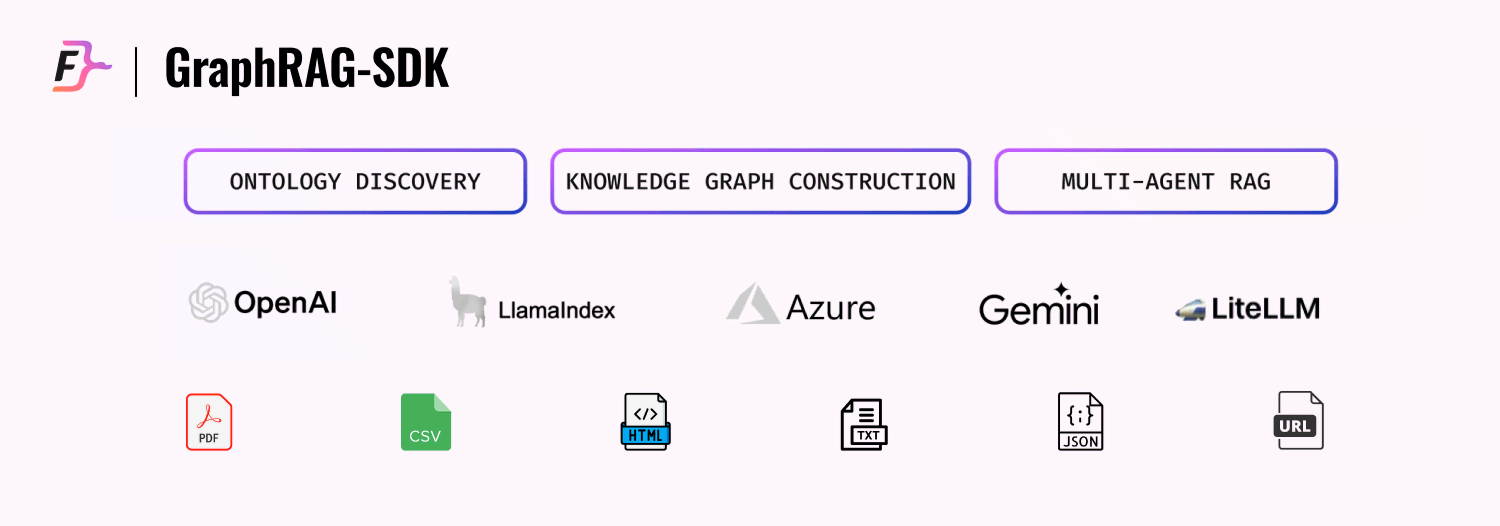
GraphRAG-SDK breaks down the RAG process into three main steps: creating ontologies (automated or manual), building knowledge graphs optimized for retrieval, and querying the graph using natural language. This abstraction allows developers to focus on application logic rather than the complexities of graph operations or LLM interactions. [Source]
What are the main use cases for FalkorDB and GraphRAG-SDK?
Key use cases include Text2SQL (natural language to SQL on complex schemas), security graphs for CNAPP/CSPM/CIEM, advanced GraphRAG for fast retrieval, agentic AI and chatbots, fraud detection, and high-performance graph storage for complex relationships. [Source]
Who is the target audience for FalkorDB and GraphRAG-SDK?
FalkorDB and GraphRAG-SDK are designed for developers, data scientists, engineers, and security analysts at enterprises, SaaS providers, and organizations managing complex, interconnected data in real-time or interactive environments. [Source]
Features & Capabilities
What new features are included in GraphRAG-SDK 0.4.0?
GraphRAG-SDK 0.4.0 introduces multi-LLM support (OpenAI, Anthropic, Cohere via LiteLLM), smarter query planning for efficient graph traversals, new RAG utilities for common operations, and enhanced documentation with practical examples. [Source]
How does LiteLLM integration benefit RAG applications?
LiteLLM integration allows developers to easily switch between different language models for knowledge graph generation and retrieval, optimize model selection for specific tasks, reduce vendor lock-in, and streamline deployment and maintenance. It also enables cost optimization by selecting the most efficient models for each stage of the RAG pipeline. [Source]
What are the key capabilities of FalkorDB?
FalkorDB supports over 10,000 multi-graphs (tenants), offers open-source licensing, linear scalability, ultra-low latency, GraphRAG and agent memory optimization, and flexible cloud/on-prem deployment. It is designed for high performance, trust, scalability, and advanced AI use cases. [Source]
Does FalkorDB support multi-tenancy?
Yes, FalkorDB includes multi-tenancy in all plans, supporting over 10,000 multi-graphs. This is especially valuable for SaaS providers and organizations with diverse user bases. [Source]
What integrations are available for FalkorDB?
FalkorDB integrates with frameworks such as Graphiti (by ZEP), g.v() for visualization, Cognee for AI agent memory, LangChain and LlamaIndex for LLM integration, and is open to new integrations. [Source]
Does FalkorDB provide an API?
Yes, FalkorDB provides a comprehensive API with official documentation and guides available at docs.falkordb.com, supporting developers, data scientists, and engineers in integrating FalkorDB into their workflows. [Source]
Where can I find technical documentation for FalkorDB and GraphRAG-SDK?
Comprehensive technical documentation and API references for FalkorDB are available at docs.falkordb.com. For GraphRAG-SDK, visit the GitHub repository for guides, examples, and release notes. [Source]
Performance & Scalability
How does FalkorDB perform compared to other graph databases?
FalkorDB offers up to 496x faster latency and 6x better memory efficiency compared to competitors like Neo4j, making it ideal for real-time data analysis and large-scale, high-dimensional data management. [Source]
Is FalkorDB suitable for enterprise-scale deployments?
Yes, FalkorDB supports flexible horizontal scaling, over 10,000 multi-graphs, and advanced features like high availability and regulatory compliance, making it suitable for enterprise and SaaS deployments. [Source]
How quickly can I implement FalkorDB or GraphRAG-SDK?
FalkorDB is built for rapid deployment, enabling teams to go from concept to enterprise-grade solutions in weeks, not months. GraphRAG-SDK provides enhanced documentation and examples to help developers get started quickly. [Source]
What customer feedback is available on FalkorDB's ease of use?
Customers like AdaptX and 2Arrows have praised FalkorDB for its user-friendly design and high-speed performance. AdaptX highlighted rapid access to clinical data insights, while 2Arrows called it a 'game-changer' for non-traversal queries. [Source]
Security & Compliance
Is FalkorDB SOC 2 Type II compliant?
Yes, FalkorDB is SOC 2 Type II compliant, ensuring rigorous standards for security, availability, processing integrity, confidentiality, and privacy. This certification demonstrates FalkorDB's commitment to enterprise-grade security and compliance. [Source]
What security and compliance certifications does FalkorDB have?
FalkorDB holds SOC 2 Type II certification, covering security, availability, processing integrity, confidentiality, and privacy. This ensures protection against unauthorized access and compliance with privacy regulations. [Source]
How does FalkorDB help with regulatory compliance?
FalkorDB's GraphRAG-SDK helps organizations stay ahead of financial regulations by mapping regulations to workflows, identifying compliance gaps, and providing actionable recommendations. [Source]
Pricing & Plans
What pricing plans are available for FalkorDB?
FalkorDB offers four main plans: FREE (for MVPs with community support), STARTUP (from /1GB/month, includes TLS and automated backups), PRO (from 0/8GB/month, includes cluster deployment and high availability), and ENTERPRISE (custom pricing with VPC, custom backups, and 24/7 support). [Source]
What features are included in the FalkorDB FREE plan?
The FREE plan is designed for building a powerful MVP and includes community support. [Source]
What features are included in the FalkorDB STARTUP plan?
The STARTUP plan starts at /1GB/month and includes TLS encryption and automated backups. [Source]"}}
What features are included in the FalkorDB PRO plan?
The PRO plan starts at 0/8GB/month and includes advanced features such as cluster deployment and high availability. [Source]
What features are included in the FalkorDB ENTERPRISE plan?
The ENTERPRISE plan offers tailored pricing and includes enterprise-grade features like VPC, custom backups, and 24/7 support. [Source]
Competition & Comparison
How does FalkorDB compare to Neo4j?
FalkorDB offers up to 496x faster latency, 6x better memory efficiency, flexible horizontal scaling, and includes multi-tenancy in all plans, whereas Neo4j provides multi-tenancy only in premium plans and has limited horizontal scaling. [Source]
How does FalkorDB compare to AWS Neptune?
FalkorDB is open source, supports multi-tenancy, offers better latency performance, and supports the Cypher query language, while AWS Neptune is proprietary, has limited vector search, and does not support multi-tenancy. [Source]
How does FalkorDB compare to TigerGraph?
FalkorDB provides faster latency, more efficient memory usage, and flexible horizontal scaling, while TigerGraph offers moderate memory efficiency and limited horizontal scaling. [Source]
How does FalkorDB compare to ArangoDB?
FalkorDB demonstrates superior latency and memory efficiency, with flexible horizontal scaling, compared to ArangoDB's moderate memory efficiency and limited horizontal scaling. [Source]
Use Cases & Success Stories
What industries use FalkorDB?
Industries represented in FalkorDB case studies include healthcare (AdaptX), media and entertainment (XR.Voyage), and artificial intelligence/ethical AI development (Virtuous AI). [Source]
Can you share specific case studies or success stories?
Yes. AdaptX uses FalkorDB for clinical data analysis, XR.Voyage overcame scalability challenges in immersive media, and Virtuous AI built a high-performance, multi-modal data store for ethical AI development. [Source]
Who are some of FalkorDB's customers?
Notable customers include AdaptX, XR.Voyage, and Virtuous AI. Their stories are available in the FalkorDB case studies section. [Source]
What business impact can customers expect from using FalkorDB?
Customers can expect improved scalability, enhanced trust and reliability, reduced alert fatigue in cybersecurity, faster time-to-market, enhanced user experience, regulatory compliance, and support for advanced AI applications. [Source]
What core problems does FalkorDB solve?
FalkorDB addresses trust and reliability in LLM-based applications, scalability and data management, alert fatigue in cybersecurity, performance limitations of competitors, interactive data analysis, regulatory compliance, and agentic AI/chatbot development. [Source]
Support & Getting Started
How can I get started with GraphRAG-SDK?
You can get started by visiting the GraphRAG-SDK GitHub repository, which provides installation instructions, documentation, and practical examples. Community support is available via Discord and GitHub Discussions. [Source]
What support options are available for FalkorDB and GraphRAG-SDK?
Support options include comprehensive documentation, community support via Discord and GitHub Discussions, solution architects for tailored advice, and demo/trial options for onboarding. [Source]
Where can I find the latest updates and releases for FalkorDB and GraphRAG-SDK?
The latest updates and release notes for FalkorDB are available on the GitHub Releases Page. For GraphRAG-SDK, check the GitHub repository. [Source]
How can I contact the FalkorDB team for more information?
You can contact the FalkorDB team via the Contact Us page for sales, support, or integration inquiries. [Source]