

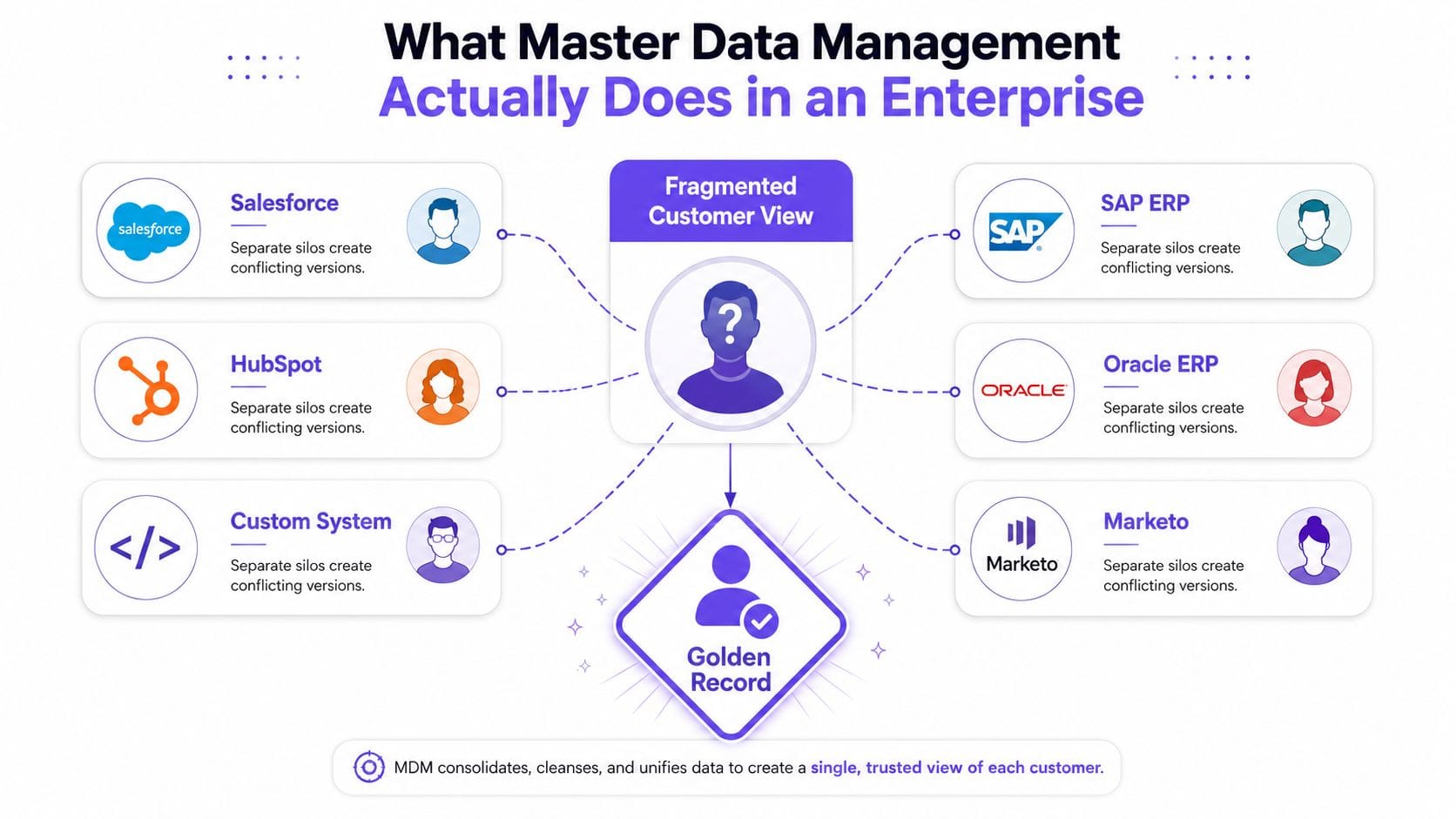
Your support team sees one version of a customer in Salesforce, another in HubSpot, and a third in the ERP. The damage shows up long before anyone notices the reporting is off: a rep calls the wrong account, marketing sends duplicate outreach, and the AI assistant answers with the wrong company history because the record underneath it never agreed with itself.
Master data management is the discipline that resolves those conflicting versions into one governed entity. It has been around for decades, but the stakes changed when enterprises stopped running one system of record with a few downstream feeds and started running dozens of cloud apps, hybrid stacks, automated workflows, and AI systems that amplify whatever data they are handed.
Analyst forecasts for the MDM market vary widely depending on how each firm scopes it. Grand View Research put the global market at USD 19.9 billion in 2023 and projects USD 60.7 billion by 2030, a 17.4% CAGR (Grand View Research). Other firms land on different numbers. The spread matters less than the direction, and the direction is consistent across all of them.
Table of Contents
What Master Data Management Does in an Enterprise
When a company runs three CRMs, two ERPs, and a marketing platform, the same customer appears with different spellings, addresses, ownership details, and lifecycle status. The consequences reach further than most teams expect. Billing, segmentation, forecasting, support, compliance, and AI all read from a different version of reality, and each one is confident it has the right one.
Master data is the business’s shared reference layer
Master data is the set of core entities a business keeps returning to: customers, products, suppliers, locations, and often assets or employees. Transactional data records events, like an order or a support ticket. Analytical data supports reporting and modeling. Master data sits underneath both and gives those events and reports a stable identity to attach to.
Take a customer who changes legal name in the billing system, updates a shipping address in the order platform, and appears under a different spelling in support. Those three records still need to resolve to one governed entity. That is the job. MDM platforms profile, consolidate, cleanse, enrich, and synchronize records across operational and analytical systems, holding metadata for hierarchies and relationships along with cross-references back to each source (Oracle’s MDM architecture). Strip those capabilities out and the enterprise is left maintaining three plausible customers and no way to say which one is real.
Practical rule: If your teams argue about which customer record is right more often than they argue about dashboards, MDM belongs in the operating model.
Why the timing is different now
AI raises the cost of getting this wrong. A human looking at three conflicting customer records notices the conflict. A retrieval system does not. It picks one, or blends them, and returns an answer with no signal that anything was ambiguous. Inconsistent master data does not make an assistant slightly wrong; it makes it confidently wrong, which is considerably harder to catch.
MDM produces the governed entities every other system leans on. Customer, product, supplier, and location became the canonical domains because they sit at the center of commercial, operational, and regulatory processes. Fracture any one of them and every dependent workflow absorbs the inconsistency, then passes it downstream into analytics, automation, and AI.
Modern MDM also has to be relationship-aware. A master record earns its keep when it can express links: customer to household, supplier to parent company, product to category and substitute. That relationship layer is what turns master data from a cleaned-up list into machine-readable business context, which is what graph queries, RAG pipelines, and agents need when a single isolated row will not answer the question.
Core MDM Concepts Every Practitioner Should Know
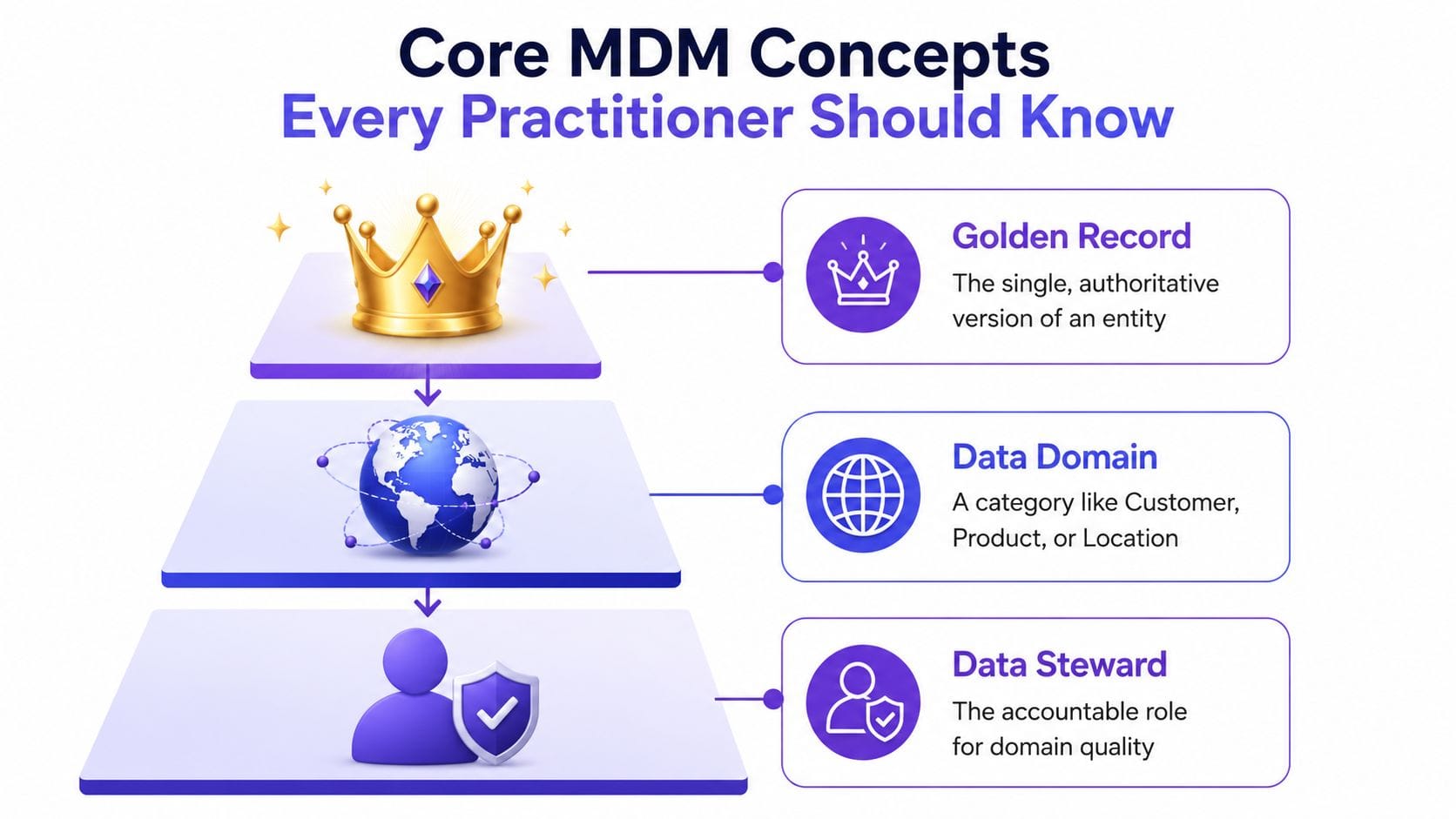
The first term anyone learns in an MDM program is the golden record: the cleanest, most trusted version of an entity. It does not appear on its own. It gets assembled from source records, matching rules, and a set of decisions about which value wins when systems disagree.
Golden record, source record, survivorship
Consider a customer named Maria Chen who exists in a CRM, a billing system, and a support platform. One has her old address, one has a nickname, one has the legal company name. Those three are the source records. The golden record is what comes out the other side after the rules decide what to keep, what to discard, and what to enrich.
That decision logic is survivorship. If billing holds the most current legal name, that value survives. If the CRM has the freshest phone number, that one survives instead. The goal is not to crown one system the winner out of habit but to codify which source is authoritative for which attribute, and to write it down somewhere an auditor can read it.
Worth separating two steps that often get collapsed together. Matching decides whether two records describe the same entity. Survivorship decides which attribute values win once you have concluded that they do. Deterministic rules still handle survivorship well, because “billing owns legal name” is a policy decision, not a prediction. Matching is where the modern stack has actually moved: fuzzy string comparison and lightweight ML classifiers have been standard for years, and teams increasingly use embeddings or an LLM pass to catch the cases rules miss, like a subsidiary trading under a name that shares no tokens with its parent.
That works, with one guardrail. Probabilistic matching returns a confidence score, and confidence scores need thresholds: auto-merge above the high bar, auto-reject below the low one, and route the middle band to a steward. An LLM that silently decides two customers are the same entity has not saved anyone work. It has moved a merge decision out of the audit trail, which is the one place in an MDM program where you cannot afford to lose it.
Domain, governance, stewardship
A data domain is the category being mastered. Customer, product, supplier, location, and asset each behave differently and need different rules. A product domain cares about hierarchy and category rollups. A customer domain cares about contact preference, account ownership, and legal entity matching.
A data steward is the person accountable for a domain’s quality. Stewardship is the human layer that decides who can create, change, approve, or retire master records. It matters more than most vendors admit, because MDM tooling only works when business and IT have already agreed on definitions, ownership, and escalation paths. Buying a platform does not produce that agreement.
Data governance is not decoration around the platform. It is the operating agreement for who gets to change the business view of an entity.
Architectural Patterns for MDM
No single MDM architecture fits every enterprise. The right pattern depends on who owns the data, how fast consuming systems need answers, and how much governance control the business actually requires. Three patterns keep showing up: hub-and-spoke, registry, and graph-based.
Hub-and-spoke and registry
In hub-and-spoke MDM, a central hub holds the mastered record and pushes updates out to consuming systems. It works well when one team owns the domain and the business wants tight control over quality, survivorship, and auditability. Regulated environments tend to land here, because the hub becomes the single place where governance decisions get applied.
Registry MDM is lighter. It stores identifiers and pointers back to authoritative source systems rather than centralizing every attribute. That suits distributed ownership and latency-sensitive workloads, since identity can be resolved without relocating everything into one store first.
Graph-based MDM
Graph-based MDM models entities and the relationships between them as first-class citizens. Many enterprise questions are not “what is this customer” but “which customers are connected to this supplier, this product line, or this transaction chain.” Those are traversals, and traversals are what graphs are built for, which is also why the pattern fits AI retrieval and recommendation workloads so naturally.
| Pattern | Governance | Latency | Implementation Cost | Best Fit |
|---|---|---|---|---|
| Hub-and-spoke | Strong, centralized control | Moderate | Higher | Regulated domains, single-owner stewardship |
| Registry | Moderate, depends on source discipline | Low | Lower | Distributed ownership, fast identity lookup |
| Graph-based | Strong when relationships are governed | Low to moderate | Moderate | AI, recommendations, security, cross-domain analysis |
Choosing the pattern
Oracle’s architecture guidance argues for a flexible, application-neutral model covering duplicate removal, survivorship, cleansing, and change propagation, on the grounds that an MDM layer has to keep serving other systems while remaining authoritative (Oracle). IBM’s harmonization model goes further into the mechanics, covering de-duplication, enrichment, record linkage, consolidation, transformation, aggregation, and mapping across batch, transactional, and real-time loads (IBM).
The short version: hub-and-spoke when control matters most, registry when you need lighter integration, graph when relationship traversal and AI-readiness are central to the business case.
Implementation Guide and Migration Checklist
The first domain you pick determines whether the program feels like traction or drag. Many teams start with whatever is politically easiest, which is usually a mistake. The better starting point is the domain with the highest operational leakage, where duplicate records, rework, and process friction are already costing ERP, CRM, and analytics users real time.
Start with the domain causing the most pain
If customer onboarding drags because sales, billing, and support each maintain their own version of the account, start with customer. If product hierarchy errors are breaking the catalog, start with product. Target the domain where a better master record changes someone’s actual workday inside a quarter.
A good pilot is small enough to finish and large enough to matter. In practice that means one domain, a bounded set of sources, and a success definition tied to something countable: fewer duplicates, faster onboarding, better downstream accuracy.
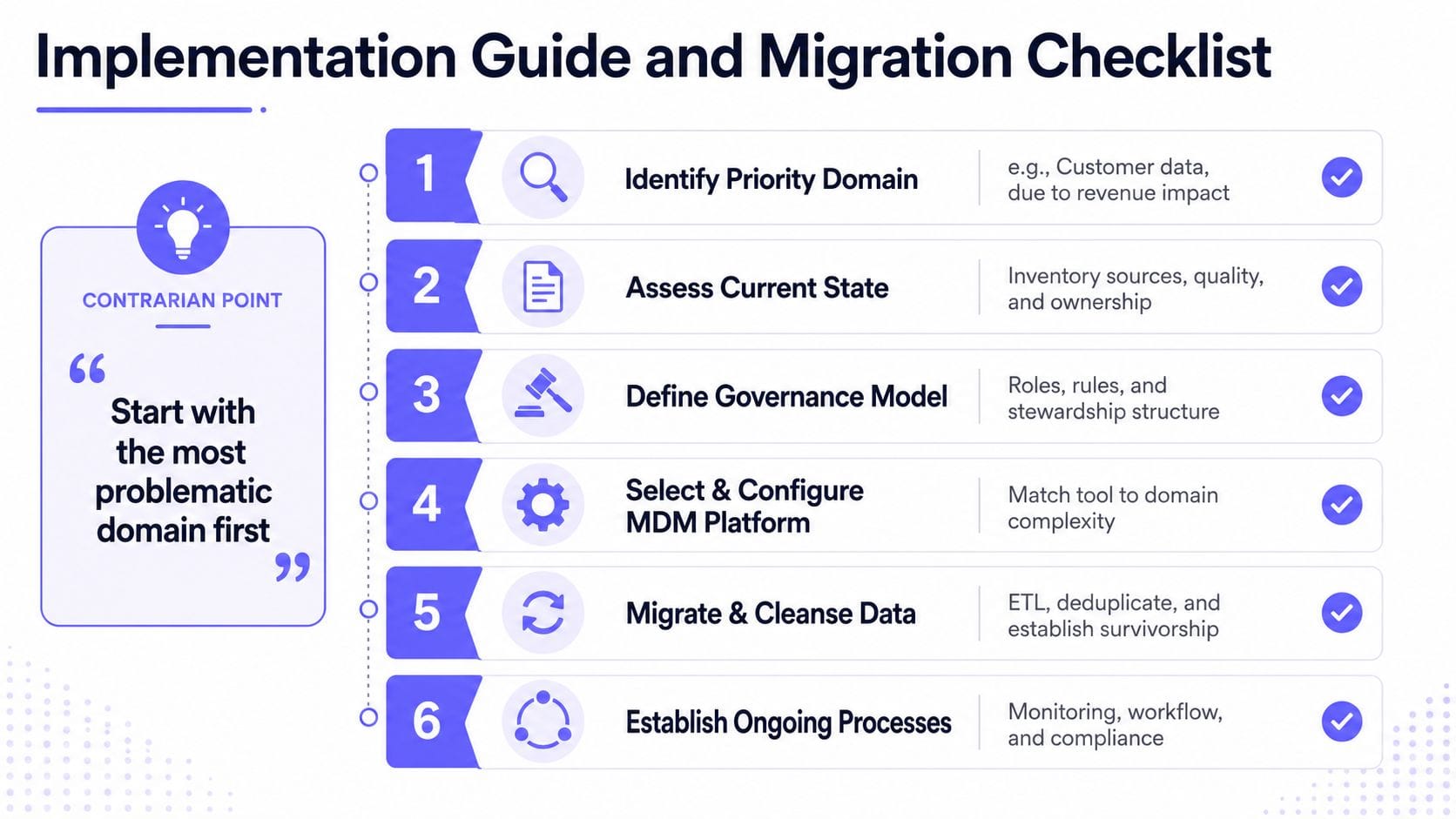
A practical migration sequence
-
Identify the priority domain. Pick where bad master data causes the most friction, not where the loudest sponsor sits.
-
Assess the current state. Inventory source systems, ownership, and the quality gaps everyone already complains about.
-
Define the governance model. Assign stewards, approvers, and escalation paths before the platform goes live, not after.
-
Select and configure the platform. Match the tool to the domain’s complexity and its relationship model.
-
Migrate and cleanse. Deduplicate, standardize, and write explicit survivorship rules for conflicting attributes.
-
Establish ongoing processes. Monitoring, workflows, and compliance checks, or the program decays within two quarters.
What the pilot should deliver
A pilot that produces only a cleaner database has underdelivered. What you want out of it is a repeatable operating pattern: source inventory, data quality rules, stewardship roles, survivorship logic, integration paths, and a rollout plan for consuming systems. Once those pieces work together for one domain, expanding to the next becomes a portfolio decision rather than a rescue mission.
Cloud deployment has become the default for most new programs, which helps here. It makes it easier to treat MDM as a live service that keeps running, rather than a migration that gets declared finished and then quietly rots.
Integrating MDM with RAG and LLM Systems
Most real retrieval questions have two halves that need different machinery. Take “show me recent hardware issues for this account.” The first half is semantic. “Hardware issues” has no fixed vocabulary, and matching it against tickets that say thermal throttling, chassis fault, or failed SSD is exactly what vector embeddings are good at. The second half is not semantic at all. “This account” is a hard boundary, and the only correct way to resolve it is an exact match on a governed identifier.
Fragmented master data breaks the second half specifically. If “Acme North America” and “Acme Corp NA” exist as separate records, the retriever has to guess which one you meant, and embedding similarity will cheerfully rank a sibling subsidiary’s tickets as relevant to both. In a multi-tenant or multi-account deployment that stops being an accuracy problem and becomes one customer reading another customer’s support history.
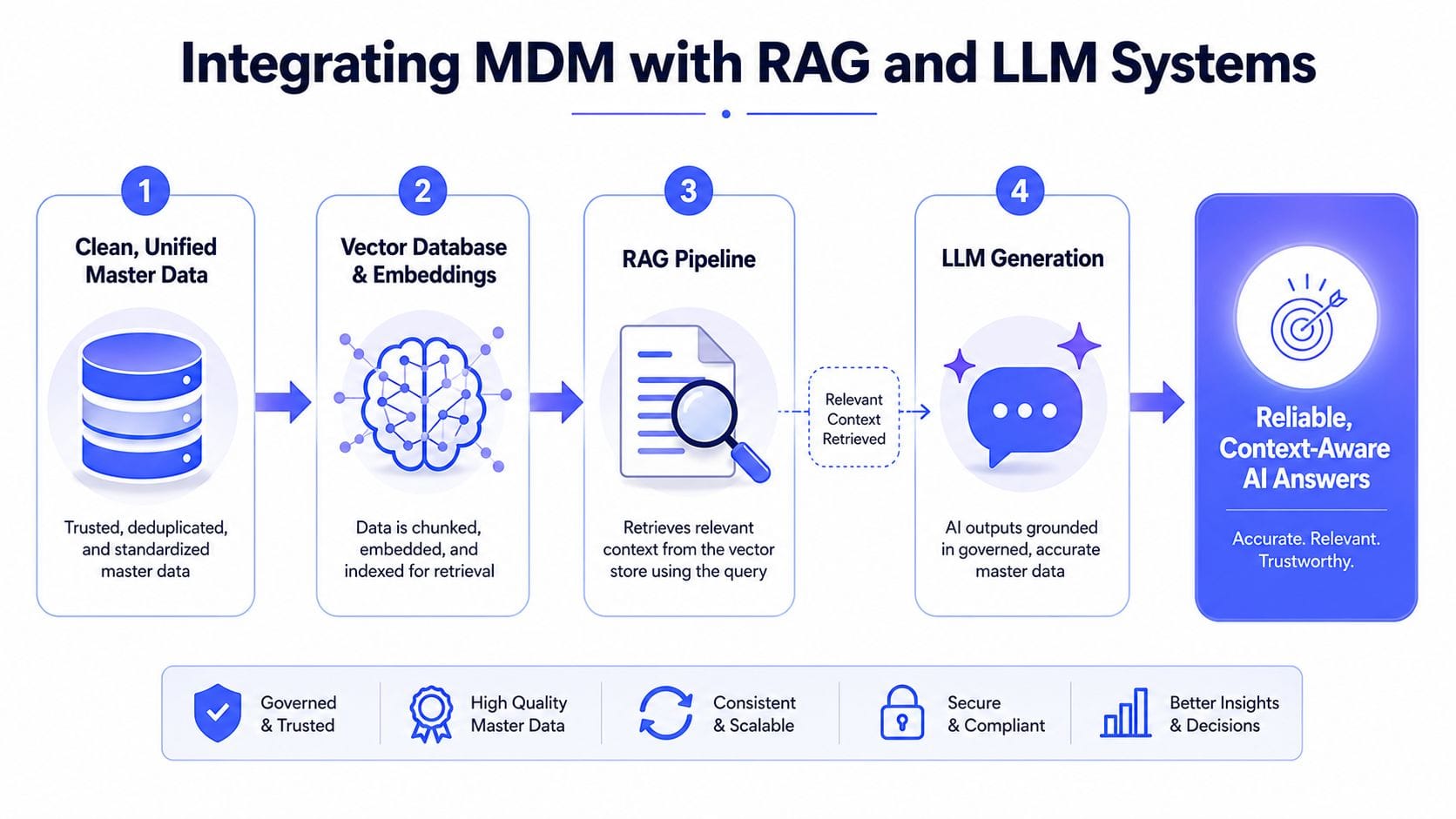
So the division of labor is clean: vectors resolve intent, the graph resolves the entity boundary. Governed master data plus explicit graph structure gives retrieval something exact to anchor on, which frees similarity search to do the part it is genuinely better at.
Why relationships matter to AI
Master data is conventionally defined as entities, attributes, unique identifiers, hierarchies, and relationships. The last two get treated as documentation in most implementations. They should be treated as data. Once hierarchies and relationships are explicit and queryable, retrieval systems, agents, and analytics workflows can all use them directly, and the goal shifts from “single source of truth” to relationship-aware, machine-readable master data.
The pattern is straightforward: master data feeds a graph model, the graph supports traversal, and retrieval pulls grounded context into the prompt. The model never has to infer identity from messy text. It gets a traceable path through entities and links instead.
A worked graph example
Take a support agent asking: which products did this customer buy before they opened the current case? In a graph model, the customer, their orders, the products, and the case are all connected nodes and edges, so the answer is a traversal rather than a guess.
The design behind it, along the lines described in FalkorDB’s chatbot guidance, is deliberately plain:
-
Customer nodes hold the mastered identity, keyed by the golden record ID.
-
Product nodes hold governed product entities.
-
Order edges preserve what was bought, when, and by whom.
-
Case nodes connect support events back to the customer.
The query is equally plain:
MATCH (c:Customer {master_id: $master_id})-[:PLACED]->(o:Order)-[:CONTAINS]->(p:Product)
MATCH (c)-[:OPENED]->(t:SupportCase {case_id: $case_id})
WHERE o.placed_at < t.opened_at
RETURN p.sku, p.name, o.placed_at
ORDER BY o.placed_at DESC
LIMIT 20
Twenty rows of grounded context, scoped to one governed customer identity, retrieved before generation starts. The master_id is doing the important work: without it the same traversal would run against whichever duplicate the retriever happened to match first.
In a hybrid setup this traversal is the first stage rather than the whole pipeline. The graph draws the boundary, returning the set of records that provably belong to this customer, and vector similarity ranks within that set to find the ones about hardware. Neither ordering works reversed. Rank first and you are filtering a candidate list that already contains the wrong customer’s data.
Useful pattern: If the question involves who is connected to what, graph retrieval belongs between MDM and generation.
This is also where ontology detection and GraphRAG fit. The master domain defines the entities, the graph expresses their relationships, the retrieval layer assembles grounded context, and the model generates an answer that can be audited by walking the same path a human took. Teams comparing orchestration patterns across multiple providers may find this guide to unified AI model hubs useful for thinking about how that context travels between models.
Operational Scale, Security, and Compliance
Once MDM is live, the work does not end so much as change shape. Records keep arriving, source systems keep changing, and governance decisions still need enforcing. A program that looks immaculate on launch day drifts fast if synchronization, monitoring, and access control were treated as project deliverables rather than runtime requirements.
Keeping master data trustworthy at scale
Change data capture and continuous synchronization matter because master data rarely sits still. A customer relocates, a supplier gets reclassified, a product hierarchy shifts, and each change has to propagate without breaking the systems downstream. In SaaS environments there is a second constraint: shared infrastructure still has to preserve tenant-level boundaries, so multi-tenant isolation becomes part of the governance story rather than a separate infrastructure concern.
Stewardship workflows need observability too. When a record gets flagged, routed, approved, or rejected, someone will eventually ask who did what and when. If that trail is not visible, governance exists as a document in a folder rather than a live process. Adjacent disciplines have run into the same reporting problem, which is partly why observability tooling has spread into areas like LLM rank tracking, where teams want a record of how systems behaved over time rather than a snapshot.
Security controls that actually matter
Access control, audit logging, and masking belong in the MDM design from the start. Sensitive identifiers need protection in transit and at rest, and regulated industries need a clear answer to who touched what and when. In financial services and healthcare, auditability is not overhead on the system’s value. It is a large part of the value. For a practical reference on securing data movement, see our notes on encryption in transit.
Resilience is the other half. Backups, high availability, and disaster recovery are not generic infrastructure boxes to tick, because the mastered view is the identity layer other systems depend on. When it goes down, every consuming system loses its definition of truth simultaneously.
Measuring MDM Success and Picking the Right First Domain
Executives do not care that you created more records. They care that onboarding got faster, that support stopped arguing about identities, and that analytics stopped counting the same customer twice. Measure MDM in business outcomes or expect the budget conversation to go badly.
Metrics that tell the truth
The most defensible metrics show friction dropping: duplicate rate reduction, cycle time for onboarding new entities, error rates in downstream analytics, and the accuracy of AI-grounded answers. Each one maps to work people do every day, which makes it far easier to defend in a review than an abstract governance score.
Total record count is the metric to avoid. More records can mean better coverage or more imported noise, and the number alone cannot tell you which. The useful question is whether the business resolves identity faster and issues fewer corrections downstream than it did last quarter.
Choosing the first domain
Score each candidate domain on three axes: business pain, data fragmentation, and implementation complexity. The domain with the sharpest pain and the clearest path to governance usually wins, even when it is not the interesting one.
For some businesses that is customer. For others it is product or supplier. The right answer is wherever reduced leakage becomes visible fast enough to keep the sponsor engaged. If you want a domain example beyond customer records, the supply chain database pattern is a good illustration of how master data gets most valuable precisely when several operational systems have to agree on the same entities.
Pick the domain where repeated corrections cost the most time, then prove the value with fewer errors and shorter cycles.
Frequently Asked Questions
How is MDM different from a data catalog?
A data catalog helps people find and understand data assets. MDM creates governed master entities that other systems treat as authoritative. A catalog is a map; MDM decides which entity record the business should trust when finance, sales, and operations each point at a different version of the same customer. Catalogs improve discoverability. MDM improves identity consistency.
Should MDM run in the cloud or on-premises?
Cloud makes sense when sources and consumers already span SaaS and hybrid systems, which describes most enterprises now. On-premises still fits regulated or legacy-heavy environments with hard data residency constraints. The deciding question is where your sources and consumers actually live, since master data has to move across the whole application stack without spawning new silos.
Where does MDM fit in a data mesh or data fabric?
Both are broader architectural ideas, and MDM can sit inside either as the governed entity layer. That is most valuable when domains need consistent IDs and relationships across boundaries, so the same master customer can be referenced in a service catalog, a CRM, and an analytics pipeline without each one inventing its own truth.
Does graph-based MDM replace the data warehouse?
No, they solve different problems. The warehouse is strong at aggregation; the graph is strong at connected context. Consider a supplier linked to subsidiaries, locations, contracts, and incidents. A warehouse summarizes those records efficiently. A graph shows how they relate and what a change in one node does to the rest of the network. Most enterprises end up running both.
What does a realistic first project look like?
Pick one domain, define the golden record, and expose it through a graph model or API that downstream systems can consume. In a customer domain, that is one reconciled profile with stable IDs, explicit survivorship rules, and relationship edges to accounts or households. Stakeholders get something concrete to test against instead of another governance deck.
