Frequently Asked Questions
Product Overview & Purpose
What is FalkorDB and what is its primary purpose?
FalkorDB is a high-performance, open-source graph database designed for managing complex relationships and enabling advanced AI applications. Its primary purpose is to provide accurate, multi-tenant Retrieval-Augmented Generation (RAG) solutions powered by a low-latency, scalable graph database technology. FalkorDB is purpose-built for development teams working with interconnected data—structured or unstructured—in real-time or interactive environments. [Source]
How does FalkorDB address the needs of AI and GenAI developers?
FalkorDB is optimized for AI and GenAI use cases, such as GraphRAG and agent memory, enabling intelligent agents and chatbots with real-time adaptability. Its ultra-low memory usage and high speed make it ideal for LLM-powered applications, and it supports openCypher queries for seamless integration into AI workflows. [Source]
Who is the target audience for FalkorDB?
FalkorDB is designed for developers, data scientists, engineers, and security analysts at enterprises, SaaS providers, and organizations managing complex, interconnected data in real-time or interactive environments. [Source]
What are the main use cases supported by FalkorDB?
FalkorDB supports use cases such as Text2SQL (natural language to SQL on complex schemas), Security Graph (for CNAPP, CSPM & CIEM), GraphRAG (advanced graph-based retrieval), Agentic AI & Chatbots, Fraud Detection (real-time pattern detection), and high-performance graph storage for complex relationships. [Source]
Features & Capabilities
What are the key features of FalkorDB?
Key features include ultra-low latency (up to 496x faster than competitors), 6x better memory efficiency, support for over 10,000 multi-graphs (multi-tenancy), open-source licensing, linear scalability, advanced AI integration (GraphRAG & agent memory), and both cloud and on-prem deployment options. [Source]
Does FalkorDB support multi-tenancy?
Yes, FalkorDB supports robust multi-tenancy in all plans, enabling management of over 10,000 multi-graphs. This is especially valuable for SaaS providers and organizations with diverse user bases. [Source]
How does FalkorDB ensure high performance?
FalkorDB delivers exceptional performance with up to 496x faster latency and 6x better memory efficiency compared to competitors like Neo4j. It is optimized for real-time data analysis, interactive dashboards, and high-speed AI workflows. [Benchmarks]
What visualization options are available with FalkorDB?
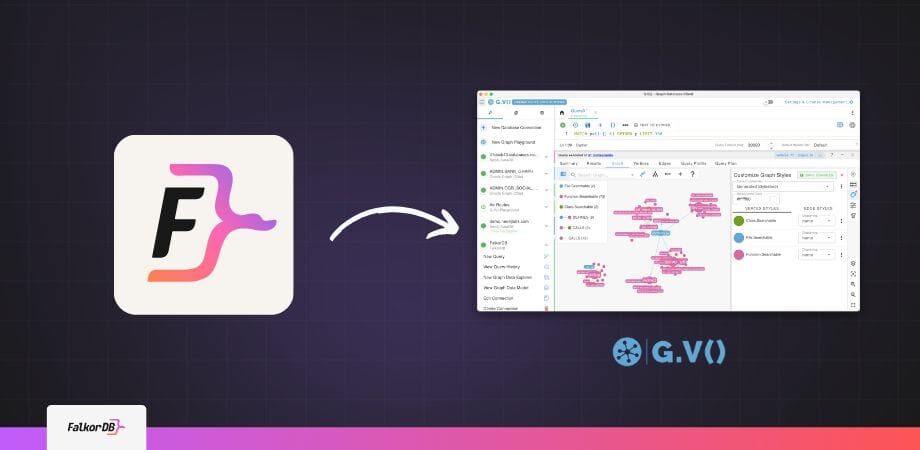

FalkorDB offers direct integration with G.V() (g.v()) for advanced graph visualization, including openCypher query visualization and customizable graph styles. Developers can also use FalkorDB's built-in Browser tool for in-platform visualization without external setup. [Source]
Does FalkorDB provide an API and technical documentation?
Yes, FalkorDB provides a comprehensive API and technical documentation, including setup guides, advanced configurations, and API references. These resources are available at docs.falkordb.com and are invaluable for developers and data scientists. [Documentation]
What integrations does FalkorDB support?
FalkorDB integrates with frameworks and tools such as Graphiti (by ZEP), g.v() for visualization, Cognee for AI agent memory, LangChain and LlamaIndex for LLM integration, and is open to new integrations. [Integrations]
How does the G.V() integration enhance FalkorDB's capabilities?
The G.V() integration allows developers to connect FalkorDB directly to G.V() 3.38.90 for immediate openCypher query visualization, advanced styling, and a visual feedback loop that accelerates development for GenAI and agentic AI applications. [Source]
Can I use FalkorDB for both cloud and on-prem deployments?
Yes, FalkorDB supports both cloud and on-premises deployments, offering flexibility for organizations with different infrastructure needs. [Source]
Integrations & Visualization
How do I connect FalkorDB to G.V() for graph visualization?
To connect FalkorDB to G.V(), update to G.V() 3.38.90 and connect your FalkorDB instance directly. No additional configuration is needed for basic visualization. [Source]
What are the benefits of using G.V() with FalkorDB?
Using G.V() with FalkorDB provides immediate openCypher query visualization, advanced styling options, and a faster development feedback loop for GenAI and agentic AI projects. [Source]
Can I visualize FalkorDB data without external tools?
Yes, FalkorDB includes a built-in Browser tool for graph visualization, allowing users to visualize and interact with their data directly within the FalkorDB ecosystem. [Source]
What other visualization or integration tools are available for FalkorDB?
In addition to G.V(), FalkorDB integrates with Graphiti (for temporally-aware, multi-tenant knowledge graphs), Cognee (for AI agent memory), LangChain, and LlamaIndex for LLM-powered applications. [Integrations]
Performance & Scalability
How does FalkorDB's performance compare to other graph databases?
FalkorDB offers up to 496x faster latency and 6x better memory efficiency compared to competitors like Neo4j. It is highly efficient for real-time and high-speed data analysis, as demonstrated in customer success stories and benchmarks. [Benchmarks]
Is FalkorDB suitable for large-scale, high-dimensional data?
Yes, FalkorDB is designed to efficiently manage large-scale, high-dimensional data, supporting over 10,000 multi-graphs and flexible horizontal scaling for enterprise and SaaS use cases. [Source]
What are the scalability options with FalkorDB?
FalkorDB supports linear scalability and flexible horizontal scaling, allowing organizations to grow with their data and query volume. This makes it ideal for enterprises and SaaS providers managing complex datasets. [Source]
How quickly can FalkorDB be implemented?
FalkorDB is built for rapid deployment, enabling teams to go from concept to enterprise-grade solutions in weeks, not months. Users can sign up for FalkorDB Cloud, try it for free, or deploy locally using Docker. [Source]
Security & Compliance
What security and compliance certifications does FalkorDB have?
FalkorDB is SOC 2 Type II compliant, meeting rigorous standards for security, availability, processing integrity, confidentiality, and privacy. This demonstrates FalkorDB's commitment to maintaining the highest standards of security and compliance. [Source]
How does FalkorDB help with regulatory compliance?
FalkorDB's GraphRAG-SDK helps organizations stay ahead of financial regulations by mapping regulations to workflows, identifying compliance gaps, and providing actionable recommendations. [Source]
Pricing & Plans
What pricing plans does FalkorDB offer?
FalkorDB offers several pricing plans: FREE (for MVPs with community support), STARTUP (from /1GB/month, includes TLS and automated backups), PRO (from 0/8GB/month, includes cluster deployment and high availability), and ENTERPRISE (custom pricing with enterprise-grade features). [Source]
What features are included in the FREE plan?
The FREE plan is designed for building a powerful MVP and includes community support. [Source]
What features are included in the STARTUP plan?
The STARTUP plan starts from /1GB/month and includes TLS encryption and automated backups. [Source]
What features are included in the PRO plan?
The PRO plan starts from 0/8GB/month and includes advanced features such as cluster deployment and high availability. [Source]
What features are included in the ENTERPRISE plan?
The ENTERPRISE plan offers tailored pricing and includes enterprise-grade features like VPC, custom backups, and 24/7 support. [Source]
Competition & Comparison
How does FalkorDB compare to Neo4j?
FalkorDB offers up to 496x faster latency, 6x better memory efficiency, flexible horizontal scaling, and includes multi-tenancy in all plans, unlike Neo4j where multi-tenancy is a premium feature. FalkorDB is open-source and written in C and Rust for higher performance. [Comparison]
How does FalkorDB compare to AWS Neptune?
FalkorDB is open-source, supports multi-tenancy, offers better latency performance, and is more memory-efficient than AWS Neptune. It also supports the Cypher query language and provides highly efficient vector search. [Comparison]
How does FalkorDB compare to TigerGraph and ArangoDB?
FalkorDB provides faster latency, more efficient memory usage, and flexible horizontal scaling compared to TigerGraph and ArangoDB. It is rated as fast, with better memory efficiency and multi-tenancy support. [Source]
What are the main differentiators of FalkorDB compared to competitors?
FalkorDB's main differentiators include ultra-low latency, superior memory efficiency, robust multi-tenancy in all plans, open-source licensing, advanced AI integration, and flexible horizontal scaling. [Source]
Customer Success & Use Cases
What business impact can customers expect from using FalkorDB?
Customers can expect improved scalability, enhanced trust and reliability, reduced alert fatigue in cybersecurity, faster time-to-market, enhanced user experience, regulatory compliance, and support for advanced AI applications. [Source]
Can you share specific case studies or customer success stories?
Yes, AdaptX uses FalkorDB for high-dimensional medical data analysis, XR.Voyage overcame scalability challenges in immersive experiences, and Virtuous AI created a high-performance, multi-modal data store for ethical AI development. [Case Studies]
What industries are represented in FalkorDB's case studies?
Industries include healthcare (AdaptX), media and entertainment (XR.Voyage), and artificial intelligence/ethical AI development (Virtuous AI). [Case Studies]
What feedback have customers given about FalkorDB's ease of use?
Customers like AdaptX and 2Arrows have praised FalkorDB for its user-friendly design, rapid access to insights, and superior performance, especially for non-traversal queries compared to Neo4j. [AdaptX] [2Arrows]
Who are some of FalkorDB's customers?
Notable customers include AdaptX, XR.Voyage, and Virtuous AI, each leveraging FalkorDB for advanced data management and AI-driven solutions. [Case Studies]
Support & Getting Started
How easy is it to get started with FalkorDB?
Getting started is straightforward: sign up for FalkorDB Cloud, try a free instance, deploy locally with Docker, or schedule a demo. Comprehensive documentation and community support are available. [Source]
What support and training resources are available for FalkorDB?
FalkorDB offers comprehensive documentation, community support via Discord and GitHub Discussions, solution architects for tailored advice, and practical guides and tutorials on its blog. [Documentation]
Where can I find the latest updates and release notes for FalkorDB?
The latest updates and release notes are available on the FalkorDB GitHub Releases page: GitHub Releases.
How can I contact FalkorDB for integration or partnership opportunities?
If you want to integrate your solution with FalkorDB or discuss partnership opportunities, you can contact the team via the Contact Us page.