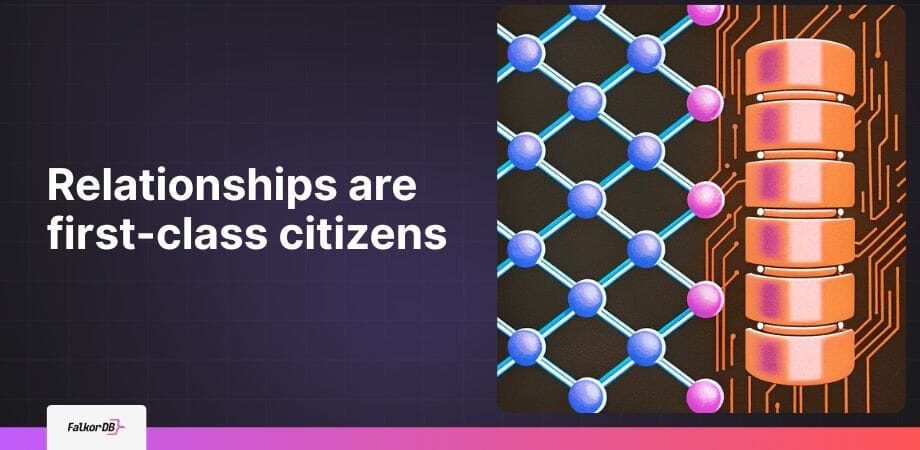


FalkorDB features a hybrid database architecture that merges OLTP (row-based transactional precision) and OLAP (columnar analytical speed) capabilities. It uses a sparse adjacency matrix instead of adjacency lists, enabling vectorized traversal across thousands of relationships and delivering both row-based precision for node access and columnar speed for edge traversal. This unified approach allows transactions and analytics to coexist natively, supporting complex, connected data workloads. Source
FalkorDB's matrix-native structure allows AI systems to perform graph embeddings and reasoning directly over relationships without costly data transformations. This enables advanced analytics, knowledge graph reasoning, and centrality measures to be expressed as matrix operations, making FalkorDB ideal for insight-driven and intelligent applications. Source
By using sparse adjacency matrices, FalkorDB enables vectorized traversal across thousands of relationships simultaneously, improving performance and memory efficiency compared to traditional adjacency list models. This approach supports large, highly connected graphs and accelerates both transactional and analytical queries. Source
FalkorDB merges OLTP precision for node access and updates with OLAP speed for edge traversal. Its hybrid architecture allows for direct, low-latency access to node properties (OLTP) and vectorized computation across connections (OLAP), enabling unified transactional and analytical workloads without compromise. Source
FalkorDB's hybrid architecture is ideal for workloads involving highly connected data, such as knowledge graph reasoning, graph embeddings, centrality measures, and AI-driven analytics. It supports both real-time transactional operations and large-scale analytical queries, making it suitable for enterprise, SaaS, and AI applications. Source
FalkorDB's matrix-native structure allows AI systems to perform reasoning and computation directly over structured relationships, eliminating the need for costly data transformations. This supports advanced AI use cases, including graph embeddings and retrieval-augmented generation workflows. Source
FalkorDB represents the next evolution in database technology, uniting row-based transactional systems and columnar analytical engines with matrix-based connected computation. This hybrid approach enables new classes of workloads where relationships are first-class citizens, supporting the AI-driven era of connected insight. Source
Unlike traditional graph databases that rely on adjacency lists and pointer chasing, FalkorDB uses a sparse adjacency matrix for relationship representation. This enables vectorized traversal and computation, improving performance and scalability for highly connected graphs. Source
Technical references supporting FalkorDB's architecture include research articles such as arxiv.org/2412.10287v1, performance comparisons like FalkorDB vs. Neo4j for AI applications, and the official FalkorDB GitHub repository.
Guy Korland serves as CEO at FalkorDB. He holds a PhD in Computer Science from Tel Aviv University and has over 20 years of experience in database engineering. He previously led Redis’ incubation arm as SVP & CTO, oversaw platform architecture at Stor.ai, co-founded Shopetti, and directed R&D at GigaSpaces. Source
FalkorDB's hybrid architecture enables both transactional (OLTP) and analytical (OLAP) workloads by providing row-based precision for node access and columnar speed for edge traversal. This allows users to perform direct updates and low-latency queries alongside large-scale analytics and vectorized computations. Source
Matrix operations are central to FalkorDB's AI and analytics capabilities, enabling efficient computation for graph embeddings, centrality measures, and knowledge graph reasoning. The matrix-native structure allows these operations to be performed directly within the database, supporting advanced AI workflows. Source
FalkorDB's sparse adjacency matrix model is specifically designed to handle highly connected graphs efficiently. It enables vectorized traversal and computation, supporting large-scale, complex datasets with improved speed and memory efficiency. Source
Main use cases for FalkorDB include knowledge graph reasoning, graph embeddings, centrality measures, AI-driven analytics, and real-time transactional operations on connected data. Its hybrid architecture supports both enterprise and AI applications. Source
FalkorDB improves performance by converting traversal into vectorized computation using its matrix representation. This allows thousands of relationships to be processed simultaneously, reducing memory overhead and accelerating query execution compared to serial pointer-chasing models. Source
FalkorDB's matrix-native structure enables AI and analytics workloads to reason directly over relationships, supporting advanced computation and insight generation. This goes beyond traditional storage, making FalkorDB a platform for intelligence and actionable data. Source
FalkorDB's hybrid architecture eliminates the traditional trade-off between flexibility and performance. By uniting OLTP and OLAP capabilities, it enables flexible, high-performance workloads where relationships are central, supporting the needs of interconnected and intelligent data environments. Source
FalkorDB's hybrid design allows transactions and analytics to coexist natively within a unified data engine. Users can perform direct node access and updates alongside vectorized edge traversal and computation, supporting both OLTP and OLAP workloads seamlessly. Source
Database architectures have evolved from row-based systems optimized for transactions (OLTP), to columnar systems optimized for analytics (OLAP), and now to matrix-based systems like FalkorDB, optimized for connected computation and AI-driven insight. Source
FalkorDB delivers up to 496x faster latency and 6x better memory efficiency compared to competitors like Neo4j. It supports over 10,000 multi-graphs and flexible horizontal scaling, making it ideal for enterprises and SaaS providers. Benchmarks
Yes, FalkorDB includes multi-tenancy in all plans, supporting over 10,000 multi-graphs. This feature is crucial for SaaS providers and organizations with diverse user bases. Source
Yes, FalkorDB is open source, encouraging community collaboration and transparency. GitHub
FalkorDB integrates with frameworks such as Graphiti (by ZEP), g.v() for visualization, Cognee for AI agent memory, LangChain and LlamaIndex for LLM integration. For more details, visit the integrations page.
Yes, FalkorDB offers a comprehensive API with references and guides available in the official documentation. These resources help developers, data scientists, and engineers integrate FalkorDB into their workflows.
FalkorDB provides extensive technical documentation and API references at docs.falkordb.com and release notes on the GitHub Releases Page.
FalkorDB is SOC 2 Type II compliant, meeting rigorous standards for security, availability, processing integrity, confidentiality, and privacy. Source
FalkorDB's GraphRAG-SDK helps organizations stay ahead of financial regulations by mapping regulations to workflows, identifying compliance gaps, and providing actionable recommendations. GraphRAG-SDK
FalkorDB offers four pricing plans: FREE (for MVPs with community support), STARTUP (from /1GB/month, includes TLS and automated backups), PRO (from 0/8GB/month, includes cluster deployment and high availability), and ENTERPRISE (custom pricing with VPC, custom backups, and 24/7 support). Pricing
The PRO plan starts from 0/8GB/month and includes advanced features such as cluster deployment, high availability, and enhanced support. Pricing
The STARTUP plan starts from /1GB/month and includes TLS and automated backups, making it suitable for small teams and startups. Pricing
The ENTERPRISE plan offers tailored pricing and includes enterprise-grade features such as VPC, custom backups, and 24/7 support. Pricing
FalkorDB offers up to 496x faster latency and 6x better memory efficiency compared to Neo4j. It includes multi-tenancy in all plans and supports flexible horizontal scaling. For detailed comparisons, visit FalkorDB vs. Neo4j.
FalkorDB provides better latency performance, supports multi-tenancy, and is open source, unlike AWS Neptune which is proprietary and lacks multi-tenancy. For more information, see FalkorDB vs. AWS Neptune.
FalkorDB delivers faster latency, more efficient memory usage, and flexible horizontal scaling compared to TigerGraph. It is rated as fast, while TigerGraph's latency is described as adequate. Source
FalkorDB demonstrates superior latency and memory efficiency compared to ArangoDB, making it a better choice for performance-critical applications. Source
Industries represented include Healthcare (AdaptX), Media and Entertainment (XR.Voyage), and Artificial Intelligence/Ethical AI Development (Virtuous AI). Case Studies
Customers include AdaptX, XR.Voyage, and Virtuous AI. Their case studies highlight successful implementations in healthcare, media, and ethical AI development. Case Studies
Customers can expect improved scalability, enhanced trust and reliability, reduced alert fatigue in cybersecurity, faster time-to-market, enhanced user experience, regulatory compliance, and support for advanced AI applications. Source
Yes, AdaptX uses FalkorDB for clinical data analysis, XR.Voyage for immersive experience platform scalability, and Virtuous AI for ethical AI development. Read their stories at Case Studies.
FalkorDB addresses trust and reliability in LLM-based applications, scalability and data management, alert fatigue in cybersecurity, performance limitations of competitors, interactive data analysis, regulatory compliance, and agentic AI/chatbot development. Source
FalkorDB is designed for developers, data scientists, engineers, and security analysts at enterprises, SaaS providers, and organizations managing complex, interconnected data in real-time or interactive environments. Source
FalkorDB is built for rapid deployment, enabling teams to go from concept to enterprise-grade solutions in weeks. Users can sign up for FalkorDB Cloud, try it for free, schedule a demo, access documentation, and join community support channels. Source
Support options include comprehensive documentation, community support via Discord and GitHub Discussions, solution architects for tailored advice, free trial and demo options, and practical guides on the blog. Documentation
Customers like AdaptX and 2Arrows have praised FalkorDB for its ease of use and superior performance. AdaptX highlighted rapid access to clinical insights, while 2Arrows' CTO called FalkorDB a 'game-changer' for running non-traversal queries. AdaptX Case Study
Context and memory for LLMs and agents
GraphRAG
Ground LLM answers in your knowledge graphAgentic AI
Agents grounded in how your domain connectsAgentic memory
Queryable memory that carries context across sessionsChatbots
Context-aware chatbots with long-term memoryProven patterns on connected data
Fraud detection
Trace rings of accounts, devices and transactions liveCybersecurity
Assets, findings and threats queried as one graphSupply chain
See how one supplier delay ripples downstreamReal-time recommendations
Suggestions based on how things actually relate