

You usually notice dependency ordering only when it breaks.
A build fails because one package now depends on a library that has not been installed yet. A workflow orchestrator stalls because two tasks implicitly depend on each other. An AI pipeline starts returning stale or incoherent results because retrieval, transformation, and memory updates are happening in the wrong sequence. In each case, the root problem is not just graph theory. It is order.
The topological sort algorithm gives engineers a disciplined way to turn dependency graphs into executable order. Most introductions stop there. Real systems do not. In production, graphs are often incomplete, disconnected, updated in real time, or polluted by inferred relationships that were not hand-modeled. That gap matters a lot in graph-backed AI systems, where bad ordering does not just slow execution. It corrupts context.
This is also where implementation details matter. If your dependencies live in a graph database, the right question is not only how topological sort works in theory. It is where the work should run. Pulling a large dependency graph into client-side Python just to iterate through it can erase the performance benefits of the database layer. In systems built on FalkorDB, the more useful pattern is to push as much dependency analysis as possible into the database engine, then return only the ordered result or the affected subgraph.
Table of Contents
- Why Order Matters in a Connected World
- Understanding the Core Concepts of Topological Sort
- Two Paths to Order, Kahn’s vs DFS-Based Algorithms
- From Pseudocode to Production Implementation
- Handling Edge Cases, Cycles, and Disconnected Graphs
- Applications in AI and Modern Graph Databases
- Conclusion, From Order to Insight
Why Order Matters in a Connected World
A circular dependency in a build pipeline feels like a tooling bug until you inspect the graph. Package A needs B. B needs C. C needs A. Nothing is wrong with the installer. The ordering is impossible.
That is why topological sorting became a foundational algorithmic primitive long before today’s AI workflows. Arthur Kahn published the most widely used implementation, Kahn’s algorithm, in 1962, and the dependency-resolution problem it addresses still sits inside modern engineering systems. One source notes that topological ordering is a runtime necessity for approximately 90% of package management systems such as npm and pip because they must install libraries in a valid dependency order before dependent packages are processed (EmbeddedRelated on Kahn’s algorithm and dependency resolution).
Where engineers actually feel this pain
You see the need for ordered execution in places like these:
- Software builds: Compile shared modules before the services that import them.
- Data pipelines: Run schema normalization before feature generation.
- Workflow engines: Ensure a downstream task does not start before its prerequisites finish.
- AI orchestration: Execute retrieval, ranking, memory updates, and tool calls in a sequence that preserves context.
Practical rule: If one task cannot legally start until another finishes, you are already dealing with a graph, whether your code models it explicitly or not.
The reason topological sort remains relevant is simple. It translates dependency constraints into an execution plan. In small systems, that helps teams avoid annoying failures. In larger data and AI platforms, it becomes a guardrail against invalid state transitions, partial outputs, and hard-to-debug orchestration errors.
Understanding the Core Concepts of Topological Sort
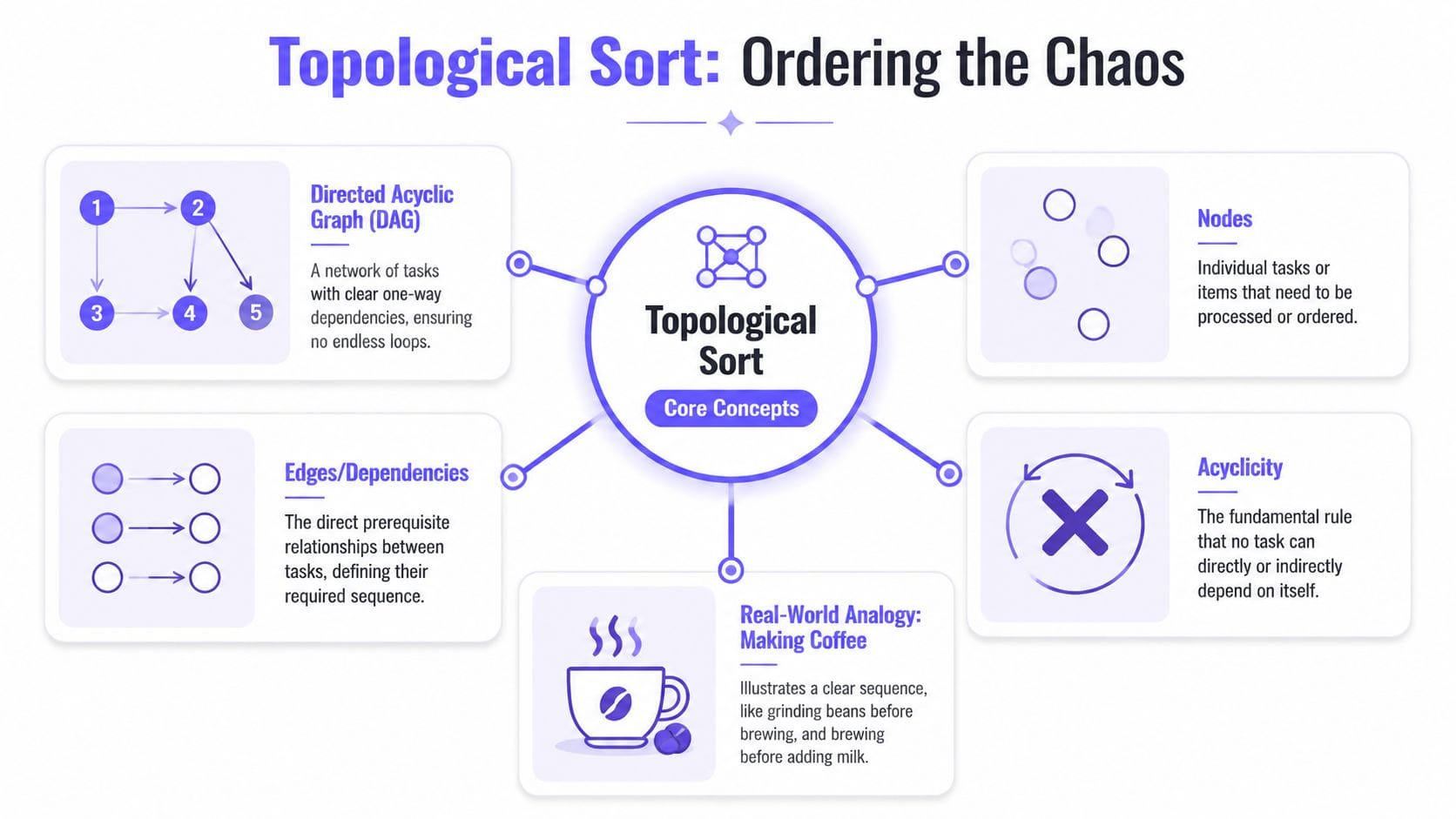
Most confusion around the topological sort algorithm disappears once you stop thinking about graphs and think about sequencing.
Getting dressed is a clean analogy. Socks come before shoes. A shirt might come before a jacket. Left sock and right sock do not depend on each other. You can represent that as a directed graph where each item is a node and each prerequisite is a directed edge.
For a broader look at how graph thinking helps uncover relationships in complex systems, FalkorDB’s article on finding connections with graph algorithms in complex networks is a useful companion.
A DAG is the contract
A topological ordering exists only for a Directed Acyclic Graph, or DAG. That constraint is not a convenience. It is the mathematical requirement for the algorithm to work. If the graph contains a directed cycle, there is no valid ordering at all. The standard formulation also relies on repeatedly identifying nodes with in-degree zero, and the operation runs in O(V + E) time, where V is vertices and E is edges (Wikipedia on topological sorting).
That gives you two immediate rules:
- Directed means dependencies have a clear one-way meaning.
- Acyclic means no task can depend on itself, directly or indirectly.
If you violate either rule, you do not have a schedulable dependency graph.
What the ordering actually guarantees
Topological sort does not promise one unique answer. Many DAGs have several valid orderings.
What it does guarantee is this:
- If there is an edge from A to B, then A appears before B in the result.
- Independent nodes may appear in different relative positions across valid outputs.
- The output is a linear order derived from a partial order.
A good mental model is valid before optimal. Topological sort tells you what order is allowed. It does not tell you which allowed order is best for caching, latency, or business priority.
In practice, that distinction matters. Engineers often assume the topological sort algorithm is a scheduler. It is not. It is the legality layer underneath a scheduler. You still need separate logic for priorities, batching, resource limits, retries, or tenant isolation.
Two Paths to Order, Kahn’s vs DFS-Based Algorithms
A build pipeline is waiting on upstream jobs. An AI agent is assembling context from a GraphRAG pipeline. A feature store refresh has to respect lineage across thousands of dependencies. In each case, topological sort is doing the same job underneath the surface, but the algorithm you choose changes how well the system behaves under pressure.
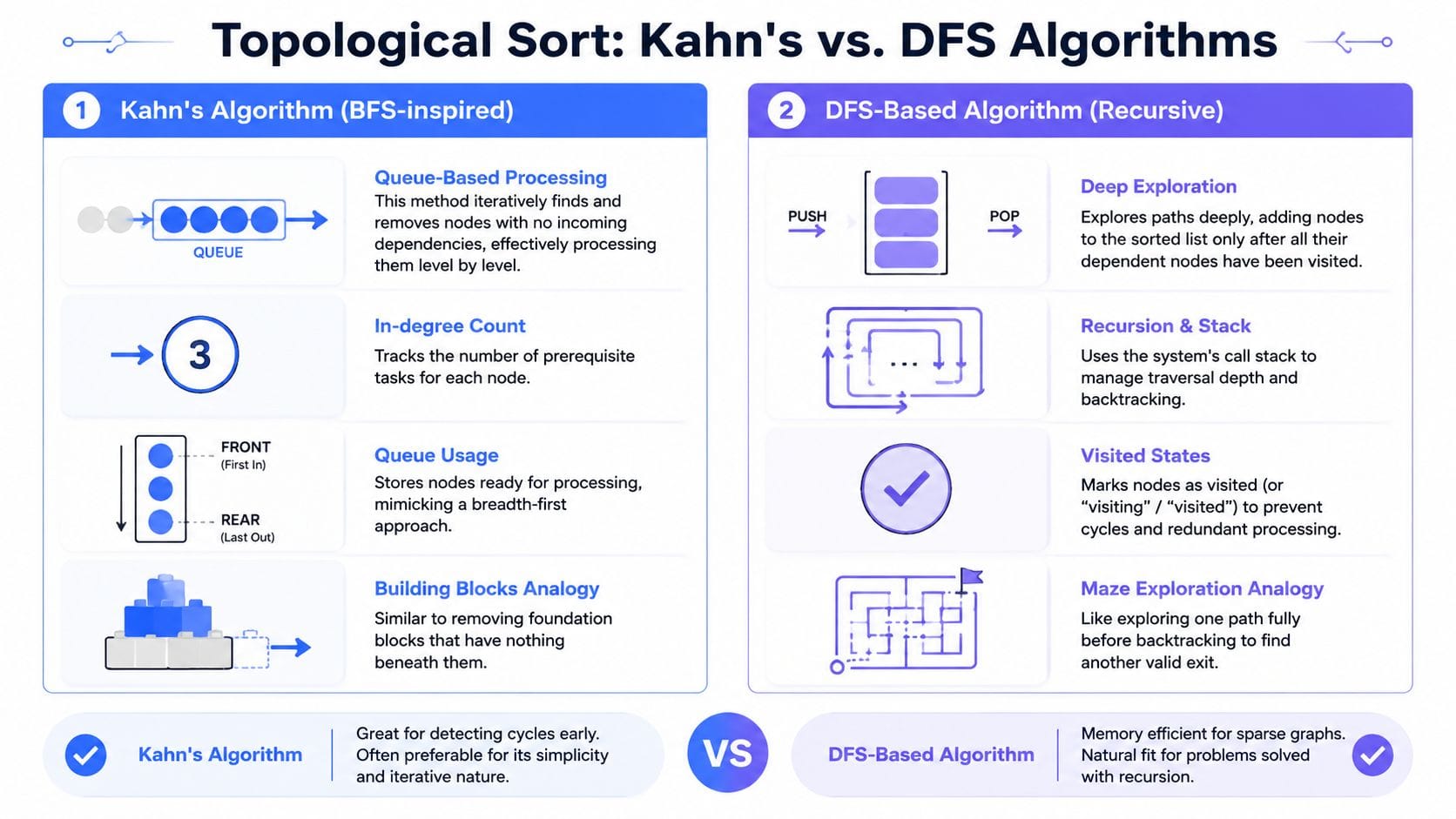
Both Kahn’s algorithm and the DFS-based approach produce a valid ordering for a DAG. They differ in ways that matter in production: how they expose readiness, how they detect failure, how they behave on deep graphs, and how easy they are to adapt when the graph is changing instead of sitting still.
Kahn’s algorithm works from ready nodes outward
Kahn’s algorithm matches how many real systems execute work. Start with every node that has no unmet prerequisites. Put those nodes in a queue. Remove one, append it to the result, then reduce the in-degree of each outgoing neighbor. When a neighbor reaches in-degree zero, it becomes eligible to run.
That makes Kahn’s method easy to map to schedulers, job orchestration, and dependency-aware serving layers. The core question stays operational: what is ready right now?
A compact pseudocode sketch looks like this:
compute indegree for each node
enqueue all nodes with indegree 0

while queue not empty:
    node = dequeue
    append node to result
    for each neighbor of node:
        indegree[neighbor] -= 1
        if indegree[neighbor] == 0:
            enqueue neighbor

if result size != total nodes:
    graph contains a cycle
For graph-backed systems, that readiness model is often the deciding factor. In a graph database architecture guide, the same adjacency-first view shows up in how teams store and traverse dependencies at scale. In FalkorDB specifically, the practical advantage is not that an application can maintain an in-degree map in Python. It is that dependency relationships are already represented inside the database engine in a form that can answer readiness questions efficiently.
For example, the first operational step in Kahn’s algorithm, finding nodes with in-degree zero, can be expressed directly in Cypher:
MATCH (n:Task)
WHERE NOT ()-[:PREREQUISITE]->(n)
RETURN n.id
That query is useful for the absolute first frontier, but it is not enough for a live runtime. After the first tasks complete, downstream tasks still have incoming PREREQUISITE edges in the graph, so the database also needs task state to know which prerequisites are still active. In production, the more useful pattern is to return pending tasks whose prerequisites are no longer pending:
MATCH (n:Task)
WHERE n.status = 'PENDING'
  AND NOT (:Task {status: 'PENDING'})-[:PREREQUISITE]->(n)
RETURN n.id
This shifts the question from which nodes have no incoming edges at all to which pending nodes have no currently pending prerequisites. That pattern matters because it avoids the client-side anti-pattern of exporting the entire graph just to rediscover which tasks are unblocked. On small graphs, local Python is fine. On large production graphs, it is usually better to let the database identify ready nodes, affected dependencies, or candidate cycle regions before application code takes over.
There is still a trade-off. If many nodes become ready at once, the order in which you process them affects determinism. That matters in CI pipelines, lineage processing, and AI workflows where reproducible execution can simplify debugging.
DFS-based sort works by finishing dependency chains
The DFS variant starts from traversal rather than readiness. Walk a path as far as it goes. Append each node only after all of its outgoing neighbors have been processed. Reverse the final postorder, and the result is a valid topological ordering.
Pseudocode usually looks like this:
for each unvisited node:
    dfs(node)

dfs(node):
    mark as visiting
    for each neighbor:
        if neighbor is visiting:
            cycle found
        if neighbor is unvisited:
            dfs(neighbor)
    mark as visited
    append node to result

reverse result
DFS is compact and often pleasant to implement for static graphs. It also exposes dependency chains clearly, which can help when the core question is not what can run now, but what must complete before this node is safe to process.
The downside shows up on deep or irregular graphs. Recursive implementations can hit stack limits. Even iterative DFS, which avoids recursion, still tends to feel less natural when the surrounding system is queue-driven or needs explicit visibility into which nodes are unblocked at each step.
That difference becomes sharper in AI systems. GraphRAG pipelines and agentic workflows rarely operate on perfect, frozen DAGs. Nodes arrive late, edges get rewritten after retrieval or tool use, and parts of the graph may be recomputed while other parts are still active. DFS is fine for a one-shot ordering pass. Kahn’s model is usually easier to adapt when ready is a live state, not a one-time calculation.
Choosing between them in practice
Engineers often treat the two methods as interchangeable because both are linear-time on paper. In production, the better choice depends on the shape of the graph and the way the surrounding system consumes the order.
| Attribute | Kahn’s Algorithm (BFS-based) | DFS-Based Algorithm |
|---|---|---|
| Core idea | Process all nodes that are currently dependency-free | Follow one path to completion, then backtrack |
| Primary data structure | Queue and in-degree map | Recursion or explicit stack plus visit states |
| Cycle signal | Processed count falls short of total nodes | Back-edge to a currently visiting node |
| Operational feel | Good for execution planning and readiness tracking | Good for reasoning about dependency chains |
| Deep graph behavior | Avoids recursion depth issues | Recursive versions can become fragile on deep graphs |
| Production fit | Strong default for service code and orchestration | Good when depth is bounded and traversal logic is already DFS-oriented |
A few rules hold up in practice:
- Use Kahn’s algorithm for schedulers, ETL pipelines, GraphRAG orchestration, and any system that needs a visible set of ready nodes.
- Use DFS-based sort when the graph is relatively stable, traversal logic is already recursive or stack-based, and you care more about chain exploration than execution readiness.
- Choose a deterministic tie-breaker if repeatability matters. Sort the ready queue, or use a stable insertion rule.
- Expect adaptation for dynamic graphs. In agentic AI and continuously updated knowledge graphs, a full recomputation may be too expensive or too disruptive.
In FalkorDB-backed systems, that last point matters more than many textbook explanations admit. The clean topological sort problem assumes a static DAG. Real AI graphs are often mutable, partially materialized, and assembled from streaming events, retrieval results, and agent decisions. Kahn’s and DFS still provide the foundation, but production systems often wrap them with incremental updates, state tracking, and policies for reordering only the affected subgraph.
From Pseudocode to Production Implementation
Pseudocode explains the algorithm. Shipping code requires decisions about graph representation, error handling, and interface shape.
For most application code, an adjacency list is the right default. It is compact, easy to construct from dependency pairs, and maps cleanly to both Kahn’s algorithm and DFS. If you are new to graph storage trade-offs, FalkorDB’s graph database guide is a useful reference for how graph structures show up beyond toy examples.
That said, adjacency-list Python examples should be treated as teaching code, not as the recommended execution model for a production graph database. They are useful for understanding the algorithm, writing unit tests, or handling small in-memory DAGs. They are not the best pattern for large FalkorDB-backed dependency graphs, where server-side graph evaluation will usually outperform client-side pointer chasing.
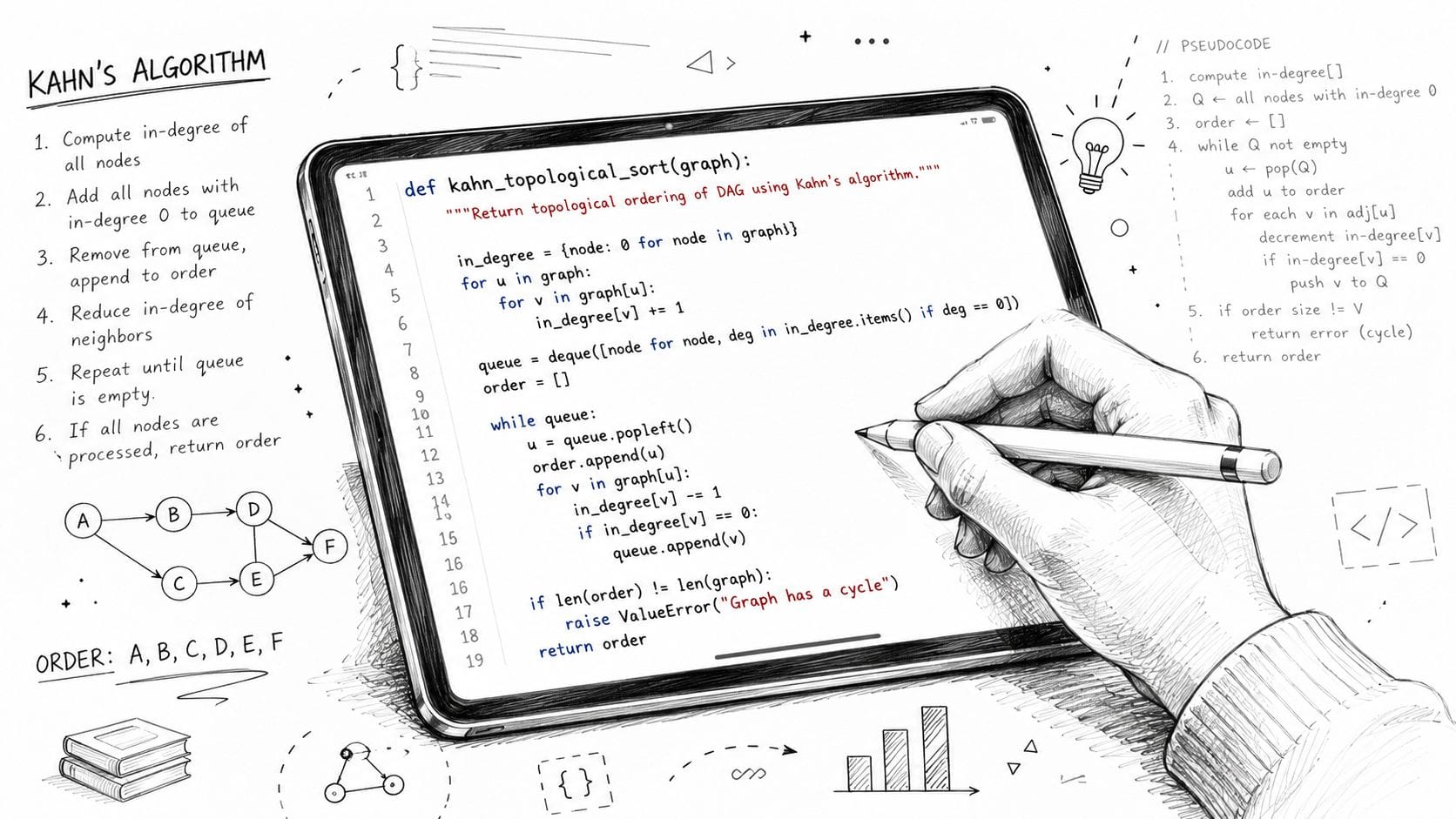
Python implementation with Kahn’s algorithm
from collections import defaultdict, deque

def topo_sort_kahn(nodes, edges):
    graph = defaultdict(list)
    indegree = {node: 0 for node in nodes}

for src, dst in edges:
        graph[src].append(dst)
        indegree[dst] += 1

queue = deque([node for node in nodes if indegree[node] == 0])
    result = []

while queue:
        node = queue.popleft()
        result.append(node)

for neighbor in graph[node]:
            indegree[neighbor] -= 1
            if indegree[neighbor] == 0:
                queue.append(neighbor)

if len(result) != len(nodes):
        raise ValueError("Cycle detected. No valid topological ordering exists.")

return result
Use it like this:
nodes = ["fetch", "clean", "embed", "index", "serve"]
edges = [
    ("fetch", "clean"),
    ("clean", "embed"),
    ("embed", "index"),
    ("index", "serve"),
]

print(topo_sort_kahn(nodes, edges))
This implementation is still a good teaching example. It exposes cycle failure clearly and mirrors how task systems think about ready work. But if your graph already lives in FalkorDB, treat this as application-layer reference code, not as the default way to process a large dependency graph.
Python implementation with DFS
from collections import defaultdict

def topo_sort_dfs(nodes, edges):
    graph = defaultdict(list)
    for src, dst in edges:
        graph[src].append(dst)

result = []
    state = {node: 0 for node in nodes}  # 0 = unvisited, 1 = visiting, 2 = visited

def dfs(node):
        if state[node] == 1:
            raise ValueError("Cycle detected. No valid topological ordering exists.")
        if state[node] == 2:
            return

state[node] = 1
        for neighbor in graph[node]:
            dfs(neighbor)
        state[node] = 2
        result.append(node)

for node in nodes:
        if state[node] == 0:
            dfs(node)

result.reverse()
    return result
A few production notes matter more than the syntax:
- Validate inputs early: Missing nodes, duplicate edges, or malformed dependency pairs create debugging noise.
- Prefer explicit exceptions: Silent partial orders are dangerous unless your API contract explicitly allows them.
- Control determinism: If order stability matters, sort the initial node list and adjacency lists before traversal.
Those details separate demo code from code you can safely wire into a build service, DAG runner, or retrieval pipeline.
How to run dependency ordering efficiently in FalkorDB
The most important architectural point is simple: if the graph is already in FalkorDB, do not reflexively export the whole thing into Python.
FalkorDB does not behave like a pointer-based in-memory adjacency list. It stores graph relationships in a form optimized for graph queries and graph computation, and its execution model is designed to avoid the cache-unfriendly pointer chasing that often limits client-side graph loops on large datasets. In practical terms, that means operations like checking inbound dependency counts, isolating frontier nodes, and traversing affected neighborhoods should start in the database whenever possible.
Conceptually, this aligns well with GraphBLAS sparse matrix linear algebra. FalkorDB executes these operations through sparse matrix primitives that map naturally to graph workloads. For a systems engineer, the key point is that in-degree is not being derived by pointer chasing through a linked structure. In GraphBLAS terms, it can be computed with a sparse matrix-vector multiplication or a column reduction over the adjacency matrix, both of which are highly parallelizable and hardware-efficient. When FalkorDB evaluates a Cypher pattern such as checking whether a pending task has any still-pending prerequisites, it is working from sparse matrix operations inside the engine, not from a client-side loop walking edges one object at a time. That is why the database can identify ready nodes faster and with less data movement than exporting the graph into Python.
A useful pattern looks like this:
- Find ready nodes in Cypher. Start by returning pending tasks whose prerequisites are no longer pending.
- Process only the active frontier. Let the application claim or execute those tasks.
- Update dependency state in the graph. Mark completed nodes, then query for newly unblocked tasks.
- Return only the affected subgraph when deeper recomputation is needed. Avoid full exports unless the graph is small enough that the simplicity is worth it.
For example, an initial frontier query can be as simple as:
MATCH (n:Task)
WHERE n.status = 'PENDING'
  AND NOT (:Task {status: 'PENDING'})-[:PREREQUISITE]->(n)
RETURN n.id
ORDER BY n.id
As the task graph grows, this frontier lookup benefits from indexing the fields used most often in filtering and return paths, especially n.status and n.id.
If you need deeper custom logic, FalkorDB’s server-side extensibility matters. For complex dependency tracking, repeated cycle checks, or domain-specific sorting rules, a User Defined Function (UDF) can push that logic closer to the database engine. That reduces network latency and avoids turning the graph database into a passive storage layer while the real work happens elsewhere.
The practical takeaway is not that Python examples are wrong. It is that there is a difference between explaining topological sort and operationalizing it in a graph database stack.
Handling Edge Cases, Cycles, and Disconnected Graphs
Production graphs fail in ways textbook DAGs do not. The hard part is rarely running topological sort itself. The hard part is deciding what the system should do when the graph reflects real operational messiness, generated dependencies, and partial state.
Cycles are a modeling failure first
In a live system, a cycle usually points to a bad dependency contract, a stale edge created by automation, or two services that implicitly became mutually dependent after separate releases. In AI pipelines, cycles can also appear when retrieval, enrichment, and feedback stages start writing edges back into the same working graph without clear phase boundaries.
Kahn’s algorithm exposes that failure cleanly. If no zero in-degree node is available before all nodes are processed, the run has reached a contradiction in the dependency graph. DFS-based implementations catch the same class of error through a back-edge into a node that is still being visited.
That matters operationally. A scheduler should stop, log the offending subgraph, and return something an engineer can act on. Silent fallback is how bad graphs make it into production.
A failed topological sort is often the safest output your system can produce.
In FalkorDB-backed workflows, cycle detection should be treated as a graph hygiene check, not just an algorithm branch. That is especially useful in code intelligence and dependency mapping workloads such as source-code graph analysis and visualization, where generated edges can drift from the actual architecture over time.
When teams need repeated validation on large graphs, cycle checks are another case where server-side logic helps. Instead of exporting every edge for each verification pass, you can isolate suspect regions, inspect local dependency loops, or package custom validation into a UDF that runs next to the graph data.
Disconnected graphs are normal in real systems
A disconnected graph often means the system is healthy. Separate ETL jobs, isolated agent tasks, or independent domain subgraphs can coexist in one graph without sharing edges. The sort still succeeds because topological order only needs to respect actual dependencies, not invent relationships that are not there.
The trade-off is determinism. Within each component, the dependency order is constrained. Across components, the algorithm has freedom. If your application treats that freedom as instability, the problem is usually in the contract above the graph. Stable output may require secondary sorting, priority rules, or component-level partitioning before execution.
This shows up often in data platforms. Once transformations are split across ingestion, warehouse, and serving layers, disconnected or loosely connected subgraphs become common, and ordering policy starts affecting both runtime behavior and debuggability.
Dynamic AI graphs add another wrinkle. In GraphRAG and agentic systems, the graph may be incomplete when sorting starts, then gain new edges as tools run, entities resolve, or confidence thresholds change. A single topological pass assumes the graph is stable. Real AI systems often need repeated validation, incremental recomputation, or phase-specific DAGs so that ordering remains meaningful as the graph evolves.
Two practical rules help here:
- Treat cycles as a graph quality error with context. Return the nodes and edges involved, not just a generic failure.
- Treat disconnected components as a scheduling choice. Decide whether arbitrary interleaving is acceptable or whether you need a deterministic policy above the algorithm.
That distinction matters. One case signals a broken dependency model. The other signals unused parallelism.
Applications in AI and Modern Graph Databases
The topological sort algorithm matters far beyond package installers and course prerequisite examples. In modern data systems, it sits under orchestration, query planning, knowledge processing, and execution control.
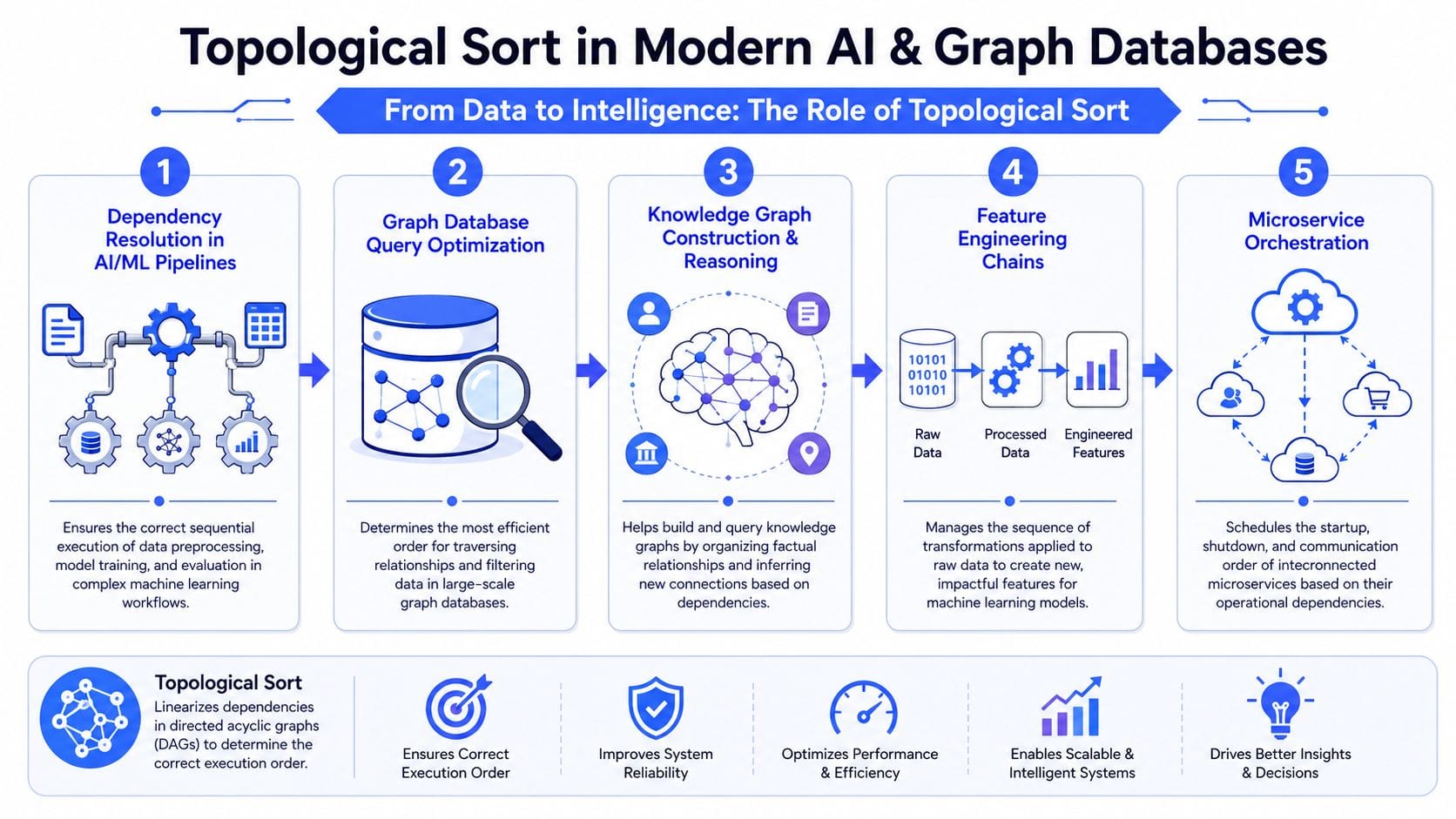
If you work with source-code structure, dependency chains, or graph-backed reasoning, FalkorDB’s write-up on code graph analysis and source-code visualization is a practical example of where ordering logic intersects with graph analysis.
Where topological sort shows up in AI systems
In AI and graph-heavy platforms, ordering usually appears in less obvious places:
Ryware’s perspective on ETL vs ELT
- Retrieval pipelines: Entity extraction, normalization, linking, reranking, and answer assembly often have prerequisite relationships.
- Knowledge graph construction: Derived facts may depend on earlier entity resolution and schema alignment steps.
- Feature engineering chains: One transformation may require outputs from several prior transformations.
- Microservice startup order: A service that depends on a vector index or metadata layer cannot initialize meaningfully before those dependencies are available.
This is also where pipeline architecture matters. Teams deciding between staged movement and in-place processing often run into dependency ordering issues at the data layer, especially when they are mapping when transformations should occur relative to ingestion and downstream graph-based enrichment.
Why static ordering is no longer enough
Most tutorials assume a fixed DAG. Agentic AI systems do not operate that way.
One verified source highlights the core issue directly: in agentic AI, dependency graphs are often dynamic, and standard topological sort methods require a full O(V + E) recomputation after each update, which is prohibitive for real-time systems. That is why dynamic topological sorting is becoming important for production GraphRAG and agentic platforms where dependencies change as state, tools, and context evolve (Hello Interview on dynamic topological sorting in agentic systems).
That challenge shows up in several messy forms:
- Conversation state changes: A new tool result may reorder what the agent should do next.
- GraphRAG updates: Newly inferred relationships can introduce fresh dependencies after the original plan was built.
- Probabilistic edges: LLM-generated graphs may include low-confidence links that create implied cycles even when the underlying domain is mostly hierarchical.
Standard Kahn or DFS implementations do not solve that on their own. They assume the graph is settled. In live AI systems, it often is not.
The practical response is to stop thinking only in terms of full recomputation. In FalkorDB-backed workflows, a better pattern is often to isolate the mutated subgraph, inspect the local dependency frontier, and update only the affected execution paths. If a new edge appears between two tasks, for example, you usually do not need to rebuild the order for every unrelated component. You need to find the nodes downstream and upstream of the change, validate whether a local cycle was introduced, and recompute the schedule for that slice.
A workable strategy looks like this:
- Capture the mutation. Identify exactly which node or edge changed.
- Expand to the affected neighborhood. Query only the upstream prerequisites and downstream dependents tied to that change. In FalkorDB, Cypher can traverse variable-length paths in either direction from the mutated edge, which makes it practical to isolate the affected neighborhood quickly instead of exporting unrelated components.
- Check local acyclicity. Fail early if the update introduces a cycle.
- Recompute the impacted order only. Leave untouched components alone.
- Merge the updated slice back into the runtime schedule.
The old problem was find a valid order. The new problem is maintain a valid order while the graph keeps moving.
That is where the topological sort algorithm needs to evolve from textbook primitive to systems capability. Static ordering still matters. But for GraphRAG, agent memory, and high-throughput orchestration, the harder question is how to update order cheaply and safely when the graph changes underneath the runtime.
Conclusion, From Order to Insight
Topological sort is one of those algorithms that looks modest on paper and turns out to be structural in practice. It gives teams a lawful execution order for dependency graphs, provided the graph is acyclic. That is the core contract.
For teams evaluating real-time graph performance, FalkorDB’s own platform materials and benchmark discussions are the more on-brand reference point for this article’s conclusions.
The two standard approaches solve the same problem with different operational strengths. Kahn’s algorithm is usually the better fit for service code because it aligns with readiness-based execution and avoids recursion depth issues. DFS-based sort remains elegant and useful when graph depth is controlled and the traversal model fits the implementation.
The larger lesson is that ordering logic did not get less important as systems became more intelligent. It got more important. AI pipelines, graph-backed retrieval, code analysis, and orchestration layers all depend on explicit dependency handling.
For FalkorDB users, the most important takeaway is architectural. Use Python examples to understand the algorithm. Use the database engine to do the heavy graph work when scale, latency, and dynamic updates matter. That is how dependency ordering becomes a production capability instead of a client-side bottleneck.
When engineers understand the topological sort algorithm as both a mathematical guarantee and a production guardrail, they build systems that fail earlier, run cleaner, and reason more reliably.
